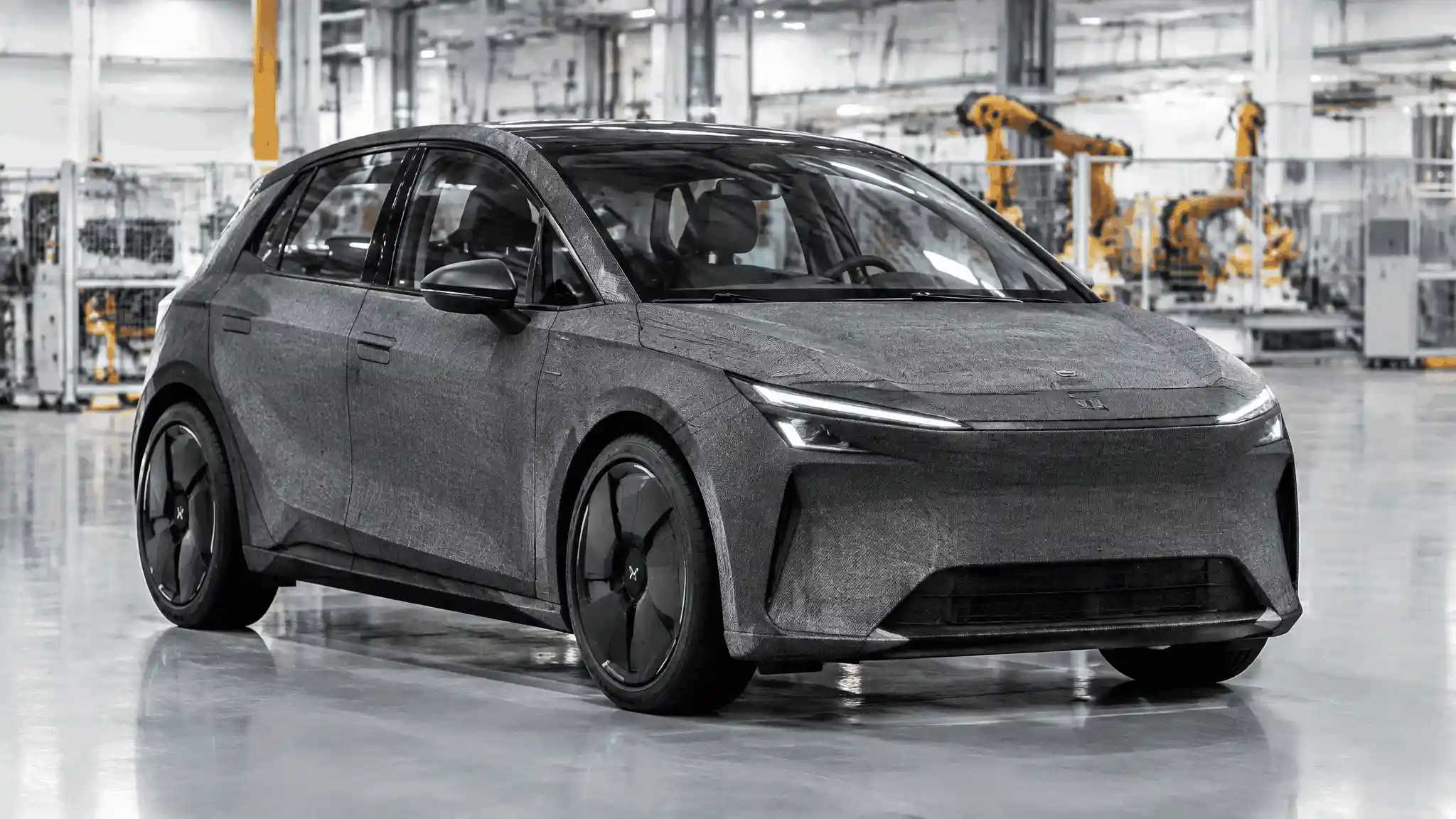
Core Series Introduction
The automotive industry's settled position is that a profitable, mass-market electric vehicle cannot be built in the UK for under £30,000 — not as an opinion, but as an assumption so widely shared it rarely gets argued anymore. Energy costs, labor costs, and a fragmented post-Brexit supply chain are treated as fixed constraints against a manufacturing template nobody thinks to question: the linear, vertically integrated, multi-billion-pound factory every mass-market EV has been built inside for the last three decades.
This series exists to question that template directly, component by component, rather than to argue the industry's cost inputs are wrong. Every constraint the consensus cites — energy cost, labor cost, supply fragmentation, post-Brexit trade friction — is real. What is not fixed is the assumption that surviving those constraints requires a Gigafactory-scale, high-capital-expenditure manufacturing model. A licensed sodium-ion cell chemistry, a structurally bridged megacasting chassis, unpainted bio-composite panels, a dual-layer software architecture, and a brownfield micro-factory floor are not cost-cutting measures layered onto a conventional car. They are a clean-sheet architecture, engineered from first principles against the actual constraint — capital expenditure — rather than against the constraints everyone else assumed were binding.
What follows is the complete, ten-part technical build of that argument: full-stack, from cell chemistry through chassis, software, factory floor, and go-to-market. Each part is a self-contained engineering brief. Together, they are a single, load-bearing case for why the sub-£30,000 British EV is not dead — it was simply never going to be built the way everyone assumed it had to be.
The Business Case
This directory covers the engineering. It does not cover the money on its own — that lives on a dedicated companion page. For the full staged capital deployment model, the Bill of Materials (BOM) breakdown, and the phase-specific break-even targets that make this architecture a venture case and not just a technical one, see Financial Architecture: Capital Scaling & Unit Economics.
The 10-Part Architectural Directory
Core Powertrain & Energy Storage
- Part 1: The £30k Paradox — the regulatory and manufacturing-model case for a 300+ mile, 200 Wh/kg pure sodium-ion launch platform, built to clear the TCA's 45% Rules of Origin threshold.
- Part 2: The Sovereign Cell — the 55 kWh pack's cell-level mass physics, Cell-to-Pack structural integration at 76% packaging efficiency, and the UKBIC factory-gate cost matrix.
Supplementary Deep Dive: The Sodium-Ion Revolution: Commercial Scale and Mass-Market Market Trajectories
Structural Engineering & Hardware
- Part 3: The Monolithic Chassis & Form — front and rear megacastings replacing 140+ stamped components, and unpainted Bcomp flax-fibre panels deleting the paint shop outright.
- Part 7: Optimising Wheels and Tyres — bespoke High Load tyre construction and aero-insert wheel design engineered against EV-specific mass and torque loading.
Supplementary Deep Dive: Designing the £30k EV: Sharp Hatchback Proportions and the Cost-Driven Cabin
Supplementary Deep Dive: The 200 Wh/kg Threshold: Why Weight is the Real Bottleneck for 300-Mile Sodium EVs
Supplementary Deep Dive: The Kinetic Harvest: Why Regenerative Braking Dictates £30k EV Economics
The Digital Backbone & Control Layers
- Part 4: The Dual-Layer Brain — licensed Android Automotive OS and Gemini in the cabin, isolated behind a hardware firewall from proprietary, in-house wide-input BMS and inverter control code.
- Part 5: The Automated Orchestra — the in-house Factory OS, AMR dynamic pathfinding, and computer-vision quality gates running the brownfield micro-factory floor itself.
- Part 6: Low-Voltage System Architecture — the phased engineering migration from legacy 12V/48V hybrid wiring to a fully consolidated, pure 48V zonal network.
- Part 9: Redundant Power Nets & Compute Topologies — fail-operational, ASIL-D dual-feed power distribution and deterministic Ethernet networking built for L4/L5 autonomous compute loads.
Supplementary Deep Dive: Coding Deceleration: The Drive-by-Wire Blended Braking Blueprint
Industrial Scale & Lifecycle Ecosystems
- Part 8: Engineering the Edge — the unfiltered risk register: shifting UK-EU Rules of Origin, Battery Passport and ELV mandates, and the unproven manufacturing methods racing to hit 2030 targets.
- Part 10: The Digital Upheaval — why the same zonal architecture that runs the car also dismantles the franchised dealership model, replaced by an app-centric D2C retail and 80/20 mobile service network.
Built in Britain: Powertrain Reference Design
Our complete engineering deep-dive into the localized, sub-£30,000 electric hatchback platform:
- Part 1: The Battery Bottleneck: Packaging Cells for an Under-£30k EV Floorpan — How pure 200 Wh/kg sodium-ion "Sovereign Cells" are structurally packed into a 110–130 mm chassis footprint.
- Part 2: Inverter Innovation: The Silicon Carbide Tech Lowering Entry-Level EV Costs — An analysis of the 800V topology and switching efficiency gains that offset battery mass penalties.
- Part 3: The Sovereign Motor: Motor Topology and Magnet Strategy for a £30k EV — A deep technical look at 150 kW hairpin stators and grain boundary diffusion magnet engineering.
Continue the Series
This directory is the hub; every part above is a spoke back to it. From any individual part, return here for the full architectural map, or jump sideways into the commercial case for how this engineering translates into unit economics. For the broader Electric Vehicles coverage this series sits inside, see the EVs section index. For a focused deep-dive tying Part 2’s cell chemistry to Part 6’s 48V rail — the charging-curve math behind a 22-minute road-trip stop — see The 22-Minute Road Trip Sweet Spot: The Physics of 800V Charging and 48V Zonal Architecture. The same chassis and pack also carry two further spokes worth the detour: how the megacast structure and sacrificial sills keep minor collisions out of insurers’ total-loss column in The Insurance & Repairability File: Solving the Cell-to-Chassis Total-Loss Trap, and how the pack’s thermal plate holds winter range in sub-zero conditions in The Zero-Lithium Winter Range Audit: Solving Sodium-Ion Cold-Climate Degradation.