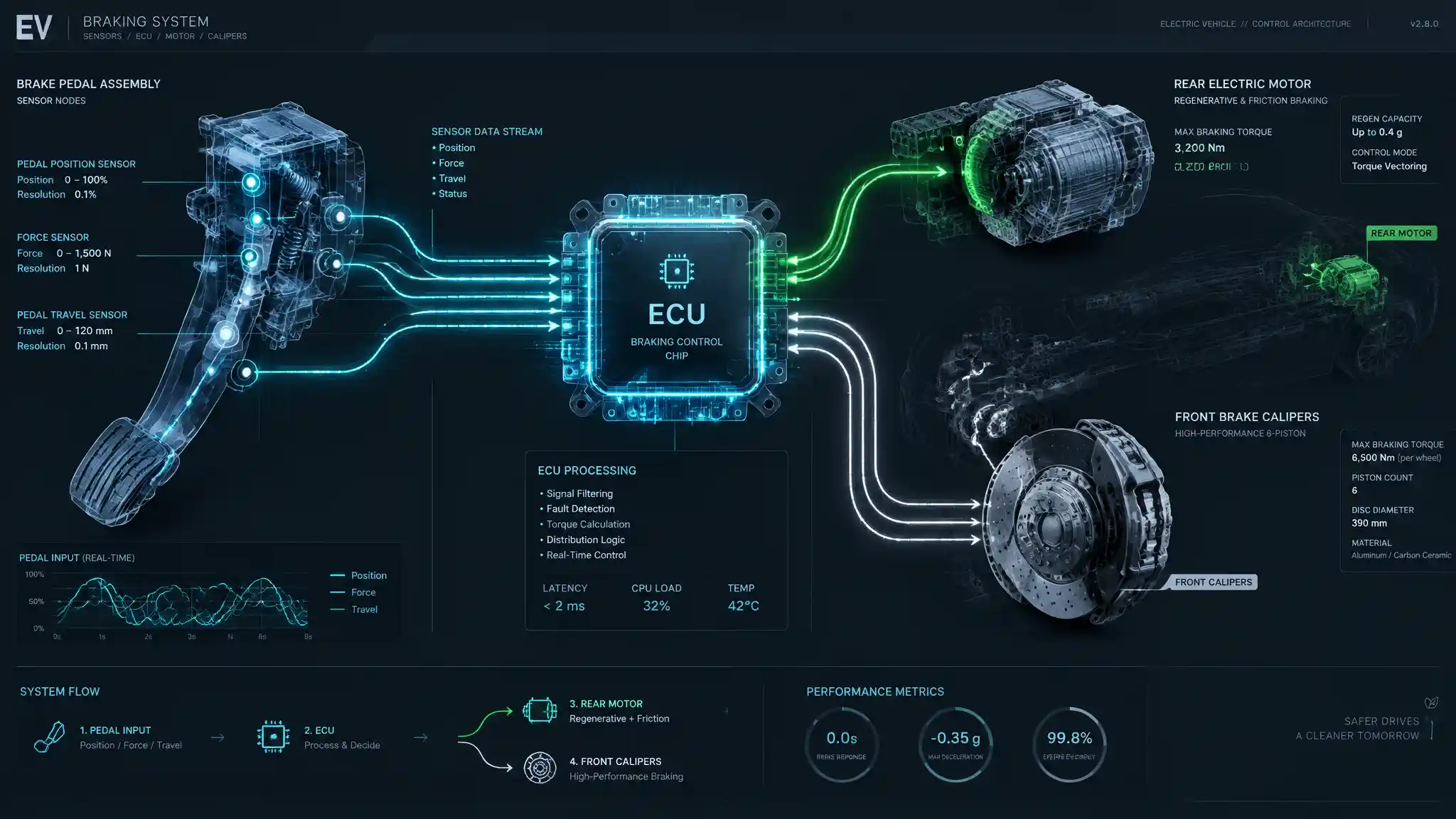
Press the brake pedal in a modern premium EV and something quietly dishonest happens. You are not pushing a rod connected by hydraulic fluid to a caliper. In almost every case, you are pressing a sensor. That sensor measures how far and how fast your foot has moved, converts it into an electronic torque request, and hands the actual decision of how to stop the car — how much comes from the rear motor, how much from the front discs — to a control computer running dozens of times a second.
This is the job of blended braking system software: to make that entire electronic hand-off invisible. The pedal has to feel exactly the same whether the car is harvesting 90% of its stopping energy back into the pack or leaning entirely on friction brakes for an emergency stop. Get the software wrong and the driver feels it — a pedal that goes soft, a car that lurches at the regen-to-friction handover, a stop that doesn't land where it's supposed to. Get it right, and the driver never knows the difference, while the car underneath is running a constant, millisecond-by-millisecond optimisation of where that stopping energy goes.
De-coupling the Foot: The Brake Pedal Simulator
The hardware that makes this possible is the brake pedal simulator, and its calibration is unforgiving. A brake pedal simulator calibration loop has to solve a genuinely strange problem: recreate the feel of a hydraulic system that, in normal driving, isn't actually connected to the wheels at all.
Inside the simulator sits a travel sensor tracking pedal position to sub-millimetre resolution, paired with a progressive dual-stage spring chamber. The first stage is soft — light, easily modulated resistance for the gentle regen-only inputs that make up most urban driving. The second stage stiffens sharply past a calibrated travel threshold, mimicking the firming resistance a driver would feel as hydraulic pressure builds in a conventional system. Get that spring curve wrong by even a small margin and drivers report the pedal as feeling "dead" or "grabby" — a subjective complaint with a very objective spring-rate cause.
Underneath the feel-engineering sits a hard safety requirement: the travel sensor has to be polled at a minimum of 1,000 Hz. That's not for comfort — it's to catch a genuine panic-stop application, foot-to-floor in a fraction of a second, and recognise it as an emergency event instantly rather than waiting for a slower control loop to notice the pedal has moved. At 1,000 Hz, the system is sampling pedal position every millisecond, fast enough that the electronic decision to dump full braking authority to the front discs happens before a human nervous system has finished registering the need to stop.
The State Machine Logic: Splitting Torques in Real Time
Underneath the pedal feel sits the real engineering: a state machine that decides, continuously, how to split the stopping request between electric and friction braking. Stripped to its essentials, the control loop looks something like this:
The detail that matters most here isn't any single branch — it's that Phase 2 blends rather than switches. A naive implementation that snapped from 100% regen to 100% friction the moment traction headroom was exceeded would produce a perceptible jolt at exactly the deceleration level most drivers use hardest: a firm, controlled stop. Blending the handover across a ramp, recalculated every control cycle, is what keeps that transition invisible.
Phase 1: Initial Tip-In
The first, lightest portion of pedal travel commands 100% rear motor regeneration. No hydraulic pressure is applied anywhere. The rear motor runs as a generator, converting kinetic energy directly into current flowing back into the sodium pack. This is where the overwhelming majority of everyday urban braking events live, and it's the phase the whole one pedal driving efficiency uk case depends on: most UK stop-start driving never needs to leave Phase 1.
Phase 2: Heavy Deceleration
As pedal travel and deceleration demand increase, the state machine starts watching rear-axle traction headroom. The instant the requested deceleration approaches what the rear tyres alone can safely deliver, the system begins hydraulic brake pressure modulation — smoothly ramping in front friction braking while backing regen torque down by a matched amount, so total deceleration follows the driver's pedal input as one continuous curve rather than a step change the driver would feel as a jolt.
Phase 3: The Final Anchor
Below roughly 3 mph, motor regeneration loses effectiveness — there simply isn't enough rotational speed left for the motor to act as an efficient generator. The state machine detects this threshold and hands 100% of stopping duty to the front friction brakes in a deliberately smoothed handshake, timed to be imperceptible, so the final crawl to a complete halt doesn't jerk or shudder the way an abrupt regen cut-off would.
Solving the RWD Slip Risk: Dynamic Stability Control Loops
rwd ev braking stability control exists because of one specific, unavoidable geometry problem: on this platform, all regenerative braking torque lands on the rear axle alone, with no front motor to share the load and no natural front-heavy brake bias to fall back on.
On a wet, oily UK road, or a cold winter motorway with residual ice at the verges, that concentration of retardation torque on the rear tyres is a genuine slip risk. Harvest too aggressively during lift-off regeneration on a low-grip surface, and the rear tyres can lose traction under braking exactly the way they would under hard acceleration — the classic ingredients of an uncommanded oversteer spin.
The drive-by-wire computer's defence is a stability control loop running continuously against wheel-speed sensor data at all four corners. It's watching for micro-slip — the earliest fractional divergence between rear wheel speed and the speed the vehicle's inertial model expects — and it catches that divergence within single-digit milliseconds. The response is immediate: regen torque request is cut, the front physical brakes are pulsed to help stabilise the chassis, and the rear axle is given a moment to regain full grip before regen is smoothly reintroduced. All of this happens long before the driver has any sensation of the rear end stepping out. The car doesn't feel like it nearly lost control, because — from the driver's seat — it never really did.
Crucially, this loop has to run independently of — and faster than — the blended-braking state machine described above. Stability control is the override, not a peer process: whatever Phase 1–3 logic has requested, the stability loop is entitled to veto it instantly if wheel-speed data says the rear axle is about to lose grip. Layering the two systems this way, rather than merging them into one monolithic controller, keeps the safety-critical logic simple enough to verify rigorously, while the efficiency-optimising blend logic is free to be as sophisticated as the engineering team wants it to be.
Conclusion: Software is the Ultimate Range Extender
None of the hardware described here — the pedal simulator, the rear motor, the front calipers, the wheel-speed sensors — is unusual on its own. What makes maximising one pedal driving efficiency uk possible isn't a mechanical breakthrough. It's the state machine logic, the millisecond-scale polling loops, and the stability control running underneath all of it, deciding thousands of times a second exactly how much of the car's momentum to hand back to the battery and how much to burn as heat. The smoother the code, the higher the efficiency dividend — and on a platform built around a lean 55 kWh pack, that dividend isn't optional. It's engineered in from the first line of the control loop.