Executive Summary
A consolidated, software-defined EV architecture does not merely permit a direct-to-consumer retail model — it makes the franchised dealership network structurally incompatible with the vehicle it would be selling, since a car built around unified telemetry and OTA-serviceable zonal hardware cannot be properly sold, financed, or maintained through a siloed, parts-margin-driven intermediary. Restructuring around a D2C app and modular service network delivers an asset-light inventory model, a single unified data loop from factory to fleet, and materially higher post-sale software margins than a parts-and-labor dealer network was ever built to capture.
Showrooms vs. Dealerships: The Asset-Light Retail Layer
From Suburban Lots to Urban Showrooms
The traditional dealership model is a real estate model wearing a retail costume: expansive, capital-intensive suburban lots, sized to hold weeks of unsold inventory, exist because the transaction itself happens on that lot. This programme inverts the model. Retail space moves into small-footprint, high-footfall urban locations, sized for foot traffic and brand experience, not vehicle storage.
"Showrooming," Defined
These urban spaces exist for exactly one purpose: education. A visitor experiences the vehicle's architecture, chassis dynamics, and cabin UI in person — the physical showroom's entire job. Every transactional step — configuration, financing, ordering — happens inside a single, unified smartphone application, not across a desk with a salesperson holding pricing authority. No inventory changes hands on the showroom floor, because there is no showroom-floor inventory to sell.
What This Eliminates
Three structural costs disappear at once. The classic dealer markup disappears with the dealer margin structure itself — there is no independent franchisee layer positioned to add one. Factory build-to-order schedules align directly against supplier delivery queues, because the order the factory is building against is the actual configured order a customer placed in-app, not a dealer's forecast-driven stocking order. And the toxic inventory depreciation cycle — unsold vehicles losing value on a lot while carrying cost accrues against them — is removed structurally, because a build-to-order model never creates that unsold inventory in the first place.
Telemetry-Driven Service: The Zonal Architecture Connection
The Engineering This Model Depends On
None of what follows is possible on a legacy electrical architecture. The cloud-connected zonal gateways and intelligent eFuses specified in Parts 6 and 9 are not just an engineering optimization for autonomy — they are the sensing and control layer a D2C service model requires to function at all. A vehicle that cannot report its own electrical health in real time cannot be serviced predictively, regardless of how good the app ordering experience is.
Reactive Dealer Maintenance vs. Predictive Fleet Management
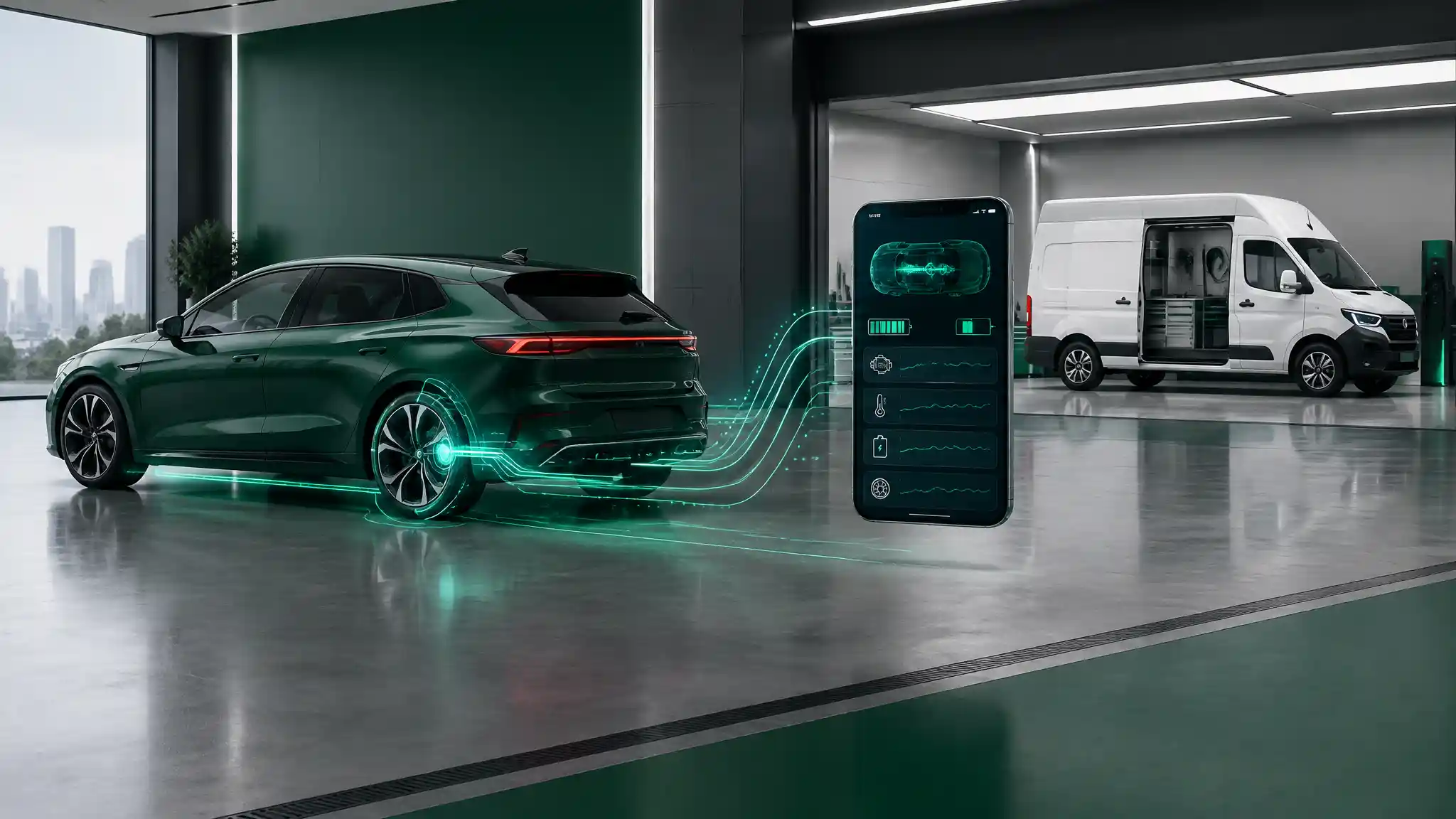
A traditional dealer service model is reactive by construction: a fault presents, the driver notices, the driver books an appointment, the vehicle is diagnosed on arrival. Every step in that chain runs after the fault has already degraded the vehicle or inconvenienced the driver. A telemetry-driven fleet management model runs the same diagnostic work continuously, in the background, against live data streaming from every zonal gateway in the fleet — not once, at a scheduled interval, but constantly.
A Concrete Scenario
An OTA diagnostic log flags a transient eFuse short circuit on a specific zonal circuit — a fault pattern too brief to have triggered a dashboard warning, but clearly logged in the gateway's fault history. The OEM cloud platform correlates that pattern against known failure signatures across the fleet, identifies it as an early indicator of component degradation, and automatically routes a mobile service booking to the vehicle's owner — before the driver has noticed anything, and before the transient fault has become a roadside failure. The service event exists because the architecture reported it, not because a customer complained.
The Distributed Service Network: 80/20 Mobile vs. Fixed
The 80/20 Rule
An EV platform, especially one built on the megacast, module-deleted architecture detailed earlier in this report, eliminates most of the mechanical friction points that made ICE service a heavy-infrastructure business. As a direct result, up to 80% of routine maintenance and module-level work — sensor recalibration, door latch actuator replacement, software refreshes, tyre and brake service — can be performed by a mobile service van, dispatched directly to the customer's home or office through the same app used to order the vehicle.
The Role of Fixed Workshops
The remaining 20% is not spread thin across a large fixed network — it is concentrated into a small number of heavy-infrastructure regional hubs, reserved strictly for the work a van cannot do: megacasting structural repair, Cell-to-Chassis structural battery pack work, and the severe collision damage scenarios flagged as a field-serviceability risk in Part 8. Fixed workshops, under this model, are specialist structural repair centres, not general-purpose service centres that happen to also do oil changes.
Legacy Franchises vs. The Digital D2C Paradigm
Parameter | Legacy Franchised Dealership | Modern Digital D2C Ecosystem |
|---|---|---|
CapEx efficiency | Low — large lots, unsold inventory carrying cost | High — small-footprint showrooms, build-to-order only |
Customer data ownership | Siloed — fragmented across independent franchisees | Unified — single OEM-owned data loop, factory to fleet |
Service revenue driver | Mechanical parts and labor margin | OTA software unlocks and subscription activation |
Factory-to-consumer feedback loop | Indirect — filtered through franchisee reporting | Direct — real-time telemetry feeding product and manufacturing decisions |
The D2C Deployment Checklist
Unified Fleet Telemetry Integration
- Bind every vehicle's real-world telemetry stream directly to its owner's customer app profile at first power-up.
- Route zonal gateway fault logs into the same cloud platform driving predictive service scheduling, not a separate diagnostics silo.
- Validate data continuity across ownership transfer, not just first-owner lifecycle.
Mobile Technician Tooling Optimization
- Equip every service van with an onboard diagnostic server capable of full zonal gateway interrogation, not a generic OBD scan tool.
- Stock plug-and-play zonal modules as field-replaceable units, sized against the fleet's actual predictive-fault distribution.
- Standardize van-based tooling against the same eFuse and zonal architecture across every vehicle in the fleet, eliminating model-specific tooling variance.
Regulatory Compliance Mapping
- Map US state-by-state franchise dealer laws before launch — several states legally restrict or prohibit direct OEM vehicle sales outright.
- Map EU block exemption regulation exposure, specifically around independent repairer access to diagnostic data and spare parts.
- Structure the app's financing and ordering flow to satisfy the strictest applicable regional regulation by default, not by market-specific carve-out.
Post-Delivery Software Monetization
- Architect the app around modular, individually activatable OTA feature unlocks, not a single fixed trim configuration at point of sale.
- Build subscription billing directly into the same unified app handling ordering and service booking, not a separate account system.
- Tie feature activation eligibility to the vehicle's real hardware configuration as reported by telemetry, not a static build record that can drift out of sync.
The Series, Closed
Ten installments ago, this report opened by disputing an industry consensus that a profitable, sub-£30,000, UK-built EV was mathematically impossible. What has followed since is not a marketing case but a full-stack engineering and commercial argument: a licensed sodium cell chemistry that clears post-Brexit Rules of Origin, a megacast and flax-fibre structure that deletes the body shop and paint shop, a dual-layer software architecture that keeps differentiation proprietary while licensing commodity infotainment, a Factory OS built for a brownfield micro-factory floor, a pure 48V architecture built to carry both routine loads and autonomous compute, and, in this final installment, a retail and service model architected around what all of that engineering actually enables rather than around a century-old distribution structure it was never designed to fit. The paradox this report opened with was never really about £30,000. It was about whether a British engineering team would build the car the old model expected, or the one the new architecture actually made possible.