
The premium EV playbook of the last decade has been a slick four-door saloon silhouette: a low nose, a fastback roofline, and a badge that justifies the price. It's a good look for a Cd figure. It's a poor look for a British buyer who needs to fit a pushchair, a dog, and a flat-pack wardrobe in the same boot. The 5-door hatchback remains the undisputed champion of practical UK motoring for a reason, and affordable ev industrial design starts from that brief, not from chasing a saloon's aerodynamic reputation at the cost of everyday usability.
This is the visual and structural case for that platform: an aggressive, angular 4.287-metre 5-door hatchback riding a long 2,705 mm wheelbase, with sculpted teardrop wing mirrors, a flush-recessed front number plate pocket, and a single-screen, stalkless interior — engineered so that every low-cost geometry decision does aerodynamic work rather than fighting against it.
The Proportions: C-Segment Dimensions with Executive Space
 The
The electric hatchback dimensions uk profile lands at:
- Length: 4,287 mm
- Width: 1,836 mm
- Height: 1,504 mm
- Wheelbase: 2,705 mm
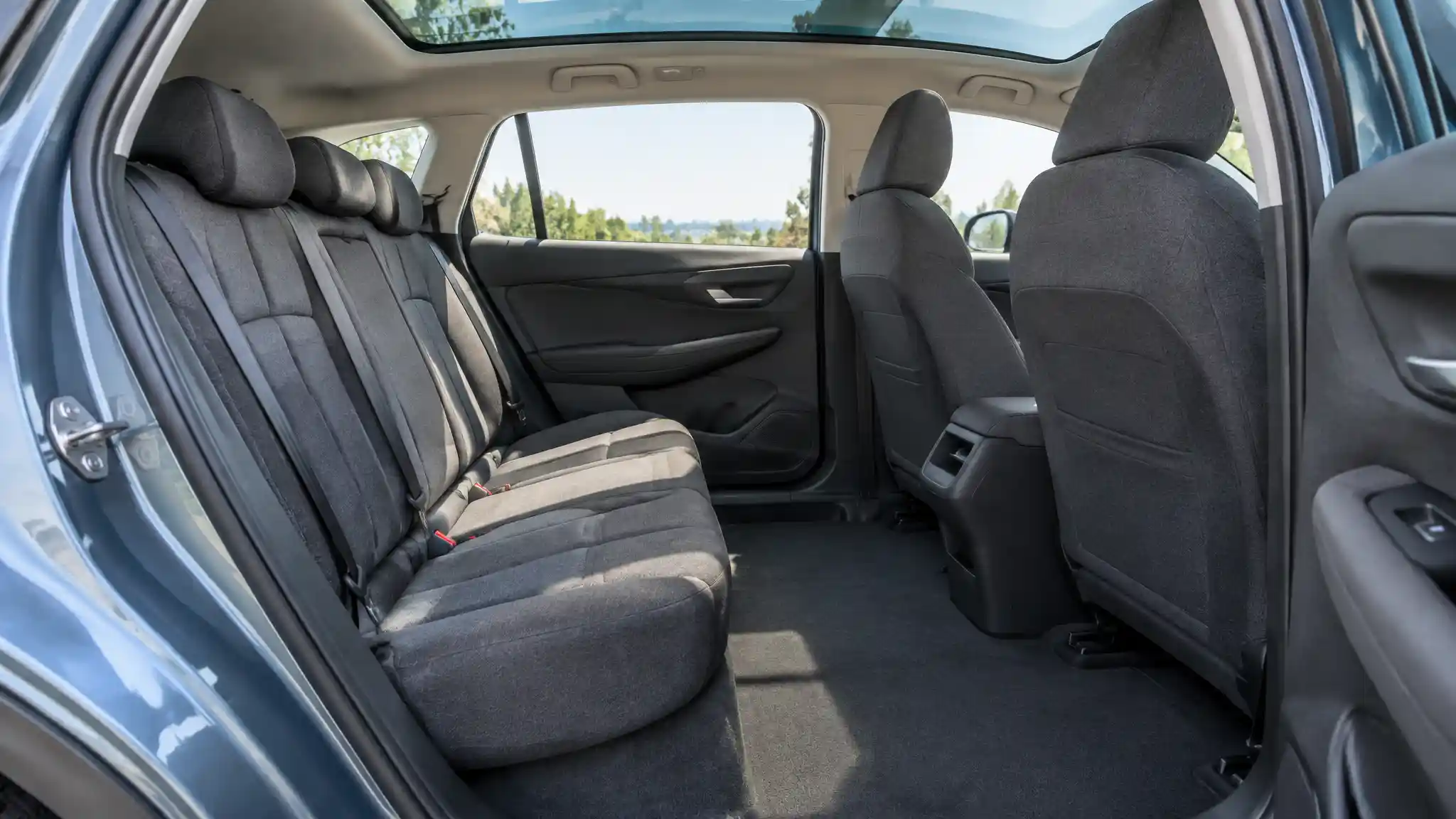
This footprint targets the absolute sweet spot of the modern British C-segment hatchback class — the dimensions a British buyer actually shops in, not an arbitrary styling choice. What changes the game underneath it is single motor rwd platform packaging. With no front motor, no front drive axles and no transmission tunnel to route around, the wheels can be pushed to the absolute corners of the chassis rather than tucked in to clear mechanical hardware.
The resulting wheelbase to length ratio electric car figure is 2,705 ÷ 4,287 — just over 63%. For comparison, a typical combustion-era hatchback sits closer to 58–60%, with the difference eaten up by engine bay and exhaust routing. That extra few percentage points of wheelbase-to-length translates directly into cabin space: a longer wheelbase means the passenger box can sit further out toward each axle, buying rear legroom and a genuinely flat boot floor within a footprint that's still agile enough to thread through a British city centre.
The width figure matters just as much as the length. At 1,836 mm, the body is wide enough to seat three across the rear bench without the middle passenger's shoulders fouling the door cards — a dimension that's easy to overlook on a spec sheet but immediately obvious the first time a family tries to fit three child seats side by side. Height, at 1,504 mm, is kept low enough to preserve the sloped, aerodynamic roofline described below, while the flat battery pack under the floor still delivers a genuinely low seating position rather than the perched, van-like stance that taller EV conversions often end up with.
Cheating the Wind Penalty: Sloping Rooflines and Dual Spoilers
A tall, practical hatchback roofline is an aerodynamic liability by default — it presents more frontal area and, without help, sheds air turbulently off the back glass. The rear aero package on this platform is built specifically to manage that liability rather than disguise it.
The roofline slopes progressively toward the tailgate and terminates in a floating twin-wing spoiler, set slightly proud of the roof surface on a pair of short pillars. That gap does real aerodynamic work: it lets a thin sheet of fast-moving air bleed through underneath the wing itself, re-energising the boundary layer just as it's about to separate from the glass and tumble into turbulent wake.
Underneath, the rear bumper is cut to a sharp, near-vertical profile — a Kamm-tail treatment. Rather than letting the body taper all the way to a point (which adds length for very little drag benefit past a certain angle), the body is deliberately truncated. At 70 mph, this forces the boundary-layer air to shear off cleanly at a fixed, predictable edge instead of wrapping around a rounded tail and pulling a large, energy-sapping low-pressure wake behind the car. A hatchback's practical, upright rear end and a competitive drag figure aren't mutually exclusive — they just require the tail to be cut, not rounded.
Deleting the Mirror and Plate Parasitic Drag Traps
Two of the biggest aerodynamic drag bottlenecks on early premium EVs are also two of the cheapest to solve properly, once you stop trying to solve them electronically.
Sculpted Teardrop Mirrors
Digital camera-and-screen mirror replacements do cut drag, and they do save a little range. They also add a display, a camera housing, waterproof connectors and a software stack per unit — production cost and complexity that has no place on a sub-£30k target. The alternative is aerodynamic wing mirrors ev housings: conventional glass mirrors, but sculpted into a true aerofoil cross-section, with a moulded air channel along the leading edge that splits oncoming air cleanly before it reaches the mirror body. Done well, a sculpted housing recovers most of the drag penalty of a traditional mirror for the tooling cost of a shape change — pennies on the production line, not a new sensor stack.
The Recessed Front Number Plate
A bolted-on, protruding aftermarket number plate bracket is a surprisingly large drag contributor at motorway speed — a flat panel standing proud in the highest-pressure zone of the entire car, right at the nose. The fix here is a recessed aerodynamic front number plate pocket, moulded directly into the front bumper skin at the design stage rather than bolted on afterward. The plate sits flush with the surrounding bodywork, so oncoming air slides smoothly over the nose instead of slamming into a proud edge and tripping into turbulence right where the car's frontal drag matters most.
The Cabin Ecosystem: Stalkless Hyper-Minimalism
 Inside, the same principle applies: every component that isn't earning its place on a cost sheet gets deleted, and the space it occupied gets reclaimed for the driver.
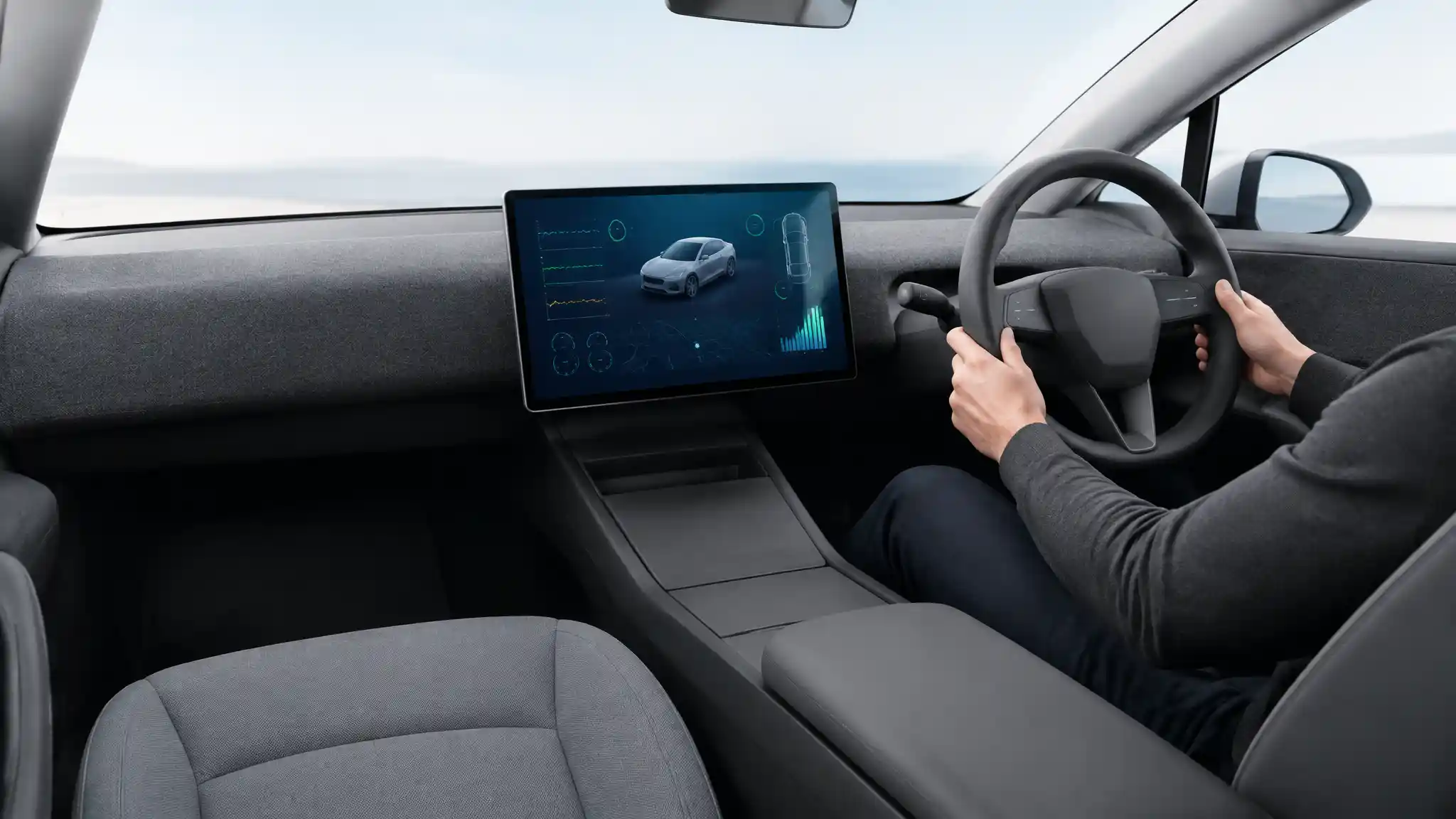
The dashboard runs a minimalist ev dashboard screen philosophy — zero physical dials, zero switchgear, and no separate driver instrument binnacle. Speed, range, navigation and vehicle status are all routed through a single central 15-inch high-definition display, angled toward the driver. Removing the binnacle doesn't just cut a component; it opens up sightlines across the dash and simplifies the injection-moulded tooling behind it, since there's one screen assembly to engineer instead of two.
The steering wheel itself deletes the mechanical indicator and wiper stalks entirely, replacing them with haptic-feedback buttons mounted directly on the wheel spokes. Beyond the parts-count saving, it removes an entire wiring sub-harness and two mechanical stalk assemblies from the steering column — less to source, less to assemble, less to go wrong under warranty.
Ergonomically, the trade-off is managed carefully rather than ignored: indicator and wiper controls are mounted on the two spoke faces the driver's thumbs naturally rest against at the standard 9-and-3 hand position, with a distinct raised texture and a firm haptic click so each control can be found and confirmed by feel alone, without the driver's eyes ever leaving the road. That single design constraint — the wheel does the stalks' job without the driver having to relearn hand position — is what keeps the stalkless layout from feeling like a cost-cutting compromise rather than a genuine ergonomic upgrade.
Conclusion: Form Follows Manufacturing Function
None of this shape is arbitrary. The hatchback proportions, the 63% wheelbase-to-length ratio, the Kamm-tail, the sculpted mirrors, the recessed plate pocket and the stalkless cabin are all the same decision, applied repeatedly: let manufacturing economics, safety regulation and aerodynamic physics dictate the geometry, rather than styling it first and costing it out afterward. A beautiful, modern electric hatchback doesn't require a premium price tag to justify it. It requires every panel, every mirror and every switch to have earned its place — and that discipline is exactly what makes a sub-£30k British EV buildable at all.