The Cold-Weather Physics of Sodium-Ion vs. Lithium
Cold does the same first thing to every liquid electrolyte: it thickens it. Rising electrolyte viscosity slows ion mobility directly, and slower ions mean slower ionic diffusivity into the hard carbon anode during both charge and discharge.
That diffusion bottleneck shows up electrically as concentration polarization — a localized ion pile-up at the electrode surface that the reaction can't clear fast enough. The pack's internal resistance spikes in response, and every amp drawn or delivered through that higher resistance shows up as wasted heat instead of usable range.
Left unmanaged, that spike is not a rounding error. A raw, unconditioned sodium-ion cell loses up to 30% of its effective capacity at -10°C ambient. This is the honest number, not the marketing one — sodium-ion is not thermally magic, and any technical case built on pretending otherwise doesn't survive a UK winter car park.
The silver lining is real, though, and it's a safety property, not a capacity one. Unlike lithium-ion, sodium-ion cells are structurally immune to low-temperature dendrite formation. A cold lithium cell forced to accept a fast charge risks lithium plating on the anode — metallic deposits that can eventually bridge the separator and short the cell internally. Sodium's larger ion and different plating chemistry simply doesn't build that bridge. A frozen sodium cell can safely accept high-power charging current the moment its resistance allows it, with no internal short-circuit risk baked into the chemistry itself.
The Octovalve Solution: Cross-Domain Thermal Harvesting
Capacity lost to cold internal resistance isn't a chemistry problem this platform tries to solve with better chemistry. It's a thermal-management problem, solved with waste heat that already exists on board.
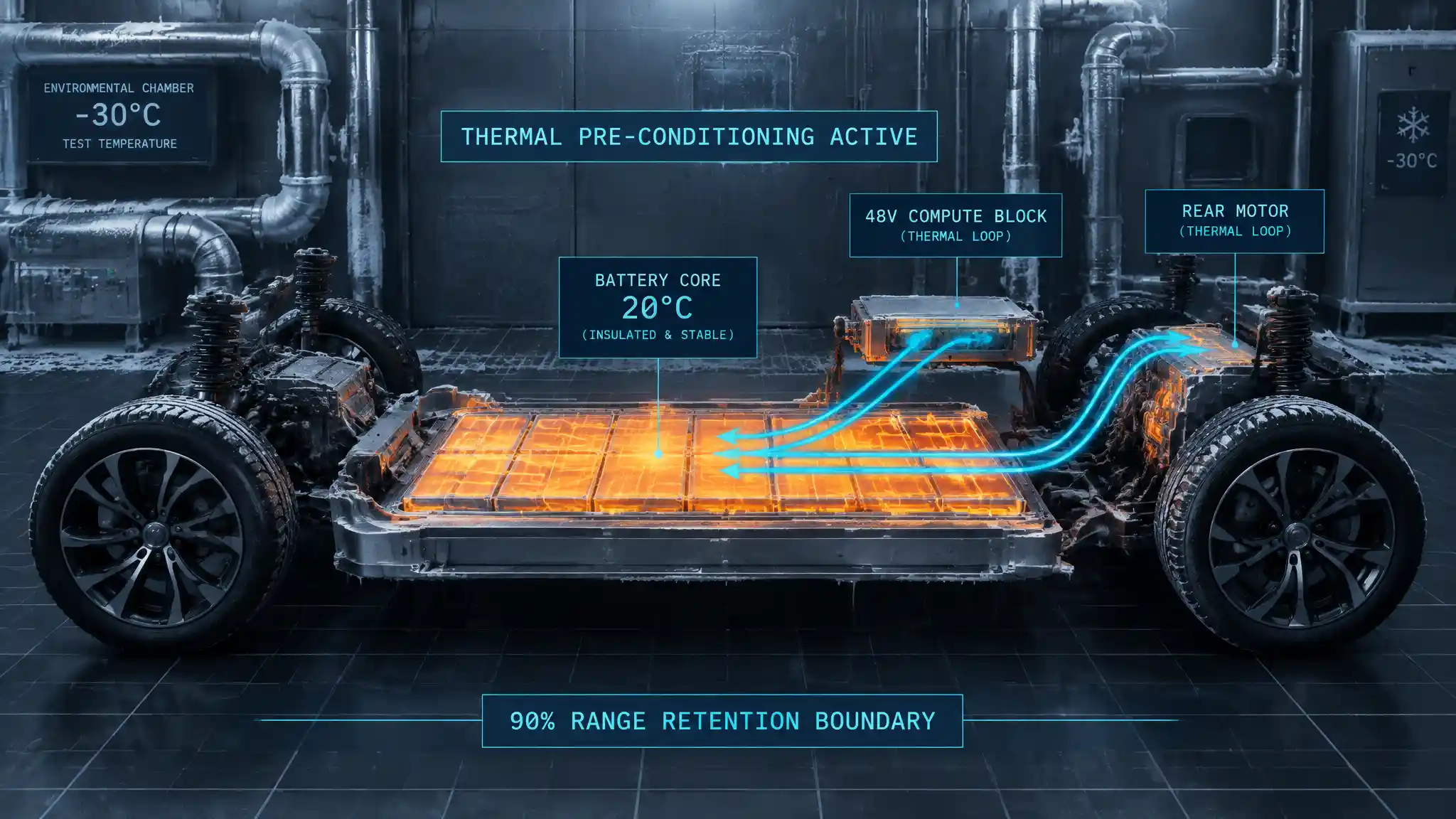
The pack's structural thermal plate, specified in Part 2 as part of the Cell-to-Pack floor assembly, threads directly through the megacast structure detailed in Part 3 — the same aluminium nodes that flank the pack mechanically also carry the thermal loop's plumbing to it.
An eight-port octovalve sits at the centre of that loop, and its job is pure energy scavenging. It actively redirects waste heat from three sources that are generating it anyway: the hairpin-wound drive-unit motors, the 48V autonomous compute nodes, and cabin exhaust air leaving the HVAC system. None of that heat is manufactured for the battery's benefit — all of it is a byproduct the vehicle would otherwise reject to the atmosphere.
The octovalve concentrates that harvested energy through the localized liquid thermal plate, using it to insulate and pre-condition the structural cell-to-chassis floor block. The target is a stable 20°C cell operating window — the temperature band where sodium-ion's internal resistance sits near its floor — held even while the vehicle is driving through a blizzard, not just while parked and plugged in.
48V thermal actuators drive the octovalve's port switching. Because the valve's actuation load is small and intermittent, not continuous, it draws current at 48V rather than the high-voltage bus, keeping the actuator wiring thin and its parasitic draw off the traction battery's own energy budget.
The Actuarial Winter Range Matrix
Metric | Managed Sodium-Ion (this platform) | Unmanaged LFP Pack |
|---|---|---|
Nominal range retained, 0°C | 97% | ~90% |
Nominal range retained, -10°C | 90% | ~60% |
Fast-charging acceptance, 10-80%, -10°C | ~20 minutes | 45–60 minutes, current-throttled |
Cabin warm-up penalty (kW draw on pack) | ~1.5 kW, scavenged waste heat | ~5–6 kW, resistive PTC heating |
Dendrite safety risk when cold-charging | None — chemistry-immune | Elevated — lithium-plating risk |
The gap between 97% and 90% retention as ambient temperature falls from 0°C to -10°C is the octovalve loop's entire job: a 7-point spread, not the 30-40 point collapse an unmanaged pack of either chemistry would otherwise show. The LFP column's slow fast-charge figure isn't a software limitation — it's the BMS deliberately throttling current to stay clear of lithium-plating risk, a constraint sodium-ion's dendrite immunity simply doesn't carry.
Cross-Linking & Discovery
Thermal management, not raw chemistry, is what actually equalises an affordable battery pack against a premium one in a UK winter. Sodium-ion's cost and supply-chain advantages, detailed in Part 2, only hold up on the road if the pack stays inside its working temperature window — and that's a systems problem, solved with waste heat already on board, not a more expensive cell.
- ← Back to the EV Blueprint Index
- Part 2: The Sovereign Cell — the pack and thermal plate this loop protects →
- Part 3: The Monolithic Chassis & Form — the megacast structure the loop runs through →