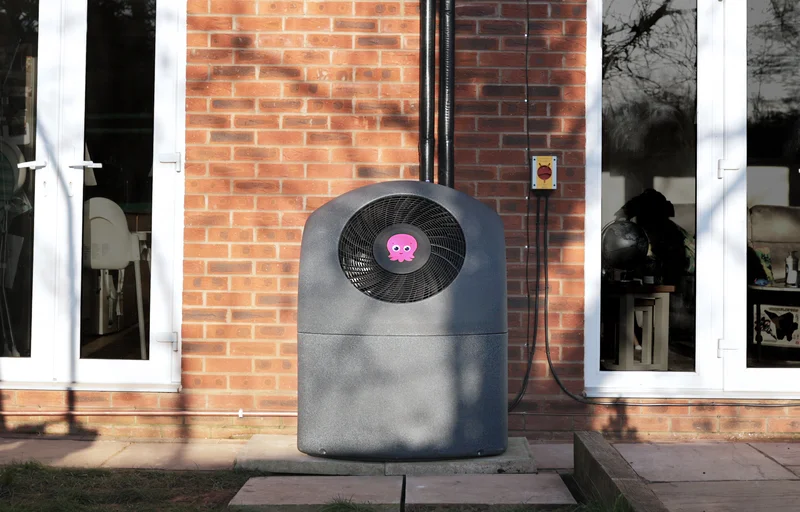
Octopus Energy has moved from retailing electricity to manufacturing the appliance that consumes it. The Cosy heat pump series, built in Portadown, Northern Ireland, is the clearest expression of that vertical integration: the same group controls the tariff, the grid-flexibility platform, the installer channel and now the compressor-bearing hardware. For heating engineers, utility system architects and clean-tech investors, the question is not whether the strategy is bold, but whether the thermodynamics and the customer experience support it.
Portadown tooling and the shared-footprint strategy
The most instructive design decision is mechanical rather than thermodynamic. The Cosy 9 and Cosy 12 share an identical 855 mm width and 595 mm depth. Only cabinet height and internal fan velocity change between them. In manufacturing terms, this allows a single set of pressed-panel dies, base-frame fixtures, brazing jigs and packaging line to serve two output classes, with the taller cabinet accommodating a larger evaporator coil face and a higher-capacity fan assembly.
This is a deliberate capital expenditure boundary. Tooling for sheet-metal casings is front-loaded and amortised across volume, so every product variant that reuses the footprint spreads the same fixed cost over more units. It also simplifies installer logistics: pad dimensions, clearance planning and condensate routing are standardised across the two largest models, which reduces the specification errors that commonly delay commissioning.
The trade-off is that capacity scaling by airflow rather than by a fundamentally different heat exchanger design places more burden on fan performance. A higher fan velocity moves more ambient heat across the coil but raises acoustic output, which is why the sound power column in the matrix below deserves close attention at design stage.
| Parameter | Cosy 6 | Cosy 9 | Cosy 12 |
|---|---|---|---|
| Nominal heat output | 6 kW class | 9 kW class | 12 kW class |
| Casing width × depth | Smaller, separately tooled footprint (see specification sheet) | 855 mm × 595 mm | 855 mm × 595 mm |
| Casing height | Shortest of the range | Mid-height cabinet | Tallest cabinet, larger coil face |
| Fan strategy | Lowest airflow | Mid airflow | Highest airflow velocity to move 12 kW of ambient heat |
| Sound power level | Lowest of the range | Intermediate | Highest, requires closest siting scrutiny under MCS 020 noise rules |
| Target property layout | Flats, small terraces, 1 to 2 bedroom dwellings with low heat loss | 3-bedroom semi-detached and detached homes of average fabric | Large detached homes, poorly insulated stock and period properties |
| Maximum flow temperature | Up to 70°C | Up to 70°C | Up to 70°C |
R290 propane physics and the 70°C threshold
R290 is pure propane, with a global warming potential of roughly 3, compared with 675 for R32. Its thermophysical properties are what make a 70°C output credible. Propane has a high critical temperature (around 96.7°C), so condensing at the temperatures required for 70°C flow keeps the cycle subcritical and well away from the transcritical regime that complicates CO2 systems. Its moderate discharge temperatures, compared with R32, reduce thermal stress on the compressor oil and windings, which mitigates the risk of lubricant breakdown and compressor seizure at high lift.
Propane also delivers a favourable volumetric heating capacity and low pressure ratios, so the compressor is not forced into the extreme pressure differentials that shorten the life of R410A and R32 machines producing similar temperatures. The refrigerant is, however, flammable (A3 classification), which constrains charge size, enclosure ventilation and the placement of the unit relative to openings, drains and ignition sources. Because the whole refrigerant circuit sits in the outdoor monobloc unit, no refrigerant enters the dwelling, a significant safety and compliance simplification.
None of this repeals the Carnot relationship. Coefficient of Performance falls as the temperature lift between source and sink increases. At a 70°C flow temperature on a cold day, the lift is so large that baseline heating efficiency drops to approximately 2.0, against figures well above 4.0 when the machine is delivering 35°C in mild weather. A COP of 2.0 still beats direct electric resistance by a factor of two, but it removes much of the running-cost advantage over mains gas unless the household is on a favourable time-of-use tariff.
Weather compensation and the Cosy Hub ecosystem
The commercial answer to that efficiency penalty is control. The system pairs a central Cosy Hub with wireless room pods and ambient weather tracking. Rather than holding a fixed high flow temperature, the controller applies a weather compensation curve: as outdoor temperature rises, the target flow temperature falls. In mild conditions the flow can sit at a highly efficient 35°C, where the compressor operates at low lift and the system spends most of the heating season at its best COP.
Room pods supply the feedback loop. By reporting actual indoor temperatures to the hub, they allow the controller to trim the compensation curve per property and per zone, rather than relying on a single fixed offset. In engineering terms, this is closed-loop optimisation layered on open-loop weather compensation. The 70°C capability then acts as a reserve for the coldest design-day conditions and for dwellings with undersized emitters, not as the normal operating point.
This is where the vertical integration becomes financially relevant. Because the hub is tied to Octopus tariff and flexibility products, the controller can pre-heat the thermal mass of the building during cheap off-peak windows and coast through peak periods. That standardised, software-defined load shifting is a form of asset-optimisation that converts a lower seasonal efficiency into a lower unit cost of heat, and it makes each installed unit a controllable demand-side asset for the wider grid.
Funding context: the Boiler Upgrade Scheme
The Boiler Upgrade Scheme grant lowers the upfront cost of an eligible air source heat pump installation, and Octopus has used it alongside its own pricing to position the Cosy range against established manufacturers. The 70°C flow capability complements this: it widens the addressable market to homes that would otherwise require extensive radiator replacement or fabric upgrades before a heat pump was viable, and so reduces the total installed cost that a customer weighs against a like-for-like boiler replacement.
Real-world vulnerabilities reported by installers and customers
Field observations from active installer networks and early customers highlight several design vulnerabilities that investors and specifiers should weigh against the headline specification.
- Exterior geometry: the cylindrical exterior has attracted aesthetic criticism. Some customers and installers regard it as visually distinctive in a way that is hard to conceal on narrow terraced frontages, which complicates planning and siting conversations.
- Single-compressor limitation: with one compressor, the unit cannot deliver domestic hot water and space heating simultaneously. During a cylinder reheat, space heating is interrupted. In a well-insulated home the thermal mass of the structure absorbs this, but in leaky or low-mass properties and during cold snaps, the interruption can be noticeable and increases the importance of correct cylinder sizing and scheduling.
- No physical wall thermostat: the system has no manual wall-mounted control interface. Occupants rely on the app and room pods. For households that prefer a tactile, always-available dial, or for guests and less digitally confident residents, this is a recurring source of complaints.
Each of these is addressable through installer training, scheduling defaults and firmware, but they are a reminder that a tightly integrated, software-first proposition shifts risk from the hardware to the user interface and to the operator's ability to support it.
Engineering verdict
Can the Cosy replace a gas boiler at 70°C flow? Mechanically, yes: R290 makes the temperature achievable with acceptable compressor stress, and the shared 855 mm × 595 mm cabinet shows disciplined manufacturing economics. Thermodynamically, it can do so only at a COP penalty, so the system's real value depends on how rarely it needs to run there. A well-characterised property with correctly sized emitters should operate predominantly at 35°C to 45°C, where the machine performs strongly. A poorly characterised one will expose the ~2.0 COP floor and a bill to match.
For heating engineers, the recommendation is to complete a proper room-by-room heat loss calculation and emitter assessment before relying on the 70°C headline. For investors, the strategic bet is that tariff, hub and hardware owned by one entity will out-optimise a fragmented market. The hardware is credible; the proof will come from seasonal performance data across a large, diverse installed base.