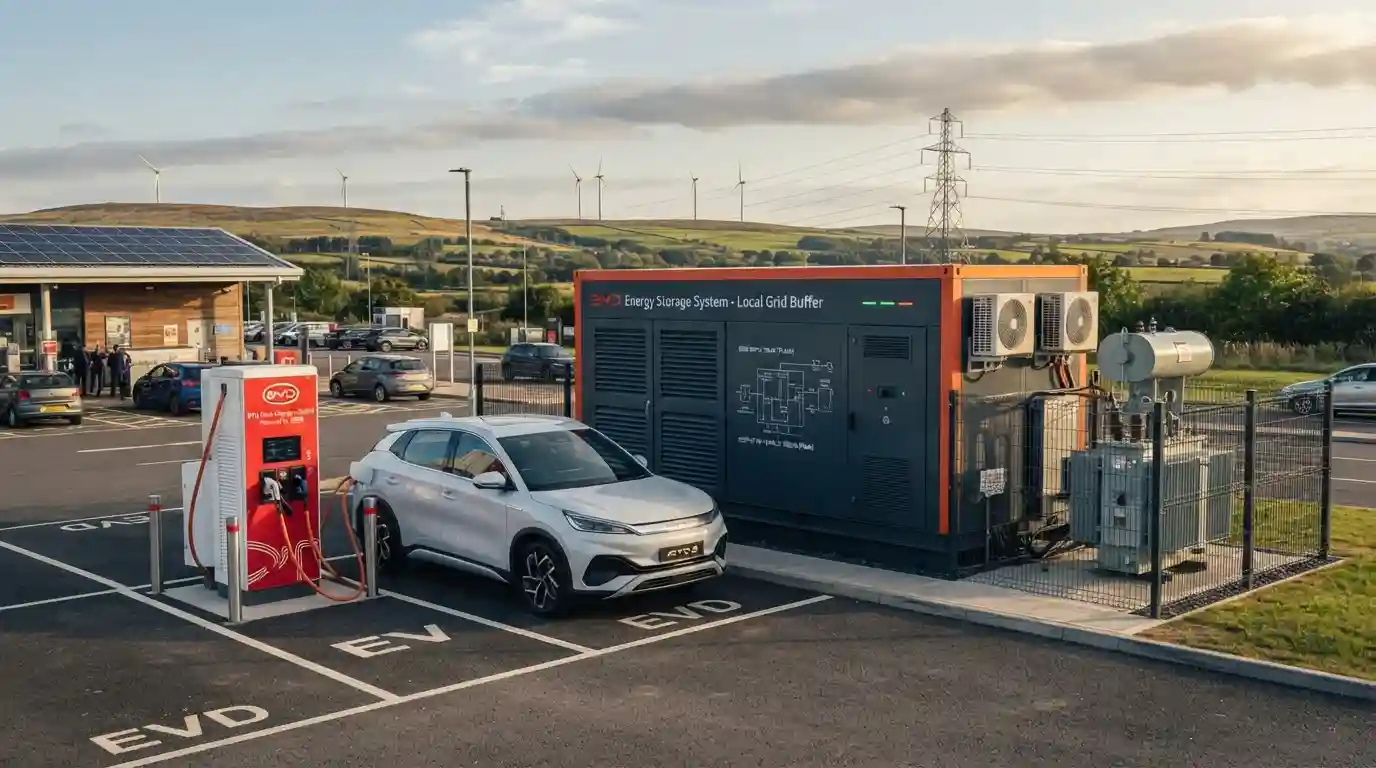
The conventional argument against electrifying transport is that the grid cannot supply the power. That argument treats the network as a rigid, instantaneous pipe in which every kilowatt of demand must be matched by a kilowatt of upstream capacity at the same moment. Battery Energy Storage Systems break that assumption. By decoupling the timing of energy supply from the timing of demand, they convert a peak-power problem into an average-power problem, and an average-power problem is far cheaper to solve. For grid distribution engineers, renewable asset specifiers and technology deployment analysts, BESS is no longer an accessory to the network. It is a structural component of it.
The role of BESS in the decarbonised grid
A modern grid-scale BESS combines Lithium Iron Phosphate (LFP) cell matrices, a battery management system, thermal management, and bidirectional inverters that interface with the alternating-current network. The same asset can charge during renewable generation surges, when wholesale prices are low or negative, and discharge during peak demand windows, capturing the spread. This is the classical arbitrage role. Its importance has grown with the volatility of wind and solar output, which creates deeper troughs and sharper peaks in the residual demand curve.
LFP chemistry has become dominant in stationary storage because it combines thermal stability with long cycle life and avoids cobalt and nickel supply risks. Its lower energy density is largely irrelevant on a static site where footprint is cheap relative to the cost of an unplanned thermal event. In practical terms, an LFP array with proper thermal management can sustain thousands of full-equivalent cycles over its life, which suits frequent shallow cycling for frequency services.
| BESS parameter | Core advantages | Operational constraints |
|---|---|---|
| Response speed | Inverter-based response within milliseconds of detection; full Dynamic Containment delivery within the contracted sub-second to one-second window, with no mechanical spin-up. | Requires accurate, high-resolution frequency measurement and fault-tolerant control software; response limited by inverter ramp rate and state of charge. |
| Chemistry (Lithium Iron Phosphate) | Thermally stable chemistry, long cycle life and no cobalt or nickel; well suited to frequent shallow cycling. | Lower gravimetric energy density than nickel-based cells, so larger footprint per MWh; calendar and cycle ageing still erode capacity. |
| Round-trip efficiency | Typically 85 to 90 per cent AC-to-AC, far higher than most long-duration alternatives. | A 10 to 15 per cent conversion loss on every cycle, dissipated as heat that requires cooling and erodes arbitrage margins. |
| Grid connection and capital cost | Local buffering lets a site draw a low continuous load, avoiding utility-scale substation upgrades and long connection queues. | Large utility-scale arrays still face connection queues, planning scrutiny and fire-safety requirements; battery cost remains the dominant capital item. |
| Service stacking and revenue | Frequency response, wholesale arbitrage, capacity market and balancing services can be stacked on one asset. | Revenue cannibalisation as more capacity enters Dynamic Containment; availability windows and state-of-charge management conflict between services. |
| System inertia | Provides synthetic or fast-frequency response without relying on rotating mass, supporting a grid with fewer synchronous generators. | Grid-following inverters cannot match true physical inertia in all fault conditions; grid-forming capability is still maturing. |
| Degradation and lifetime | Warranted lifetimes of 15 to 20 years with managed depth of discharge and temperature control. | Cell ageing, capacity fade and augmentation costs; high C-rate and high temperature accelerate degradation. |
The BYD localised buffer: deconstructing the grid-bypass trick
Ultra-fast vehicle charging has a connection problem. A conventional 350 kW charger requires a high-capacity connection, and a site hosting several such chargers can require several megawatts of supply, a new or upgraded substation and a distribution network operator process that can take years. The BYD flash-charging architecture sidesteps the problem with a local buffer: a stationary LFP battery bank sits between the grid and the vehicle.
The physics is straightforward energy balance. Consider a station drawing a continuous 30 kW from the grid. Over 24 hours, that supplies 720 kWh of energy, before losses. A 350 kW charging event delivering around 58 kWh to a vehicle takes approximately 10 minutes. The energy consumed by that event is drawn not from the grid at that moment but from the local LFP cell bank, which is replenished by the 30 kW trickle during the idle periods between vehicles. The peak current is isolated entirely within the local battery and inverter system, never appearing at the point of connection. A 30 kW feed can therefore support roughly a dozen 58 kWh sessions per day (before accounting for conversion losses), each delivered at 350 kW.
The economic consequence is large. The connection capacity needed is set by average energy throughput, not peak power. A site that would otherwise need a multi-megawatt connection can operate on a supply comparable to a small commercial premises, avoiding the cost and delay of substation reinforcement. The trade-off is that the buffer must be sized for the busiest realistic sequence of arrivals. If vehicles arrive in rapid succession, the cell bank discharges faster than the trickle can refill it, and once the state of charge falls below a threshold, delivered power is throttled to the sustainable rate. Utilisation modelling, queue behaviour and peak-hour demand profiles therefore determine the correct buffer capacity.
The same logic generalises beyond a single brand. Any charging hub with an on-site battery can pair modest grid connections with high instantaneous power, and can additionally sell flexibility to the grid when no vehicle is charging, stacking revenue streams on a single asset. This is where vehicle charging and grid infrastructure become the same engineering problem.
The UK frequency response shield: Dynamic Containment
Grid frequency in Great Britain is nominally 50 Hz and is held within a statutory operational range, normally 49.5 to 50.5 Hz. Frequency falls when generation is lost faster than demand falls, and rises in the opposite case. Historically, the rotating mass of synchronous generators provided physical inertia, which slowed the rate of frequency change and gave operators time to respond. As coal and gas plant retire and inverter-based wind and solar grow, system inertia declines, and frequency can move faster after a disturbance.
Dynamic Containment is a fast-acting frequency response service procured by the system operator to contain frequency deviations after a large loss event. Batteries are well suited: monitoring equipment measures frequency continuously, and when it departs from the 50 Hz baseline beyond the service deadband, control software commands the inverter to inject or absorb power. Detection and command execution occur within milliseconds, and the service specification requires a response that begins almost immediately and is fully delivered within about one second, depending on the service terms. The response is proportional to the size of the deviation, rising as frequency departs further from 50 Hz.
This response arrests frequency decline before it reaches the thresholds at which protection systems trip generators, which can otherwise cascade. It does so without relying on mechanical spinning mass: the inverter synthesises a power response electrically. Faster response is not the same as inertia, since conventional inertia is an instantaneous physical property while a battery inverter responds to a measured signal, but fast frequency response can substitute for much of the stabilising function. Grid-forming inverter technology, which allows a battery to establish a voltage and frequency reference rather than follow one, is extending this capability towards genuine synthetic inertia.
The practical constraints are state of charge management and market saturation. A battery contracted for frequency services must hold headroom in both directions, which means it cannot be fully charged or fully discharged while it is available. As more capacity has entered the market, prices have fallen sharply, pushing operators to stack additional services such as wholesale arbitrage and capacity market contracts. Asset-optimisation therefore becomes a scheduling and control problem as much as a hardware one.
Thermodynamic realities: pros and cons
Storage is not free energy. Each charge and discharge cycle incurs conversion losses in the inverter, transformer, battery cells and auxiliary systems such as cooling. The round-trip efficiency of a well-designed LFP system is typically 85 to 90 per cent, which means a 10 to 15 per cent penalty on every cycle, dissipated as heat. For arbitrage, this loss must be recovered through the price spread: if a unit of energy bought at one price returns only 85 to 90 per cent when sold, the spread must exceed the lost energy's value plus the cost of degradation. At low spreads, operation is uneconomic.
Cell degradation is the second constraint. Capacity fades with both calendar ageing and cycling, accelerated by high temperature, high charge and discharge rates, and extreme states of charge. A well-managed LFP system might retain 70 to 80 per cent of nameplate capacity after 15 to 20 years, depending on the duty cycle. Operators handle this through oversizing, augmentation (adding modules over time) and operating strategies that limit depth of discharge. Degradation costs per kilowatt-hour throughput are a core input to dispatch decisions and should be included in the bid price for any service.
Against these costs sits a substantial capital benefit. The ability to supply peak demand from local storage reduces or eliminates the need to reinforce substations, lay new cables and expand upstream capacity. For flash-charging hubs, the avoided connection cost can exceed the cost of the battery itself, and the time saving, avoiding multi-year connection queues, can be decisive. At network level, targeted storage deployed at constrained points can defer reinforcement investment, lowering overall system cost. Fire safety, planning and thermal runaway containment remain important design considerations, though LFP's lower propensity for thermal runaway is a significant mitigating factor.
Engineering verdict
BESS is best understood as a grid-flexibility asset rather than a mere energy store. It performs frequency response in milliseconds, absorbs renewable surges, supplies peak demand and, in flash-charging applications, converts a modest grid connection into high-power charging capability. The losses are real, at 10 to 15 per cent per cycle, and so is degradation, but both are predictable and can be priced.
The claim that blackouts have become an engineering impossibility overstates what any single technology can guarantee. Batteries substantially reduce the probability and severity of frequency events, but system security still depends on a combination of fast response, adequate generation, transmission strength and robust protection. The accurate statement is that storage materially strengthens the grid against the failure modes that growing renewable penetration introduces. For distribution engineers and asset specifiers, the priority is to site storage where it relieves constraints, to size buffers on measured utilisation, and to stack services intelligently.