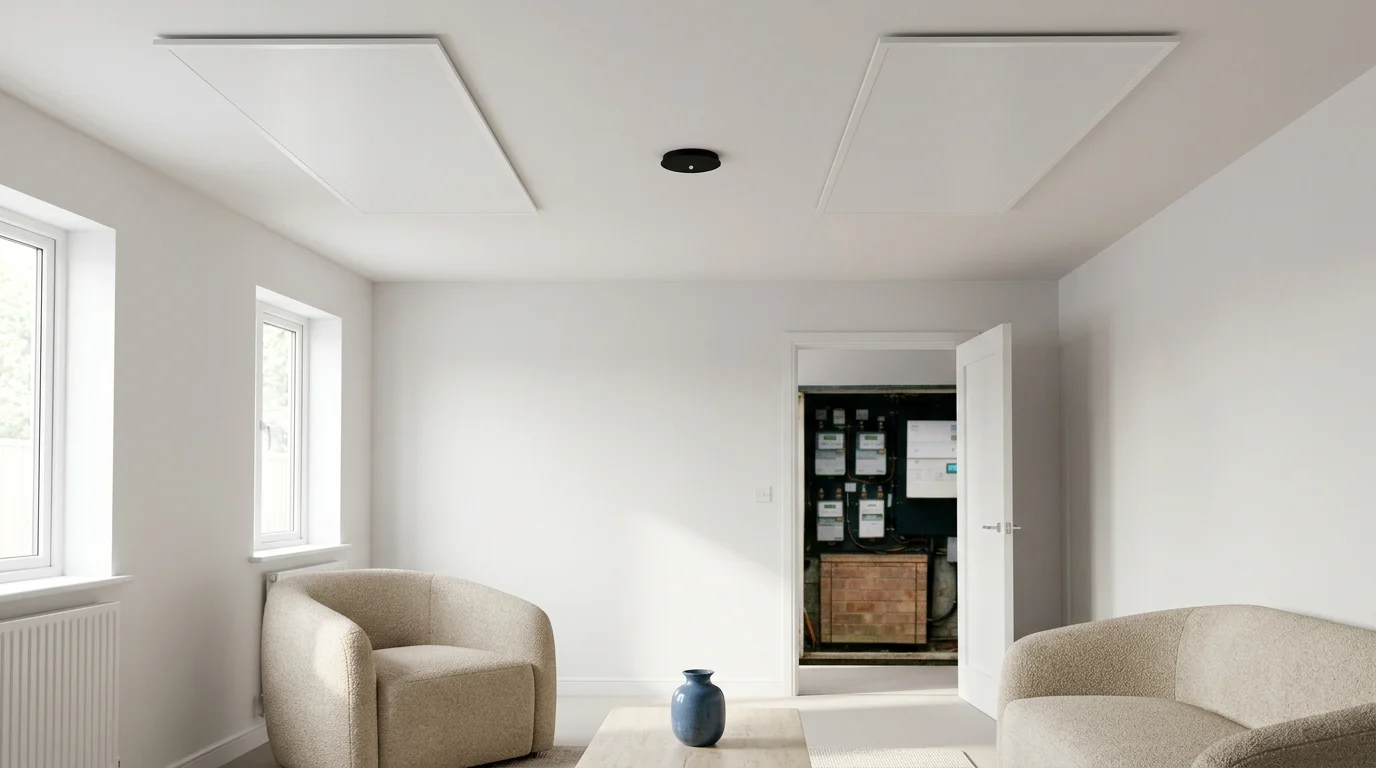
Far-infrared panels operate on radiant physics rather than convection. Emitting wavelengths typically in the 3 to 15 micron range, they stimulate molecules in solid structures such as masonry, floors and furnishings, which accumulate thermal mass and re-radiate warmth. Because the air is not the primary heat carrier, there is less dust circulation and fewer of the continuous air-exchange losses that define traditional convective heating. This suits intermittently occupied rooms, where response speed matters.
The thermodynamics, however, are uncompromising. An electric panel delivers one unit of heat per unit of electricity, a COP of 1.0, whereas an air-source heat pump typically achieves a COP of 3.5 to 4.5. At a peak rate of 24.50p/kWh, panels therefore cost roughly 24.5p per kWh of heat, against about 5.4p to 7.0p for a heat pump. Homes lacking deep zoning and smart thermal controls face aggressive utility bill spikes: without storage, demand costing a heat pump owner roughly £500 a year costs panel owners nearer £2,000.
Storage changes the arithmetic. A 10kWh to 15kWh residential battery allows local-first smart home automation scripts to charge during a 7.60p/kWh off-peak window and discharge into the panels during the day, subverting the 24.50p/kWh peak penalty. Allowing for roughly 90 per cent round-trip efficiency, heat then costs about 8.4p/kWh, close to parity with a heat pump running at peak rates. Capacity is finite, though, and winter demand can exceed what a single battery can shift.
| System | Initial capital cost | Installation complexity | Coefficient of performance | Annual running cost | Asset payback window |
|---|---|---|---|---|---|
| Infrared panels | Approx. £3,000 to £6,000 (plus £5,000+ for a battery) | Low; wall or ceiling mounting and dedicated circuits | 1.0 | Approx. £1,960 at peak rates; materially lower with battery load-shifting | Approx. 6 to 9 years with a battery; no case without storage |
| Air-source heat pump | Approx. £7,000 to £13,000 before grants | High; hydronic pipework, cylinder and emitter upgrades | 3.5 to 4.5 | Approx. £430 to £560 at peak rates | Approx. 5 to 7 years |
| Legacy electric convector radiators | Approx. £1,500 to £3,500 | Low; plug-in or fused spur | 1.0 | Approx. £1,960 at peak rates | Baseline; none |
For building services specifiers and asset-optimisation investors, infrared is a capital-light strategy rather than a free lunch. The case is strongest in well-insulated, zoned properties on a time-of-use tariff with a battery, where installation simplicity offsets the thermodynamic penalty. In poorly insulated, continuously occupied homes, a heat pump remains the more defensible long-term investment, and any decision should be modelled against measured heat-loss data.