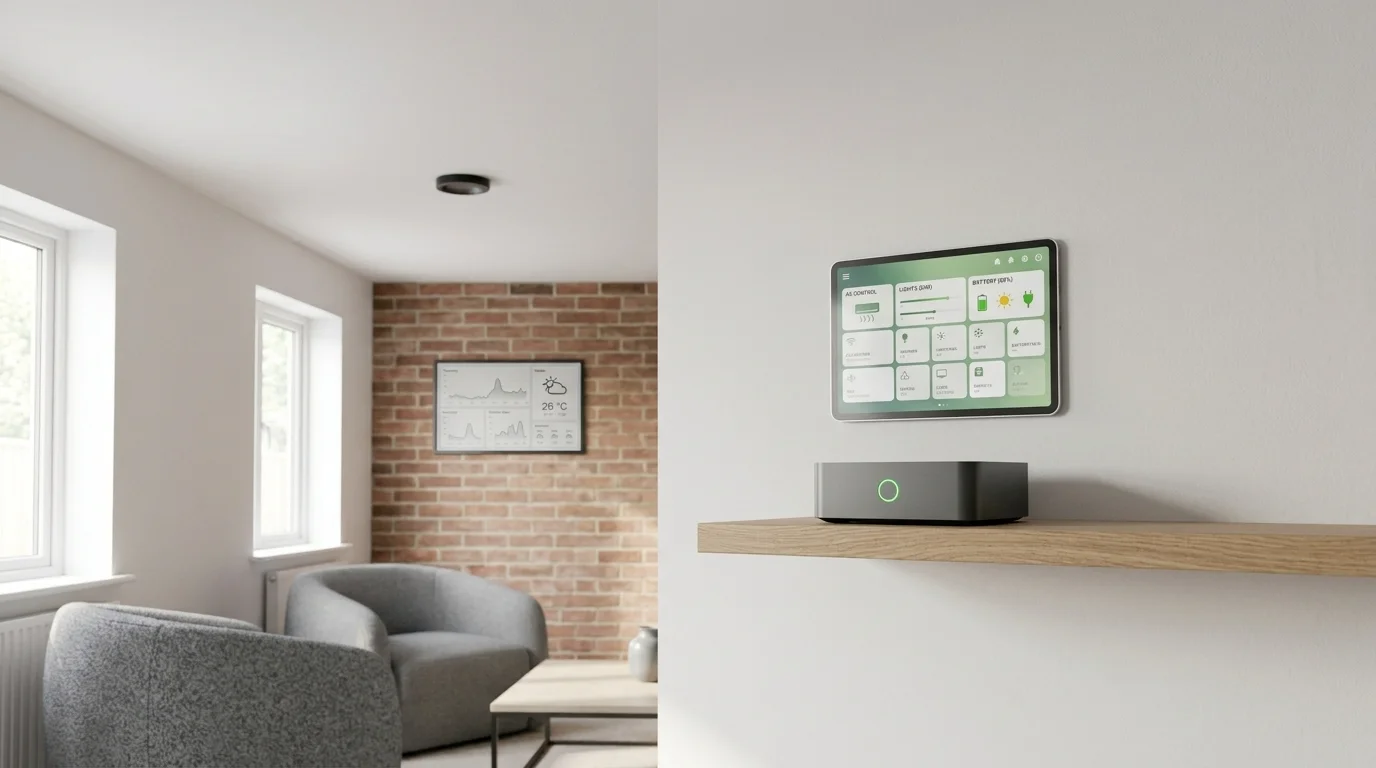
Cloud-based platforms such as Alexa, Google Home and SmartThings route commands through remote servers, adding round-trip latency, a persistent privacy exposure and a hard dependency on both the internet connection and the vendor's continued service. Local-first platforms such as Home Assistant and Hubitat execute automations on dedicated hardware inside the property, so a heating or battery schedule runs identically during an outage. The trade-off is that the installer or homeowner takes on configuration and maintenance responsibility.
The mesh layer determines whether that local controller is reliable. In Zigbee and Thread, mains-powered nodes act as routers and relay traffic for their neighbours, so the network re-routes around a failed node without operator intervention. Thread adds IP-native addressing (IPv6 over 6LoWPAN) and supports multiple border routers, which removes the single coordinator as a point of failure. Zigbee uses its own network stack and typically relies on one coordinator. Both run on low-power IEEE 802.15.4 radios, which allows battery sensors to operate for years across dense, multi-room footprints. Matter is an application layer, not a radio, and it inherits its mesh behaviour from the transport beneath it.
| Wireless Protocol | Mesh Capability | Power Consumption Profile | Transport Layer Baseline | Primary Residential Asset Fit |
|---|---|---|---|---|
| Zigbee | Self-healing mesh via mains-powered routers | Very low; suits battery sensors | IEEE 802.15.4 radio with its own network stack (not IP-native) | Sensors, switches, lighting, radiator valves |
| Thread | Self-healing mesh with redundant border routers | Very low; suits battery sensors | IPv6 over IEEE 802.15.4 (6LoWPAN) | Sensors, locks, battery-powered controls |
| Matter | Inherits mesh from Thread; none of its own | Depends on the underlying transport | Application layer over IPv6 on Thread, Wi-Fi or Ethernet | Cross-vendor interoperability for plugs, thermostats and lighting |
| Wi-Fi | No native mesh; vendor mesh systems add coverage | High relative to 802.15.4 | IEEE 802.11 with native IP | Mains-powered, high-bandwidth devices such as EV chargers and heat pump controllers |
The commercial value lies in algorithmic energy arbitrage. An open-source local server can run a predictive linear programming engine such as EMHASS (Energy Management for Home Assistant), which cross-references solar generation forecasts, household load and half-hourly dynamic tariff prices. It then produces an optimised schedule for battery charge and discharge cycles, heat pump baseloads and electric infrared panel heating. Where a spare electric vehicle battery is available, the same scheduler can extend to vehicle-to-home arbitrage using a used EV battery, treating the car as a further dispatchable store. Because the optimisation runs locally, the schedule continues to execute if cloud services are unavailable, and tariff or forecast data is the only external input.
For building services specifiers and property developers, the characterisation is clear: local-first control with a standardised protocol stack lowers vendor lock-in and asset-optimisation risk. Investors should treat realised savings as dependent on tariff structure, forecast accuracy and the flexibility of the controlled loads, rather than as a fixed return.