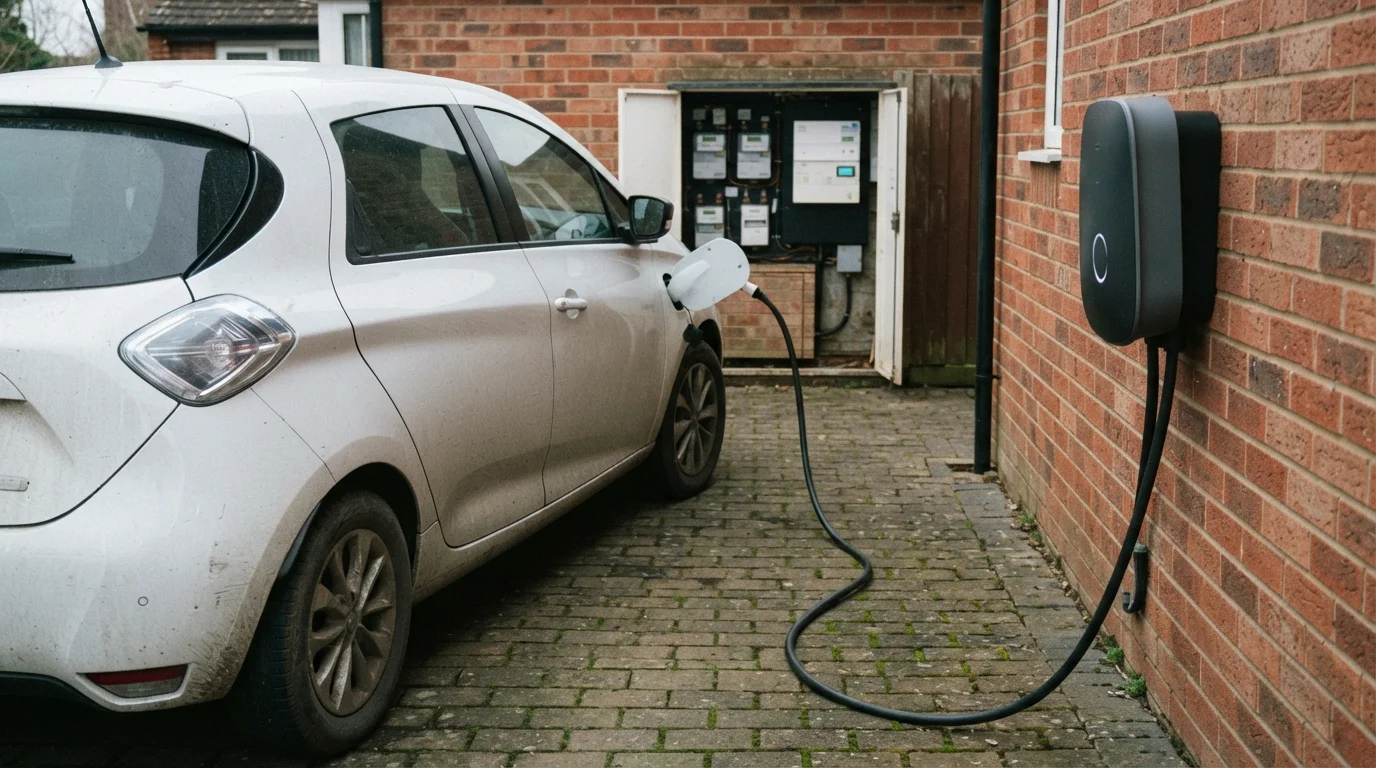
First-generation CHAdeMO vehicles, notably the Nissan Leaf and Mitsubishi i-MiEV, remain the only practical platforms for vehicle-to-home deployment today. Their DC pins connect directly to the traction battery, bypassing the constraints of the internal onboard charger and allowing a standardised bidirectional DC wallbox to manage power flow in both directions. CCS2 bidirectional standards are rolling out far more slowly, leaving few supported models and little domestic hardware, while the Renault Zoe is limited to AC bidirectional pilots.
The tariff arbitrage case is straightforward engineering arithmetic. Charging at an off-peak rate of roughly 7.6p/kWh avoids peak grid rates of up to 37.48p/kWh, a spread of 29.88p/kWh. Cycling 18 kWh nightly at an assumed 88 per cent round-trip efficiency delivers around 15.8 kWh to the home, worth approximately £5.94 against a charging cost of £1.37. That nets roughly £4.57 a day, or between £1,140 and £1,670 a year, depending on whether you achieve 250 or 365 full cycles.
Hardware is the hidden cost multiplier. A donor car can be secured for under £3,500, yet a domestic bidirectional DC wallbox requires separate DNO G99 approval and can exceed £4,000 installed. Dispatching the pack only during peak windows also depends on automated relay scheduling, which a local-first smart home controller running tariff-aware automation can provide, although integration adds engineering time. That capital expenditure, rather than the vehicle itself, dominates the investment and lengthens the true payback timeline, as the performance matrix below demonstrates.
| Asset | Usable capacity | Vehicle asset cost | Hardware integration cost | Grid standard compatibility | Modelled payback |
|---|---|---|---|---|---|
| Used Nissan Leaf (24kWh base) | Approx. 18 to 21 kWh (degraded pack) | Under £3,500 | £4,000+ bidirectional DC wallbox, plus G99 approval | CHAdeMO DC; V2H-capable | Approx. 4.5 to 6.5 years |
| Used Renault Zoe (AC V2G pilot) | Approx. 18 to 22 kWh (nominal; lower once degraded) | Market dependent | Pilot-grade AC bidirectional unit; not a standard retail product | AC V2G; trial deployments only | Not reliably calculable |
| Brand-new dedicated 13.5kWh home battery stack | 13.5 kWh | Not applicable; the battery is the asset | Approx. £6,500 to £9,000 installed | AC-coupled; no CHAdeMO dependency; standard G98/G99 routes | Approx. 5 to 10 years |
For asset-optimisation enthusiasts, the used-EV battery is credible but not frictionless. Degraded packs lose further capacity under daily cycling, warranty positions on bidirectional use remain uncertain, and the car must stay on the driveway throughout peak periods. Buyers should model their own evening demand, confirm G99 timescales with their DNO, and treat the payback figures as indicative rather than guaranteed.