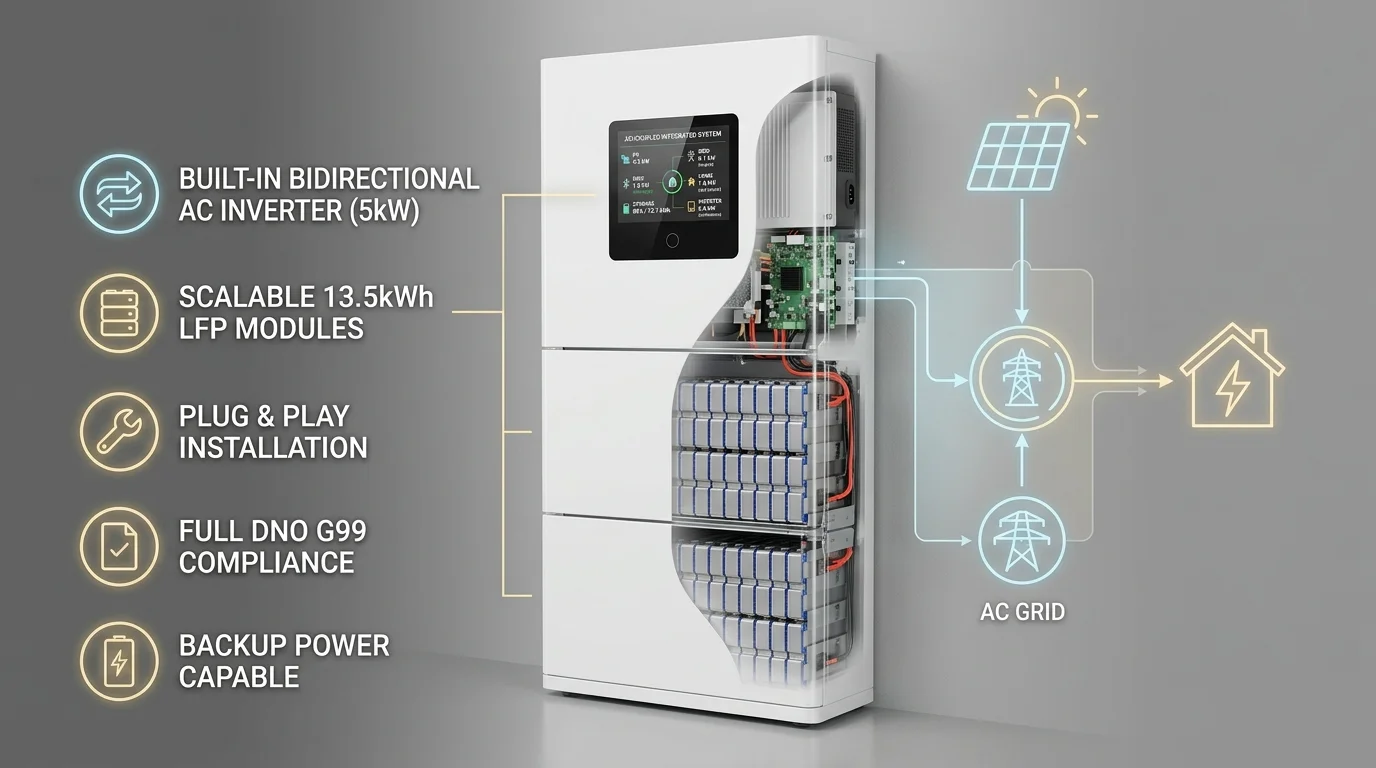
An integrated AC-coupled battery stacks cells, battery management and inverter in one enclosure that connects directly to the home's main consumer unit. For retrofits this is decisive: the existing solar inverter is untouched, and installers add storage on the AC side without re-stringing panels or matching DC voltage windows. The cost is physics. Energy from the roof is converted DC to AC by the solar inverter, then AC to DC to charge the cells, then back to AC on discharge. This double conversion can impose a 10% to 12% round-trip efficiency loss against a DC-coupled architecture, a penalty that compounds during grid-sourced overnight charging.
Continuous output is the specification that most often goes unexamined. An integrated inverter rated at 6 kW cannot carry a simultaneous EV charger, heat pump and electric shower, so the home draws the shortfall from the grid. An 11.5 kW unit can isolate the household through most peaks. The same ceiling governs arbitrage. A 13.5 kWh pack needs only about 2.7 kW to fill within a five-hour window such as Intelligent Octopus Go, so a single unit is rarely charge-limited. Modular stacks of 20 kWh or more approach 5 kW of sustained absorption once efficiency losses are included, and then inverter headroom matters.
| Platform | Usable Capacity | Continuous Output | Thermal Management | Chemistry |
|---|---|---|---|---|
| Tesla Powerwall 3 | 13.5 kWh | 11.5 kW | Liquid thermal management | LFP |
| GivEnergy All-In-One | 13.44 kWh | 6.0 kW | Active liquid cooling | LFP |
| Sigenergy SigenStor | 5.0 to 25.0 kWh (modular blocks) | 6.0 to 10.0 kW | AI heat dissipation | LFP |
Compliance favours integration. A single pre-certified hardware enclosure presents one set of type-test evidence to the distribution network operator (DNO) under the G98 and G99 frameworks, which standardises notification and commissioning records. A mix-and-match stack of separate inverters, batteries and controllers must demonstrate that the combined system behaves as certified, which adds paperwork and potential for rejected applications.
The Value Tier: Accessible & Modular Alternatives
Beneath the premium single-enclosure units sits a tier of modular bundles, where a separate battery tower and hybrid inverter are sold as a package. The specialised entry points range from the 1.28 kWh Daikcell ChargON 1280 to the 16.6 kWh GoodWe bundle.
| System | Capacity | Inverter | Scalability | Indicative Price |
|---|---|---|---|---|
| myenergi libbi 5.0kW Bundle | 5.0 kWh base | 5.0 kW hybrid | Up to 20 kWh | £2,400 to £2,666 |
| SolaX X1-IES All-in-One | 5.0 to 20.0 kWh stackable | 3 to 8 kW single-phase | Stackable modules | £2,559 to £3,428 |
| GoodWe 10kW Single-Phase Bundle | 16.6 kWh | 10 kW hybrid | Optimised for high-load larger homes | ~£5,896 |
| Daikcell ChargON 1280 | 1.28 kWh (1,280 Wh) | 1,100 VA | Fixed micro-capacity, wall-mounted apartment variant | Not supplied |
The compromise is physical. A modular bundle occupies two or more wall or floor positions, with inter-unit cabling and a larger commissioning footprint, whereas a single-enclosure premium system mounts as one certified item. That matters in tight garages and utility cupboards, and it is why the wall-mounted ChargON variant targets apartments, where floor space is the binding constraint.
The advantage emerges when solar is installed at the same time. A hybrid inverter manages both the PV strings and the battery, so the home does not need a separate standalone string inverter. This removes one major component and one set of installation labour, and because the array is DC-coupled to the battery, solar energy avoids the double-conversion penalty described above. Pricing in the matrix is indicative and should be verified with installers before specification.
For building services specifiers and property developers, the characterisation is straightforward: integrated units trade a measurable efficiency penalty for lower installation risk and cleaner compliance. Investors pursuing time-of-use arbitrage should model inverter capacity, not just storage capacity, against the tariff window and the household's peak loads.