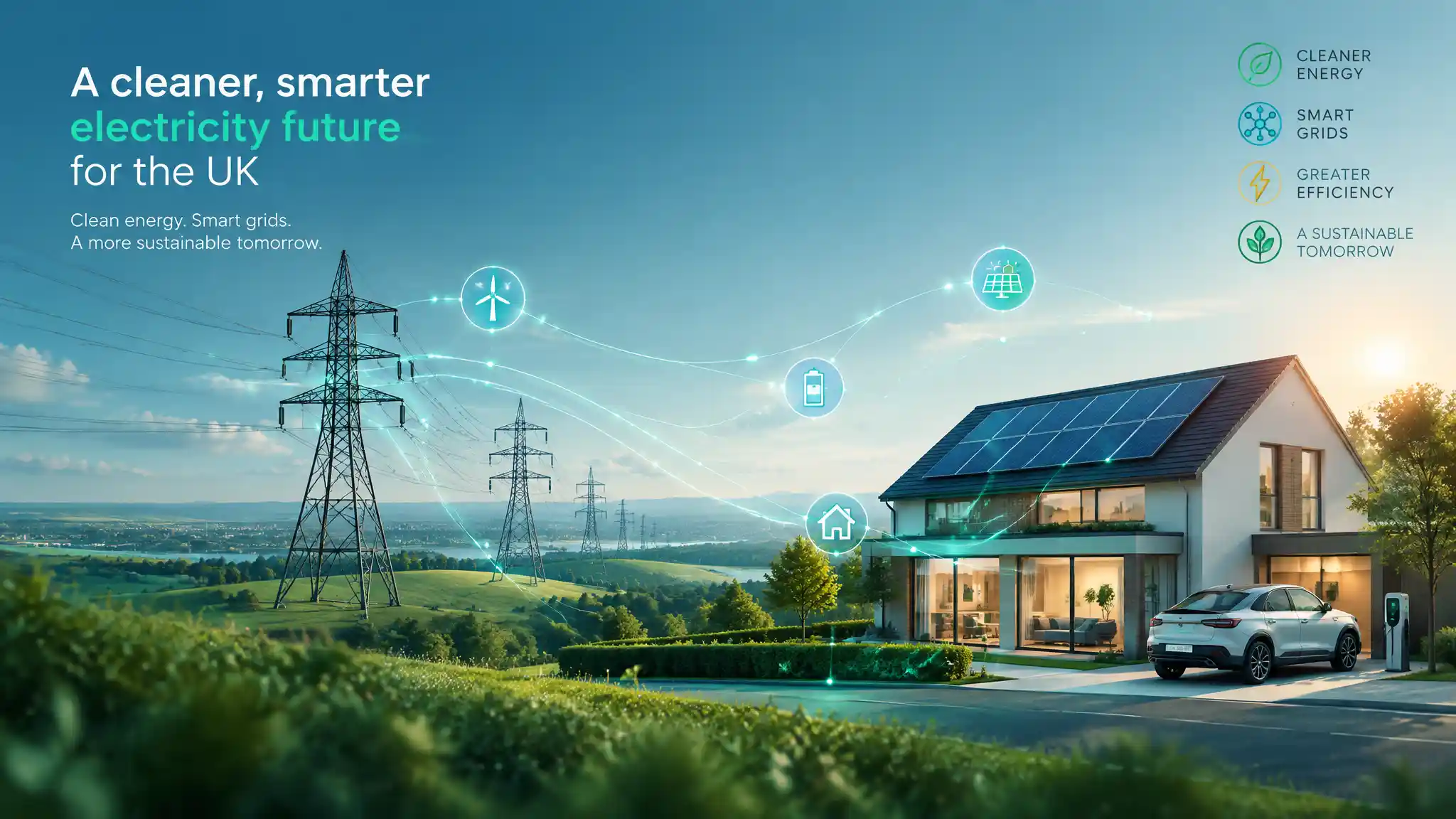
Great Britain keeps setting records it should be proud of. On a blustery day this year, wind turbines alone covered more than half the country's electricity demand. Solar farms across East Anglia and the South West are quietly beating forecasts. And yet your bill hasn't fallen to match — and if you're a developer trying to connect a new wind or battery project, you could be waiting 10 to 15 years just to get plugged in.
That's the paradox at the heart of Britain's energy transition. We're brilliant at generating clean power and increasingly bad at moving it to where it's needed. So what needs to happen to the UK grid to fix that?
The blunt answer: a rebuild on a scale not seen since the network was first built in the 1950s. Industry estimates for reaching a fully clean power system put the cost of rewiring the UK grid somewhere between £90bn and £240bn by 2035, depending on how ambitious the target and how fast it's delivered. It's a staggering number — but the cost of doing nothing, paid out in constraint fees and stalled decarbonisation, is arguably worse.
The £150bn Problem: Why Our Current Grid is Failing
Britain's electricity grid was designed for a different country. Coal and gas power stations sat in the Midlands and the North, and electricity flowed one way: down to the cities and industry of the South. It was a simple, top-down system.
That model is now backwards. Our biggest sources of clean power — offshore wind in the North Sea and around Scotland, solar farms across the southern counties — sit far from the cities that consume the most power. Meanwhile, millions of homes are becoming generators in their own right, sending solar power back into a network that was never built to receive it.
Today's grid needs to be:
- Bi-directional — able to handle power flowing from homes and farms back into the network, not just downstream from power stations.
- Decentralised — built around thousands of smaller generation points instead of a handful of giant plants.
- High-capacity — able to move huge volumes of Scottish wind power south without bottlenecking.
What is Wind Curtailment and Why Are You Paying For It?
Curtailment is what happens when a wind farm generates more power than the grid can physically carry away — so National Grid pays it to switch off. It sounds like a technical footnote. It isn't: it's already costing billpayers hundreds of millions of pounds a year.
The core issue is a transmission bottleneck between Scotland, where much of our newest wind capacity sits, and England, where most of the demand is. The connecting cables and pylons simply don't have enough spare capacity on a windy day.
So why does the UK grid limit renewable energy at exactly the moment it's cheapest and cleanest? Because the alternative is worse for grid stability — but the fix is expensive twice over, as we break down in our deep dive on the reality of wind curtailment. Billpayers fund the constraint payment to switch the wind farm off, and fund a gas plant closer to London to switch on and cover the shortfall. That double cost sits inside the "balancing costs" line on every energy bill in the country.
Cleaning Up the "Zombie Queue": Ofgem's Connection Reforms
Physical bottlenecks are only half the problem. The other half is administrative — and arguably just as damaging.
For years, any project wanting to connect to the grid joined a strict first-come-first-served queue. The trouble is, that queue filled up with speculative "zombie projects" — schemes with a grid application but no planning permission, no land rights, and sometimes no real intention of being built. They still hold a place in line, blocking genuinely ready wind, solar and battery storage projects behind them.
The result: over 750GW of projects sitting in the connection queue, several times more than Britain will ever need, while viable schemes wait years for a grid date. This is the exact problem the UK grid connection queue reform rolling out through 2026 is designed to solve.
How the TMO4+ System Prioritises Ready Projects
So what is TMO4+ grid reform in practice? Think of it as a bouncer replacing a queue that used to run purely on "first in line." Rather than working strictly by application date, the National Energy System Operator (NESO) now checks projects against real-world milestones — land rights secured, planning consent progressing, finance in place — at set checkpoints.
Miss your milestone, and you lose your place. That frees up capacity for shovel-ready projects to leapfrog stalled ones, which is exactly why NESO has already been able to offer earlier connection dates to thousands of megawatts of viable wind, solar and battery capacity since the reform began.
The Infrastructure Roadmap: Pylons, Subsea Cables, and Home Batteries
Fixing the queue only helps if there's physical wire to connect to. That's where National Grid's Great Grid Upgrade comes in — the biggest overhaul of Britain's transmission network in generations.
The National Grid Great Grid Upgrade cost runs into the tens of billions of pounds and covers work including:
- High-voltage subsea cables, like the Eastern Green Link projects, which carry power directly from Scotland to England under the North Sea — sidestepping years of onshore planning disputes over new pylons.
- New and upgraded pylons and substations across the existing overhead network, widening the pipe for renewable power heading south.
- Smarter local substations and transformers, run by regional distribution networks, to cope with millions of new heat pumps and EV chargers switching on every evening.
The Prosumer's Role: Your Home as Part of the Grid
Here's the genuinely hopeful part. If you own a solar battery, a heat pump, or an EV, you're not just a bystander in this rebuild — you're part of the solution.
Grid-Enhancing Technologies (GETs) — software and hardware that squeeze more capacity out of existing cables — are being rolled out alongside demand-side response schemes that pay households to shift or reduce usage at peak times.
Your home battery or EV can already act as a tiny power plant. Charge it with cheap overnight or midday solar power, and either use it to avoid peak-rate electricity later, or export it back to the grid at a premium during a demand spike. Multiply that by a few million households, and you get a genuine "virtual power plant" — flexible capacity that reduces the need for new gas peaker plants and eases pressure on local substations, without a single new pylon.
Looking Ahead: A Grid Built for the 2030s
The Great Grid Upgrade is a decade-long programme, with major subsea links and reinforced substations landing through the early 2030s. It won't fix curtailment or the connection queue overnight — but combined with TMO4+ style reforms, it's the first roadmap that actually matches ambition with delivery.
The payoff, when it lands, is bigger than fewer constraint payments. An agile, digitised, bi-directional grid is the foundation for genuinely smart time-of-use tariffs — where charging your EV, running your heat pump, or exporting your battery at exactly the right moment becomes the easiest way to cut your bill. Britain's grid problem is real and expensive. It's also, finally, being treated as fixable.