Picture a storm-force day on the Scottish coast. The turbines should be spinning flat out — this is exactly the weather they're built for. Instead, half of them stand completely still.
It's one of the strangest sights in UK energy, and it raises an obvious question: why do wind turbines stop spinning on the windiest days of the year? The answer isn't mechanical. It's wind curtailment — and it's become one of the biggest friction points in decarbonising the UK electricity grid.
In simple terms, we're generating more clean power than the wires can carry. And billpayers are footing the bill for that bottleneck, twice over.
What is Wind Curtailment? The Physics of a Bottleneck
Think of the grid as a garden hose trying to empty a swimming pool. However much water is in the pool — however hard you want it to drain — the hose can only carry so much at once. Pour in more than the hose can handle, and the excess has nowhere to go.
That's curtailment. Wind is the water; the transmission network is the hose. On a calm day, supply and hose capacity match up fine. On a storm-force day, supply massively outstrips what the pipe can carry south.
The geography makes this worse. Scotland holds the vast majority of the UK's onshore wind capacity and is rapidly adding offshore wind off its coasts. But the biggest demand centres — London, the Midlands, the South East — sit hundreds of miles away.
The critical chokepoint is what engineers call the B4 boundary constraint on the National Grid transmission network: the electrical border roughly between southern Scotland and northern England, where the cables carrying power south are already running close to their physical limit. Clearing that bottleneck for good is exactly the challenge our macro look at rewiring Britain's grid sets out to solve. When wind generation north of that boundary exceeds what the boundary can transmit, something has to give.
The Economics of Wasted Energy: Understanding Constraint Payments
This is where UK wind farm constraint payments come in, and the mechanism is almost absurd once you see it written down.
- National Grid identifies that Scottish wind output will exceed the B4 boundary's capacity.
- It pays the affected wind farms to switch off, compensating them for the electricity they would have generated.
- It then pays a gas-fired power station further south — closer to demand — to switch on and cover the shortfall.
Two separate payments, for the same megawatt hour: one to not generate clean power, another to generate dirtier power instead. Both costs land in National Grid's balancing and constraint budget.
And that budget isn't absorbed quietly. Balancing and constraint costs are recovered through network charges, a fixed line item on every household energy bill. Recent years have seen the UK spend well over £1bn annually on balancing actions, with wind curtailment consistently one of the largest single contributors. It's a real, measurable tax on an unfinished grid.
Fixing the Leak: How the UK Grid Can Stop Wasting Wind
None of this is permanent. There's a clear, funded roadmap to eliminate curtailment — it just needs to be built faster than wind capacity keeps growing.
- Subsea superhighways. High Voltage Direct Current (HVDC) links like Eastern Green Link 1 and 2 run under the North Sea, carrying Scottish wind power straight to English demand centres and bypassing the congested B4 boundary entirely. No new pylons, no onshore planning fights — just a wider pipe.
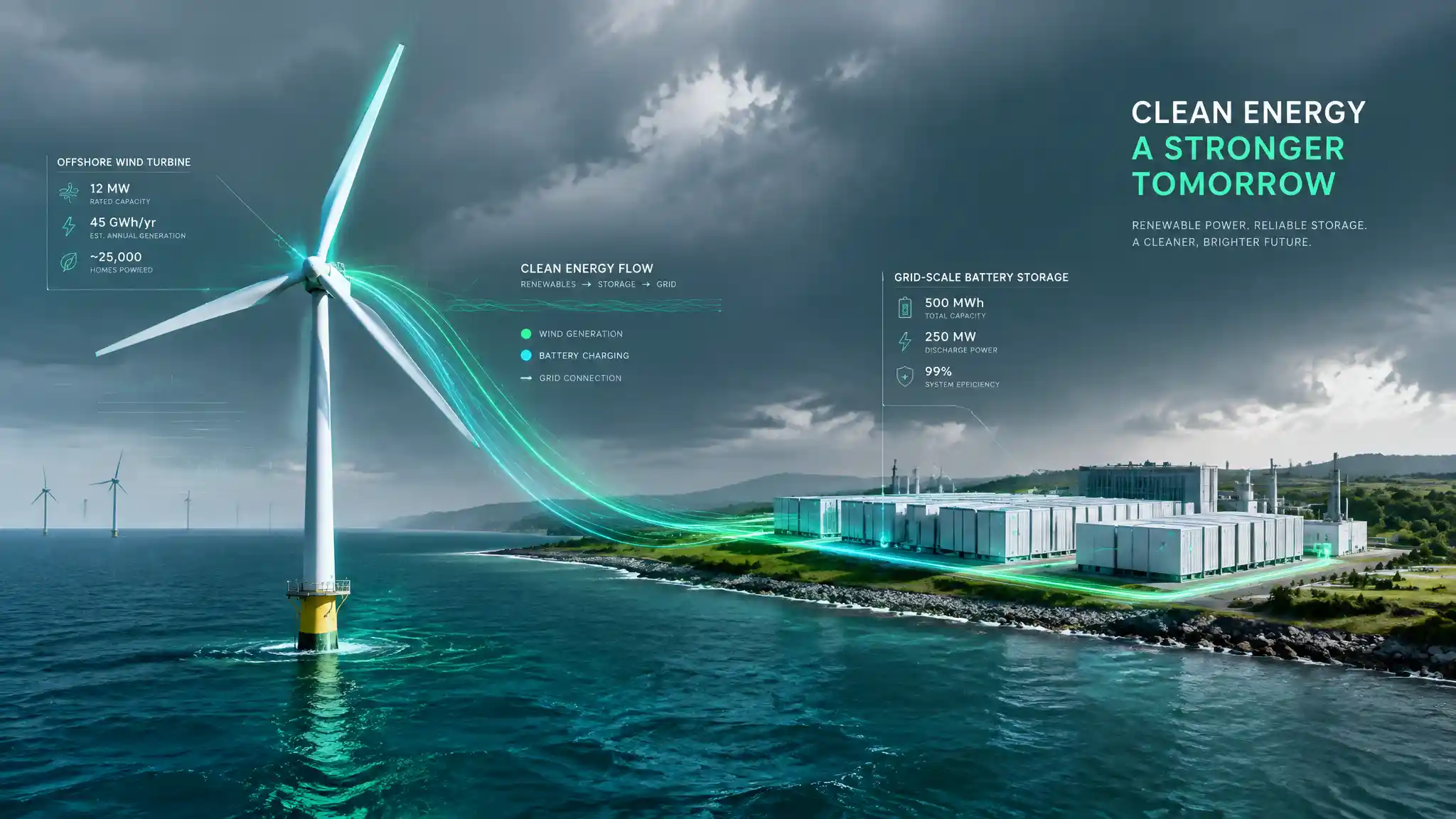
- Grid-scale battery storage. Deploying grid-scale battery storage across the UK lets the network capture excess wind the instant it's generated and discharge it hours or days later when wind speeds drop. A battery next to a constrained substation turns "wasted" power into stored power.
- Localised industrial demand. Rather than moving every electron south, some of it could be used where it's made. Green hydrogen electrolysers or data centres built next to Scottish wind landfall sites could soak up excess generation on-site, turning a curtailment problem into an industrial opportunity.
Conclusion: A Flexible Future
Curtailment isn't a sign that wind power doesn't work. It's a sign that the grid built to carry it hasn't caught up yet.
A genuinely decarbonised grid can't just keep building turbines. It has to master flexibility — more transmission capacity, more storage, and demand that can move to where the power already is. Solve that, and curtailment stops being an annual bill-inflating footnote and starts being a solved problem. Billpayers save money, and the wind Britain is already generating actually gets used.