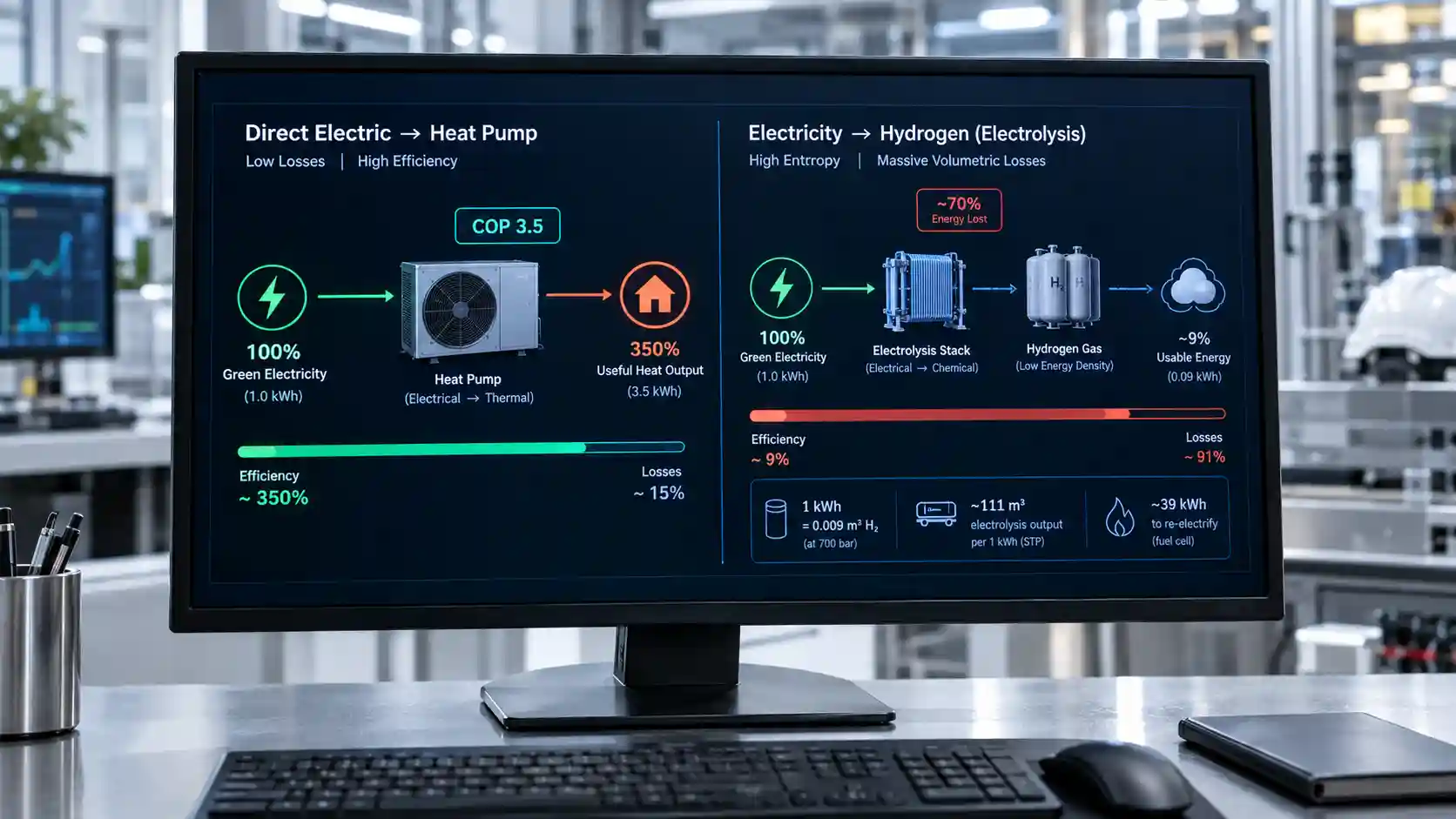
Hydrogen for domestic space heating has an obvious political appeal. The United Kingdom has a gas distribution network serving roughly 23 million homes, a workforce skilled in boiler installation and servicing, and a population accustomed to heating on demand with a flame. A zero-carbon molecule that could flow through the same pipes and burn in a similar appliance promises decarbonisation without disrupting the familiar arrangement. The difficulty is that the proposal is assessed on narrative convenience, not on thermodynamics. Heat is the lowest-grade form of useful energy, and the choice of how to deliver it is governed by conversion efficiencies that no policy preference can alter.
This audit follows a single unit of renewable electricity through each route to the radiator. It quantifies the losses in electrolysis, compression, transport and combustion; contrasts the resulting system efficiency with the physics of a heat pump; examines the materials and flow constraints of moving hydrogen through legacy gas infrastructure; and models the tariff implications for consumers and asset networks. It is written for infrastructure energy planners, building services engineers and sustainability policy advisors who must decide where limited clean energy and capital are best deployed.
The multi-stage entropy penalties of the hydrogen chain
Starting point: one kilowatt-hour of renewable electricity
Green hydrogen is produced by splitting water using renewable electricity. The comparison with direct electrification is therefore clean and unambiguous: both routes start with the same input, one kilowatt-hour of zero-carbon electricity delivered at the generator or grid connection. The question is how much useful heat reaches the occupied space at the end of each chain. Every conversion step in the hydrogen route extracts a fraction of the energy, and the losses are multiplicative, not additive.
Stage one: PEM electrolysis
Proton exchange membrane (PEM) electrolysers pass current through water across a polymer electrolyte membrane, producing hydrogen at the cathode and oxygen at the anode. The thermodynamic minimum energy to split water, expressed against the higher heating value of hydrogen, corresponds to a theoretical cell voltage of about 1.48 V. Real cells operate at 1.7 to 2.0 V and above under load because of activation overpotentials at the catalysts, ohmic resistance in the membrane and interfaces, and mass transport limitations at high current density. System-level efficiency, which also includes power electronics, water purification, cooling and control, typically falls between 60 and 70 per cent on a lower heating value (LHV) basis for current commercial equipment, with figures declining as stacks age and degrade.
Taking a representative 67 per cent, one kilowatt-hour of electricity yields approximately 0.67 kWh of hydrogen energy content. A third of the original input has already been dissipated as waste heat, and the electrolyser has not yet produced a single unit of useful heat for a building.
Stage two: compression and conditioning
Hydrogen has extremely low volumetric energy density. At atmospheric pressure it contains about 3 MJ per cubic metre, roughly a third of natural gas. To be transported and stored in useful quantities, it must be compressed or liquefied. Compression to pipeline pressure is a lesser burden than compression to storage pressure of 200 to 700 bar, but electrolyser output often has to be compressed, dried and purified before entering the network. Mechanical compression is intrinsically irreversible; hydrogen's low molecular mass and high specific heat ratio mean that compressors require substantial work per unit of energy delivered, and isothermal compression is impractical at scale. Typical compression energy ranges from 5 to 10 per cent of the hydrogen's energy content for pipeline pressures, and substantially more for high-pressure storage. Liquefaction, where used, consumes 25 to 35 per cent of the contained energy.
Applying a conservative 7 per cent compression and conditioning loss leaves about 0.62 kWh of hydrogen energy available to the transport network.
Stage three: storage, transport and leakage
Domestic heating demand is intensely seasonal. A winter peak in the UK is many times the summer baseline, while renewable generation and electrolyser output do not follow the same profile. Supplying heating demand at scale therefore requires large-scale storage, in salt caverns or similar geological formations, with further compression and conditioning on injection and withdrawal. Each cycle adds energy overhead and carries leakage risk.
Hydrogen is the smallest molecule and diffuses readily through seals, joints, valves and elastomers. Leakage rates in transmission and distribution networks are uncertain, but even rates of one to two per cent represent a measurable loss and a significant indirect climate concern: hydrogen is an indirect greenhouse gas, extending the atmospheric lifetime of methane and contributing to tropospheric ozone and stratospheric water vapour. A modest 2 per cent combined leakage and storage loss leaves around 0.61 kWh at the point of use.
Stage four: combustion in the domestic boiler
Hydrogen boilers burn the gas with air to produce heat and water vapour. A condensing hydrogen boiler can reach efficiencies of 90 to 95 per cent on an LHV basis, comparable to modern natural gas condensing boilers, provided return water temperatures are low enough to condense the exhaust vapour. In practice, many existing wet heating systems operate at flow and return temperatures that limit condensation, reducing seasonal efficiency. Applying 92 per cent gives about 0.56 kWh of useful heat delivered to the building from the original kilowatt-hour.
The overall chain efficiency is therefore the product of the stage efficiencies: 0.67 multiplied by 0.93, by 0.98, by 0.92, approximately 0.56. Under optimistic assumptions, the figure rises to 0.65 to 0.70. Under realistic network conditions, with imperfect electrolyser load factors and seasonal storage, it can be lower. The brief figure of below 60 to 70 per cent is, if anything, generous to hydrogen.
Heat pump thermodynamics: why the comparison is not close
Moving heat versus making heat
A boiler, whether fuelled by natural gas or hydrogen, converts chemical energy into heat through combustion. Its efficiency is bounded by the energy content of the fuel: even a perfect device cannot deliver more than 1 kWh of heat per kWh of fuel burned. A heat pump operates on an entirely different principle. It does not generate heat from its input energy; it uses the input energy to move heat from a low-temperature source to a higher-temperature sink.
The refrigeration cycle that achieves this is a vapour-compression loop. A refrigerant evaporates at low pressure, absorbing heat from outside air, which even at 0 degrees Celsius contains substantial thermal energy relative to the refrigerant's boiling point. A compressor raises the refrigerant to high pressure and temperature. The hot vapour condenses in a heat exchanger, releasing its latent heat into the heating circuit. An expansion valve reduces pressure, and the cycle repeats. The electrical energy consumed by the compressor accounts for only part of the heat delivered; the remainder is ambient heat harvested from the environment.
The coefficient of performance and the Carnot limit
The coefficient of performance (COP) is the ratio of heat delivered to electrical energy consumed. The theoretical maximum, the Carnot COP, equals the sink temperature divided by the temperature difference between sink and source, expressed in kelvin. For a source at 275 K (about 2 degrees Celsius) and a sink at 308 K (35 degrees Celsius, typical of underfloor heating), the ideal COP is 308 divided by 33, about 9.3. Real machines achieve a fraction of this, commonly 40 to 50 per cent of Carnot, giving instantaneous COPs of around 4 to 4.5 at those conditions.
Raising the delivery temperature to 50 or 55 degrees Celsius for conventional radiators lowers the Carnot ceiling and the real COP, typically to 2.5 to 3.2. Averaged across a heating season, with variable outdoor temperatures and defrost cycles, well-designed UK installations deliver a seasonal coefficient of performance (SCOP or SPF) of 3.0 to 4.0. For the starting kilowatt-hour of electricity, the heat pump therefore delivers 3.0 to 4.0 kWh of heat, minus a small allowance for transmission and distribution losses in the electricity network of about 6 to 8 per cent, giving roughly 2.8 to 3.7 kWh at the radiator.
The 1.0 barrier
A hydrogen boiler can never exceed a 1.0 COP at the point of use, because it burns fuel and cannot harvest ambient heat. When the upstream chain is included, the effective COP is about 0.56, meaning that the building receives roughly half a unit of heat for every unit of electricity consumed. The heat pump delivers around 3.2 units on the same basis. The difference is a factor of five to seven in heat delivered per unit of primary electricity, or equivalently, the hydrogen route consumes five to seven times more renewable electricity to heat the same space.
This is not an engineering shortcoming that better equipment will close. The hydrogen chain is limited by the second law at each conversion step and by the first law of combustion at the end. The heat pump is not limited by the 1.0 barrier because it is a heat mover. Improvements in electrolyser efficiency from 67 to 75 per cent would shift the system figure from 56 to roughly 63 per cent, an improvement that does not alter the order-of-magnitude gap.
| Parameter | Green hydrogen boiler | Air source heat pump |
|---|---|---|
| Energy Vector Path | Renewable electricity, electrolysis, compression, storage, gas network transport, boiler combustion, radiator. | Renewable electricity, electricity network, heat pump compressor, heating circuit, radiator or underfloor emitter. |
| Primary Conversion Mechanism | Electrochemical water splitting followed by exothermic oxidation of hydrogen; heat is generated from fuel. | Vapour-compression refrigeration cycle; heat is moved from ambient air to the building using a phase-changing refrigerant. |
| Round-Trip System Efficiency | Approximately 50 to 65 per cent (an effective COP of about 0.5 to 0.65 against input electricity). | Approximately 280 to 370 per cent (a seasonal COP of 3.0 to 4.0, less network losses). |
| Relative Primary Energy Input Multiplier | Approximately 5 to 7 times the electricity needed per unit of delivered heat. | Baseline of 1 times. |
| Local Distribution Network Infrastructure Friction | High: pipeline conversion or replacement, joint and seal upgrades, leak detection, appliance replacement and large-scale storage. | Moderate: electrical network reinforcement, property fabric upgrades and emitter changes in some dwellings. |
The figures in the matrix are indicative ranges. The core conclusion is insensitive to the precise numbers: for every plausible set of assumptions, delivering heat via hydrogen requires several times more renewable electricity than delivering it via a heat pump.
Gas network transport and materials engineering constraints
Hydrogen embrittlement
Hydrogen interacts with metals in ways that natural gas does not. Atomic hydrogen, formed at metal surfaces by dissociation of molecular hydrogen, diffuses into the crystal lattice of steel and accumulates at defects, grain boundaries and regions of high stress. It can reduce ductility, lower fracture toughness and accelerate fatigue crack growth, a family of effects known as hydrogen embrittlement. The risk depends on steel grade, microstructure, hardness, operating pressure, stress cycling and hydrogen partial pressure. High-strength steels and welds with hard heat-affected zones are particularly vulnerable.
The UK distribution network has been progressively replaced with polyethylene pipe under the iron mains replacement programme, which substantially reduces the embrittlement concern at distribution level. Polyethylene is not susceptible to embrittlement in the way steel is, though permeation through the pipe wall is higher for hydrogen than for methane. The higher-pressure transmission network, however, relies largely on steel, and conversion of these assets requires assessment of each pipeline segment, potentially including de-rating of operating pressure, fracture toughness testing and replacement of vulnerable sections.
Leakage through joints, seals and appliances
Even where pipe materials are compatible, networks contain a large number of joints, valves, regulators, meters and elastomeric seals designed for natural gas. Hydrogen's small molecular size and low viscosity increase volumetric leak rates through imperfect seals. Studies suggest that leakage rates through a given leak path can be several times higher on a volumetric basis than for methane, although the energy lost per unit of leaked volume is lower because of hydrogen's lower energy density. Inside the home, the same applies to internal pipework, gas meters, isolation valves and appliance connections.
Leakage has safety as well as efficiency implications. Hydrogen has a very wide flammability range in air, approximately 4 to 75 per cent by volume, compared with about 5 to 15 per cent for methane. Its minimum ignition energy is roughly an order of magnitude lower, and its flame is nearly invisible in daylight. Detection technology, odorisation methods and ventilation requirements all require adaptation. Domestic installers would need new competence and certification, and existing gas safety regimes would need to be revised.
Volumetric flow and energy density
Because hydrogen has a volumetric energy density roughly one third that of natural gas at the same pressure, delivering the same thermal power requires about three times the volumetric flow. A pipeline designed for natural gas will have a lower energy throughput when carrying pure hydrogen at the same pressure, even though hydrogen's lower density allows higher velocity. In practice, the energy capacity of an existing pipe falls to something like 80 per cent of the natural gas figure for the same pressure drop, because higher velocity increases frictional losses, while the volumetric demand on the network is roughly three times higher.
This has consequences for compression. A network moving three times the volume at higher velocity requires more compression energy, more compressor stations and potentially larger pipe diameters in constrained segments. Metering also needs replacement, since existing meters calibrated for methane do not accurately record hydrogen volumes. Billing, safety systems and network control would all need reengineering.
Appliance and system conversion
The household end of the chain requires its own conversion. Hydrogen burns with a different flame speed, temperature and combustion characteristics than methane. Boilers need burners, controls and flame detection redesigned for hydrogen, and cookers, fires and other appliances on the same supply would require replacement or conversion. A national conversion programme would demand a coordinated cut-over of entire network zones, because mixed supply is operationally difficult. The scale of this logistical challenge is far greater than the incremental installation of heat pumps in individual dwellings.
Seasonal storage and the supply problem
Supplying hydrogen to meet winter heating demand requires large-scale seasonal storage. Salt cavern storage is geographically constrained, concentrated in particular regions of the UK, while heating demand is national. Electrolyser capacity needs to be sized for the peak production rate that storage and transport allow, but the equipment will operate with a low annual load factor if it follows surplus renewable generation, driving up the capital cost per unit of hydrogen produced. Conversely, running electrolysers at a high load factor requires continuous electricity supply, which then competes with other uses of clean power.
Macro-economic and consumer tariff implications
Energy cost per unit of delivered heat
The cost to a household of heating depends on the price of the delivered energy and the efficiency of conversion. If wholesale renewable electricity costs a given amount per kWh, then the electricity cost of producing hydrogen is that price divided by the chain efficiency, before adding capital and operating costs of electrolysers, compressors, storage and the network. At a system efficiency of about 56 per cent, the electricity input cost alone per kWh of heat is 1.8 times the electricity price. The heat pump, at a COP of 3.2, requires 0.31 times the electricity price per kWh of heat. The ratio of input energy costs is therefore around 5.7 to 1 in favour of the heat pump.
To this must be added the additional cost layers specific to hydrogen: electrolyser capital cost amortised over a limited number of full-load hours, compression and storage infrastructure, network conversion and ongoing operating cost, the cost of safety systems and certification, and the cost of appliance replacement. These are significant, and in most credible scenarios push the delivered hydrogen price well above that of natural gas and many multiples above that of electricity used in a heat pump. Even where the electricity price for hydrogen production is assumed to be very low, because it uses surplus generation, the capital recovery problem remains.
Illustrative running cost model
Consider a home requiring 12,000 kWh of heat per year. With a heat pump at a SCOP of 3.2, the electricity requirement is 3,750 kWh. At an electricity unit price of 25 pence per kWh, annual heating cost is approximately 940 pounds. For the same home using hydrogen, the delivered fuel requirement at a boiler efficiency of 92 per cent is about 13,040 kWh of hydrogen. If the delivered hydrogen price were 15 pence per kWh, an optimistic assumption relative to many published estimates, the annual cost would be roughly 1,960 pounds. At 20 pence per kWh, it would be about 2,610 pounds. The point is not the precise values but the structure of the result: unless hydrogen can be delivered at a price below roughly 7 pence per kWh, which would require a price for the underlying electricity far below any prevailing level, the hydrogen household pays more for the same warmth.
The permanent tariff penalty
This is not a transitional cost that falls with scale. The efficiency chain is physical and permanent. Learning curves can reduce capital cost and incrementally improve electrolyser efficiency, but they cannot remove the multiplication of conversion losses, nor the requirement that hydrogen production consume several times as much electricity as direct use. As long as electricity is the underlying scarce resource, the hydrogen household effectively subsidises its inefficiency in every bill, for the full operating life of the installation.
For corporate asset networks, including housing associations, local authorities and commercial landlords, the same arithmetic applies at scale. A portfolio heated with hydrogen carries a persistent premium in operating cost, a heavier exposure to hydrogen commodity price volatility and a stranded-asset risk if policy changes. Fuel poverty exposure is also affected: lower-income households would face the highest burden of an expensive heating fuel, with limited ability to switch.
System-level resource implications
At national scale, the electricity requirements are decisive. If UK domestic heating demand is of the order of 300 TWh of heat per year, delivering it via heat pumps at a SCOP of about 3 requires roughly 100 TWh of electricity. Delivering the same heat via hydrogen at 56 per cent chain efficiency requires over 500 TWh of electricity, which is more than the entire current UK electricity consumption of around 270 to 300 TWh. The additional generation, grid reinforcement and storage needed would be a gigantic infrastructure project, absorbing capital and clean power that could otherwise decarbonise transport, industry and other applications for which no direct electrification alternative exists.
Where hydrogen does belong
None of this implies that hydrogen has no role in a decarbonised energy system. It has strong applications in sectors where direct electrification is difficult: industrial feedstocks such as fertiliser and refining, steelmaking, long-duration seasonal storage for the power system, long-haul shipping and aviation fuels, and certain high-temperature industrial heat processes. In these applications, there is no heat pump equivalent, and the efficiency penalty of hydrogen is the cost of achieving what cannot be done otherwise. The thermodynamic audit does not condemn the molecule; it condemns its deployment in a low-temperature application where a vastly more efficient alternative exists.
Prioritisation is therefore the key policy concept. Limited quantities of green hydrogen should be allocated to uses where its value is highest. Space heating, where heat pumps deliver three to four times the energy service per unit of electricity, is at the bottom of that ranking.
Recommendations for planners, engineers and policy advisors
- Apply an end-to-end efficiency test. Evaluate every heating pathway on delivered heat per unit of primary clean electricity, not on equipment efficiency alone.
- Prioritise heat pumps for building heat. Concentrate hydrogen policy and investment on industrial, storage and transport applications where alternatives are limited.
- Invest in building fabric and low-temperature emitters. Reducing heat demand and flow temperatures improves heat pump SCOP and reduces the required generation and network capacity.
- Reinforce the electricity network. Plan distribution upgrades and flexible demand-side management as the principal enabling infrastructure for domestic heating.
- Model tariffs transparently. Publish full lifecycle cost comparisons, including conversion, storage and safety costs, so households and asset owners can assess risk.
- Treat hydrogen-ready labelling with caution. A boiler capable of burning hydrogen does not create a supply of affordable hydrogen to the dwelling, and should not be a basis for deferring the installation of low-carbon heating.
Conclusion: the thermodynamic audit is decisive
Hydrogen combustion for domestic space heating fails the audit on the oldest and least negotiable criterion in engineering: energy conservation and the direction of entropy. A kilowatt-hour of renewable electricity converted to hydrogen, compressed, transported, stored and burned yields roughly half a kilowatt-hour of useful heat. The same kilowatt-hour driven through a heat pump yields three to four. Network materials constraints, leakage and safety issues, and the cost of converting infrastructure and appliances add to the burden, and the resulting tariff penalty is permanent because it arises from physics rather than immaturity.
For infrastructure energy planners, building services engineers and sustainability policy advisors, the sensible course is to direct scarce clean electrons and hydrogen molecules where each does the most work. In buildings, that means efficiency, electrification and heat pumps. Hydrogen should be reserved for the hard-to-abate sectors where its inefficiency is the price of decarbonisation that no alternative can deliver.