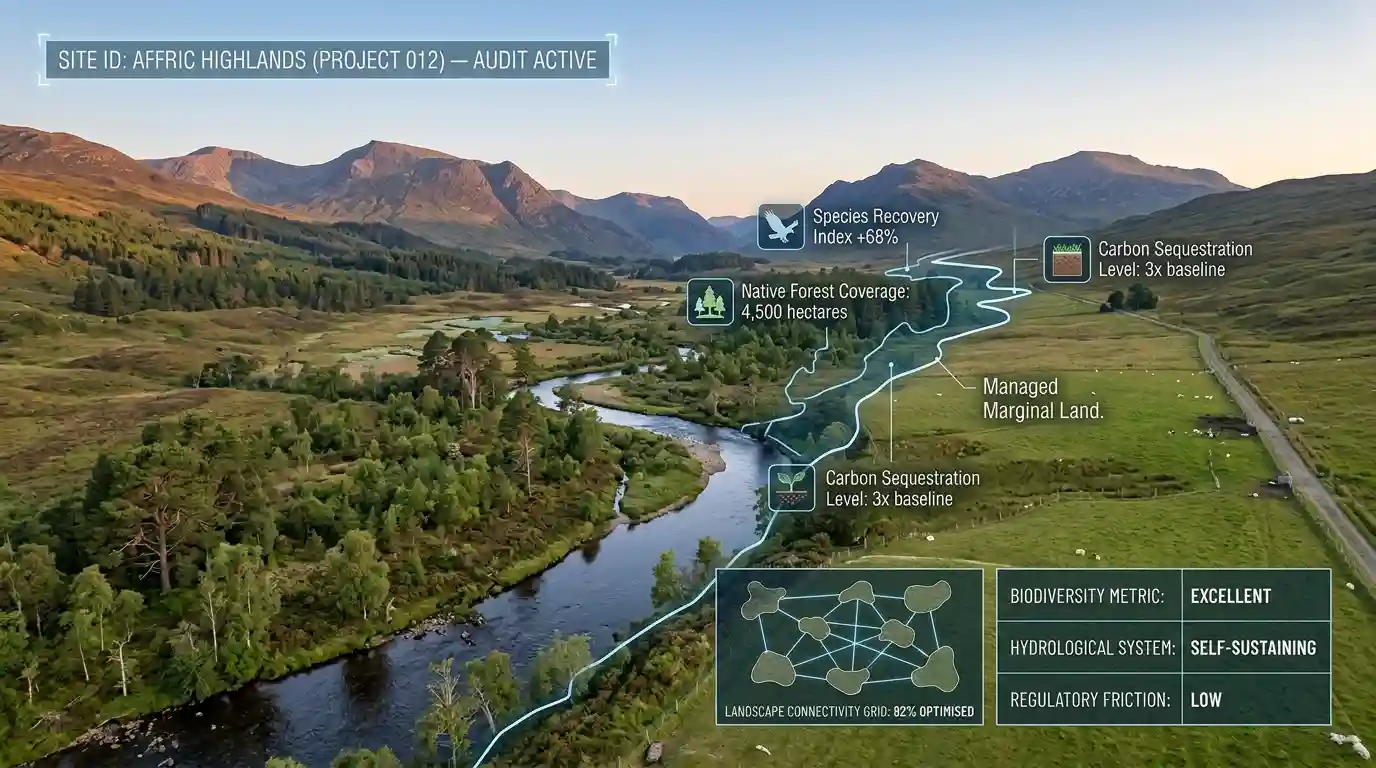
Rewilding in the United Kingdom is frequently presented as a cultural or ecological aspiration. For ecological investors, carbon offset specifiers and macro environmental system analysts, a more useful framing is that of infrastructure: a distributed network of natural assets that sequesters carbon, regulates water, supports biodiversity and, if correctly configured, does so at a lower life-cycle cost than most engineered alternatives. This audit evaluates the empirical evidence, separates mature performers from early-stage projects and maps the structural frictions that determine whether the network can scale.
Land-use opportunity cost and the carbon arithmetic
Land is finite, and every hectare allocated to one purpose is withdrawn from another. The relevant comparison for marginal agricultural land, typically low-yield pasture or arable land with poor soils, is between rewilding and the alternative productive uses, including energy crops such as oilseed rape and sugar beet for first-generation biofuels.
Rewilding scrubland and wood-pasture sequesters carbon natively, through the accumulation of woody biomass above ground and through the gradual build-up of soil organic carbon below it. Rates vary widely with climate, soil and stage of succession. As an order-of-magnitude guide, naturally regenerating scrub and young woodland on lowland sites may sequester in the region of 3 to 10 tonnes of carbon dioxide per hectare per year during the early decades, with mature native woodland holding a far larger standing stock, while upland peatland restoration primarily avoids ongoing emissions from degraded peat that can be substantial. Even at a conservative mid-range figure of 5 tonnes per hectare per year, a 1,000-hectare site would offset approximately 5,000 tonnes annually with minimal operational input.
The comparison with biomass energy crops is unfavourable to the latter. Energy crops require annual cultivation, fertiliser, machinery, harvesting, transport and refining. Each stage consumes fossil energy and emits greenhouse gases, including nitrous oxide from nitrogen fertiliser. When the full life-cycle is counted, the net carbon benefit per hectare of first-generation biofuels is small and sometimes negative, and the process remains subject to the catastrophic land-use and processing costs that erode its viability. Rewilding bypasses those costs entirely: there is no harvest, no refinery and no logistics chain. The ecosystem performs the sequestration, and the only recurring costs are monitoring, boundary management and, where necessary, grazing or population management.
Rewilding also offers co-benefits that biomass cannot match, including flood attenuation, water quality improvement, pollinator habitat and resilience to climate extremes. These do not appear in simple carbon accounting, but they carry measurable financial value, for example in avoided downstream flood damage and water treatment costs, and will increasingly be priced through natural capital markets. The correct metric for investors is therefore carbon plus ecosystem services per hectare, over a full time horizon, and on that basis the opportunity cost of rewilding marginal land is low.
The scale spectrum: is it working?
The UK now hosts over 100 projects identified by Rewilding Britain, and their performance is not uniform. A clear spectrum separates mature projects that have re-established functional ecological processes from early-stage or fragmented projects still struggling with low connectivity.
| Project tier type | Core representative site example | Total estimated scale | Primary carbon / ecological mechanism | Structural system vulnerability |
|---|---|---|---|---|
| Mature lowland pioneer | Knepp Estate, West Sussex | Approximately 1,400 hectares | Free-roaming herbivore grazing creating wood-pasture, scrub and wetland mosaics; soil carbon accumulation and rapid biodiversity recovery. | Isolated by surrounding intensive farmland; limited wildlife corridors; dependent on a single landowner model. |
| Upland landscape-scale network | Cairngorms Connect, Scottish Highlands | Tens of thousands of hectares (approximately 60,000) | Native woodland regeneration, peatland restoration and restored hydrology across contiguous upland habitats. | Deer pressure management; grazing and sporting estate economics; slow growth rates at altitude. |
| Emerging Highland catchment project | Affric Highlands, Scottish Highlands | Several thousand hectares in the core, with a long-term catchment-scale ambition | Natural regeneration of Caledonian pinewood and montane scrub, plus riparian and peat restoration. | Long time horizon to measurable sequestration; reliance on deer control and community consent. |
| Early-stage or fragmented project | Smaller sites within the wider Rewilding Britain network of over 100 projects | Individual sites from tens to hundreds of hectares | Localised habitat recovery and species reintroduction; modest standalone carbon uptake. | Low connectivity, boundary fragmentation, insufficient scale for ecosystem engineers and minimal habitat continuity. |
The Knepp Estate in West Sussex is the benchmark. Since ending intensive arable and dairy production in the early 2000s, its roughly 1,400 hectares have been managed through the free-roaming grazing of livestock proxies for extinct herbivores. The result is a mosaic of wood-pasture, scrub and wetland that has produced breeding populations of species such as turtle doves and nightingales, along with notable increases in soil carbon and invertebrate diversity. Knepp demonstrates that natural processes can be restored on formerly heavily farmed land within two decades.
In the Highlands, Cairngorms Connect and Affric Highlands illustrate rewilding at a landscape scale. Cairngorms Connect, a partnership of neighbouring landowners managing a contiguous area of tens of thousands of hectares, has pursued native woodland regeneration, peatland restoration and the re-establishment of natural hydrological systems, including the restoration of river processes. Affric Highlands is pursuing a similar catchment-scale ambition, with Caledonian pinewood and montane scrub regenerating where deer numbers have been reduced. In both cases, continuity of habitat, the key success factor, allows ecological processes to operate across ecosystem boundaries.
At the other end of the spectrum, many smaller or fragmented projects lack the scale to support wide-ranging species or ecosystem engineers. Their individual carbon yields are modest, their populations are vulnerable to local extinction and their ecological outcomes depend heavily on the condition of surrounding land. The empirical lesson is that the benefits of rewilding scale non-linearly with area and continuity: a connected 10,000-hectare landscape typically delivers far more than ten isolated 1,000-hectare blocks.
Core system friction points
The principal constraints on rewilding are not biological. Nature recovers readily when given space. The frictions are legal, economic and physical.
Fragmented boundaries. UK land ownership is highly divided, and the typical farm holding is small relative to the home range of many target species. Fences, roads and intensively managed fields isolate wildlife pools, limit gene flow and prevent natural dispersal. Without contiguous corridors, even high-quality habitat patches function as islands. Corridor generation requires coordination among many landowners, often across different tenure arrangements, which is slow and transaction-intensive.
Economic constraints of moving away from traditional farming. Agricultural land values, subsidy structures and historic regulatory frameworks have favoured productive use. Land allocated to non-agricultural purposes can be penalised in subsidy eligibility, tax treatment, tenancy law and planning classification. A farmer converting a marginal field to rewilding may forgo payments while bearing the cost of fencing, stock removal and monitoring. Newer environmental land management schemes and carbon and biodiversity credit markets are intended to rebalance these incentives, but payment rates, contract lengths and verification requirements remain barriers to scale. Investors should treat policy risk as a primary variable.
Infrastructure adjustments for ecosystem engineers. Species such as the beaver reshape hydrology by building dams, creating wetlands and slowing water flow. The benefits are well evidenced: reduced peak flood flow, improved water quality and enhanced biodiversity. The friction arises where these processes intersect with existing infrastructure. Land drains, culverts, tracks, field margins and low-lying farmland can be affected by raised water levels, and landowners downstream may bear costs without receiving benefits. Accommodating beavers therefore requires proactive design, including flow devices, protected tree and bank management, and in some cases compensation or buffer zones. The same logic applies to free-roaming grazers, which require robust boundary management and traffic planning.
Monitoring and verification. Carbon markets demand evidence. Natural regeneration is spatially variable and slow to measure, and the permanence of storage depends on land management over decades. Without standardised measurement, reporting and verification frameworks, investors face uncertainty over the volume and durability of credits. The sector needs consistent protocols that use remote sensing, soil sampling and repeat surveys to characterise stock changes with credible confidence intervals.
Engineering verdict
Empirically, rewilding works. Mature sites show restored ecological function, rising carbon stocks and rapid biodiversity recovery with minimal ongoing input, and the net carbon performance on marginal land is superior to that of first-generation biofuels once life-cycle costs are included. The limiting factors are scale, connectivity and policy.
For ecological investors and carbon offset specifiers, the asset-optimisation priority is to favour contiguous, large-scale and connected projects, to underwrite the policy and tenure risks directly, and to insist on standardised monitoring. Isolated acreage should be treated as a lower-value, higher-risk asset class. The strategic case is strongest where rewilding is planned as a corridor network, delivering carbon, water and biodiversity outcomes as a single, integrated piece of ecological infrastructure.