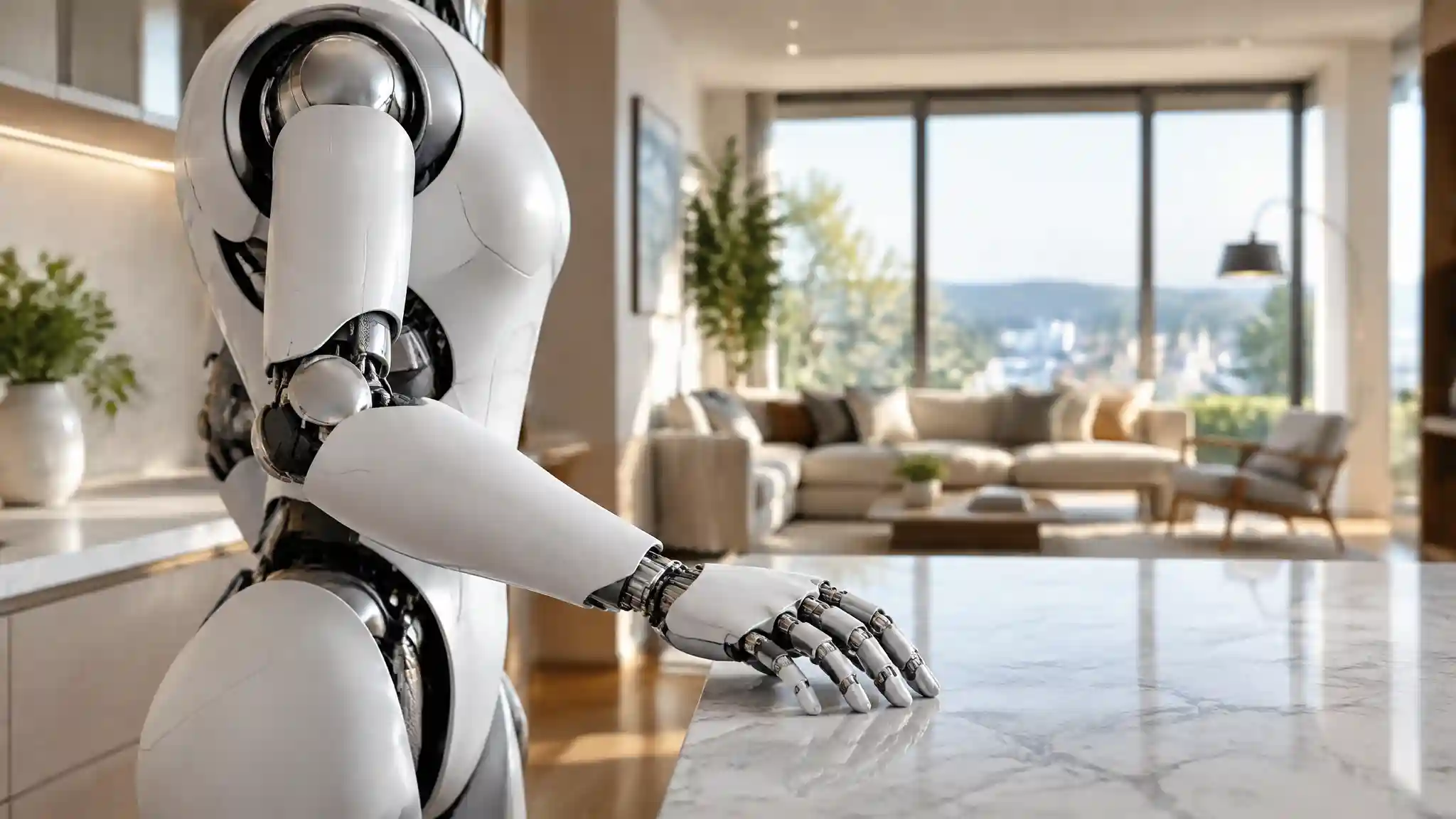
A humanoid's runtime is set by two competing loads. Up to 30 independent high-torque joint actuators must hold posture and correct balance continuously, while onboard neural-network inference, typically drawing tens of watts to over 100 W on embedded accelerators, processes vision, depth and language in real time. Both loads share a pack of only a few hundred watt-hours to around 2 kWh. Unitree rates the G1 at roughly two hours per charge. Under sustained manipulation and full perception load, useful runtime falls further, which is why swappable packs and frequent docking feature heavily in current designs.
| Parameter | Structured industrial environment | Unstructured domestic household |
|---|---|---|
| Environment geometry | Mapped, fixed, “paved path” routes | Changing furniture, clutter, stairs, rugs |
| Perception and compute budget | Low; known fixtures and fiducials | High; continuous scene understanding |
| Dynamic hazards | Controlled; trained staff | Pets, children, variable lighting and floor friction |
| Energy strategy | Scheduled docking, opportunity charging | Ad hoc charging around occupant routines |
| Safety containment | Zoning, fencing, ISO 10218 and ISO/TS 15066 risk assessment | No fencing; untrained occupants in contact range |
| Operating model | Repetitive, validated task set | Open-ended tasks, often with remote human assistance |
The compute penalty is structural. On an automotive line, a robot follows deterministic routes between known stations, so perception can be light. A home is non-deterministic: a cat crosses a hallway, sunlight washes out a depth sensor, a polished floor changes foot friction, a child grabs a limb. Each event requires inference at full rate, and the robot cannot trade perception for battery life. 1X has said remote operators will help NEO with tasks its models cannot yet handle, an admission of how wide this gap remains.
The final barrier is regulatory. A full-size humanoid can weigh 60 kg and apply hundreds of newtons of peak joint force. Before it operates untethered around occupants, manufacturers face strict product liability and certification work under frameworks such as ISO 13482 for personal care robots, with legged-robot standards still being drafted. Lighter, soft-bodied designs such as NEO respond to this constraint, but mass-market certification at scale points beyond 2030.