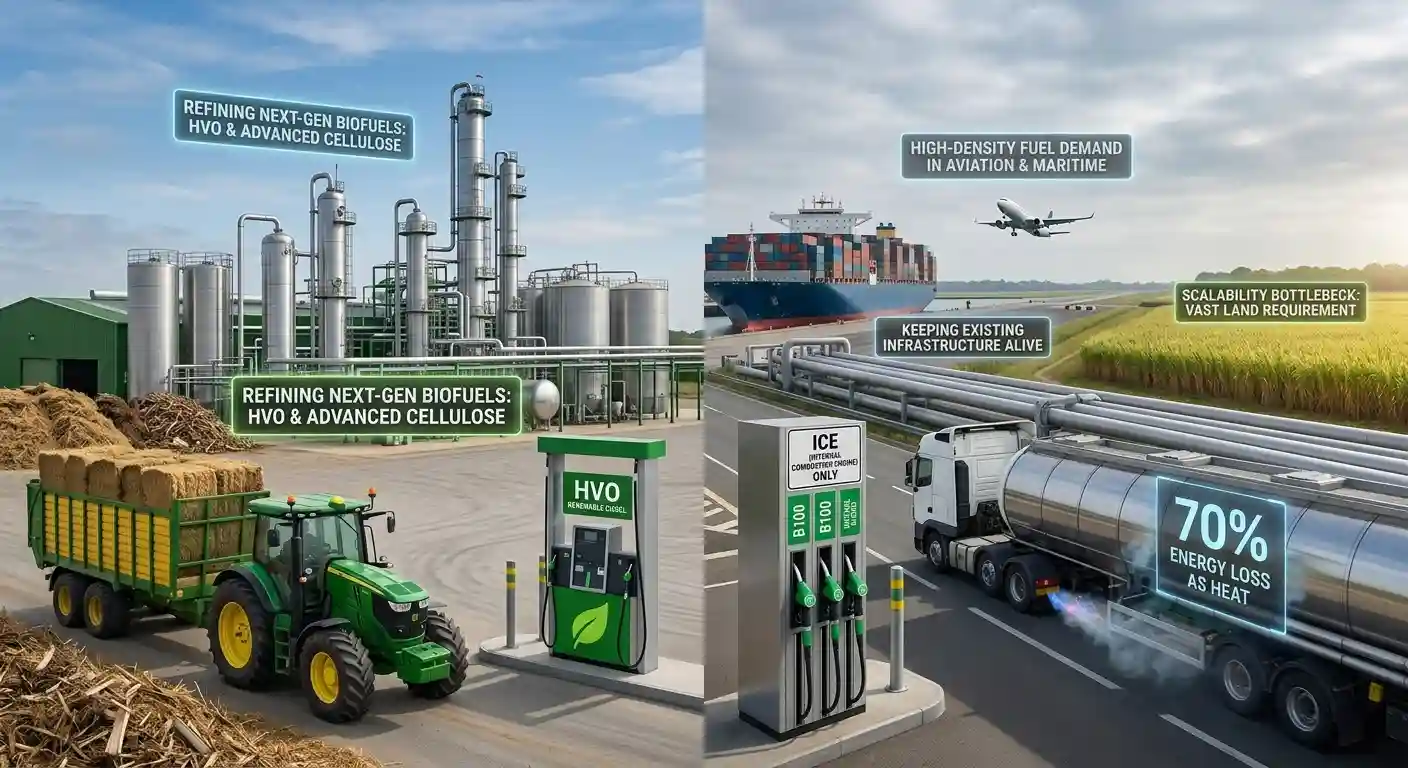
The internal combustion engine fleet represents an enormous stranded-asset risk: vehicles, refineries, pipelines, terminals and forecourts built up over a century. Drop-in biofuels and synthetic fuels promise to decarbonise that estate without replacing it. For energy system architects, transport logistics directors and clean-tech investors, the useful question is not whether the chemistry works, because it does, but whether the physics, land requirements and economics justify deployment at the scale of the light passenger vehicle fleet.
The well-to-wheel thermodynamic penalty
Efficiency must be assessed from the primary energy source to the moving vehicle. When renewable power is routed directly into an electric drivetrain, the chain is short: transmission and distribution losses, battery charging losses, and motor and inverter losses. The result is a battery-to-wheel efficiency of approximately 85 per cent, and a grid-to-wheel figure that typically remains in the range of 70 to 80 per cent.
Liquid fuels require far more conversion steps. Biomass must be grown, harvested, transported, refined and distributed; synthetic fuels require electrolysis to produce hydrogen, direct air or point-source carbon capture, synthesis (such as Fischer-Tropsch), and refining. Each stage dissipates energy. Then, at the end of the chain, the fuel enters a thermal engine whose practical efficiency is constrained by the Carnot limit, friction, pumping losses and the requirement to reject heat. Standard petrol and diesel engines operate at an average of roughly 25 per cent over real driving cycles, with the best diesels approaching 40 per cent only under steady load. The system is therefore permanently vulnerable to that physical efficiency ceiling, however clean or renewable the fuel itself may be.
The compounding is stark. A synthetic e-fuel pathway with a production efficiency of around 40 to 50 per cent, followed by an engine efficiency of 25 per cent, delivers roughly 10 to 15 per cent of the original renewable electricity as motive power. An electric vehicle delivers five to seven times as much useful work per unit of renewable electricity. Put differently, the same wind farm that can move one e-fuelled car can move five to seven battery electric cars. For a constrained renewable energy supply, that ratio dominates every other consideration for light passenger transport.
A further 70 per cent of the fuel's energy content leaves the system as waste heat through the exhaust and cooling circuit. That heat is not recovered in conventional passenger vehicles, and in transport applications there is rarely a downstream user for it. This is the thermal loss penalty that gives the physical case against biofuels for cars its force.
| Fuel generation type | Primary feedstock material | Drop-in infrastructure compatibility | Net well-to-wheel efficiency | Scalability bottlenecks |
|---|---|---|---|---|
| First generation (bioethanol, biodiesel) | Sugar beet, cereals, oilseed rape, palm and soy oil | Partial. Ethanol blends are limited by engine and material compatibility (E10 in the UK); FAME biodiesel is limited by cold-flow and oxidation stability. | Low. Typically under 10 per cent once farming inputs, processing and the engine cycle are included. | Competes directly with food crops; land conversion; fertiliser and water demand; capped by policy. |
| Second generation (HVO, cellulosic ethanol, biomethane) | Used cooking oil, tallow, agricultural and forestry residues, municipal waste | High. HVO is chemically equivalent to fossil diesel and can be used neat in most diesel engines and existing pipelines. | Low to moderate. Typically around 10 to 15 per cent, bound by the roughly 25 per cent engine ceiling and conversion losses. | Finite waste supply; collection logistics; feedstock fraud risk; competition from aviation and shipping. |
| Third generation (algal biofuels) | Microalgae cultures in ponds or photobioreactors | High in principle. Lipids can be refined to drop-in diesel and jet fuel. | Currently poor. Energy for cultivation, harvesting and drying often approaches or exceeds energy content. | Not commercially proven at scale; high capital cost; nutrient, water and harvesting demands. |
| Synthetic e-fuels (power-to-liquid) | Renewable electricity, captured carbon dioxide and hydrogen | High. Designed as chemically identical hydrocarbons for current engines and networks. | Very low for road use. Often around 10 to 15 per cent of the original electricity reaches the wheels. | Cost of renewable power and electrolysers; carbon capture energy; limited capacity and high unit price. |
Feedstock generation boundaries
Biofuels are not a single category, and treating them as such obscures profound differences in sustainability. The matrix above separates three generations, each with a distinct set of constraints.
First-generation fuels are derived from edible crops: oilseed rape for biodiesel, and sugar beet or cereals for bioethanol. Their impacts are well documented. They compete directly with food production, raising food-security concerns when crop prices rise. They also drive land conversion: where new cropland is created from forest, peatland or grassland, the resulting carbon release can outweigh the emissions savings for decades, a phenomenon known as the carbon debt. Fertiliser use introduces nitrous oxide, a potent greenhouse gas, and runoff damages water quality. For these reasons, first-generation volumes are capped by policy in many jurisdictions.
Second-generation fuels use waste streams: used cooking oil, tallow, agricultural residues and forestry residues. These avoid direct land-use change and offer markedly better life-cycle carbon intensities. The limitation is availability. Waste oils and fats are finite, and their supply is already contested by the aviation, shipping and road haulage sectors. Collection is fragmented, and fraud, including mislabelled virgin palm oil, is a recognised risk. Residues also play an agronomic role in maintaining soil carbon, so only a proportion can be removed sustainably. The consequence is that second-generation supply is real but small relative to total liquid fuel demand.
Third-generation systems culture microalgae, which can reach high lipid content and do not require arable land. In principle, yields per hectare far exceed those of terrestrial crops. In practice, the energy and capital required to cultivate, harvest, dewater and extract oil from dilute algal cultures remain prohibitive, and no pathway has reached commercial scale at competitive cost. Algae remain a research and pilot-scale option, not a basis for fleet-level planning.
Land use quantifies the problem. Producing enough biofuel to replace UK road fuel from energy crops would require a land area many times larger than the entire UK arable estate, because photosynthesis converts less than 1 per cent of incident solar energy into stored biomass energy, whereas a photovoltaic array converts 20 per cent or more into electricity. Per hectare, solar-powered electric mobility delivers orders of magnitude more distance travelled than crop-derived fuel.
Commercial cost and rationing realities
Hydrotreated Vegetable Oil is the most commercially mature second-generation drop-in fuel. It is produced by reacting waste fats and oils with hydrogen at high temperature and pressure, producing a paraffinic diesel substitute free of sulphur and aromatics, which can be used in existing diesel engines and fuel infrastructure. It is technically excellent. It is also expensive, typically carrying a premium of tens of pence per litre over fossil diesel at the pump, with the exact figure varying with feedstock prices and market conditions.
The fiscal arithmetic explains the premium. Feedstock typically constitutes the largest share of production cost, and because the feedstock supply is finite and contested, its price rises as demand grows. The process requires capital-intensive hydrotreating units and a supply of hydrogen. Scaling production therefore requires either large capital expenditure on new refining capacity or conversion of existing assets, plus a secure feedstock supply chain, and the marginal cost of additional feedstock rises as less accessible sources are used. This is the opposite of the learning-curve cost decline observed in solar, wind and batteries.
A simple illustration: at a premium of 30 pence per litre, a haulage vehicle consuming 40,000 litres a year faces an additional £12,000 in fuel cost. For a regulated fleet with carbon reporting obligations and customers willing to pay for verified emissions reductions, that may be acceptable. For a private motorist driving 8,000 miles a year in a car using about 700 litres, it adds roughly £210 annually, while a battery electric alternative would reduce running costs. The economics therefore point towards allocation by willingness to pay, which is highest in sectors with few alternatives.
This is why HVO and its equivalents are an optimisation target for heavy industrial logistics and aviation mandates rather than a cheap consumer fuel. Aviation and shipping require energy densities that batteries cannot yet meet over long distances. Heavy goods vehicles on long-haul duty cycles, off-road plant and rail on non-electrified lines have similar constraints. In those sectors, a scarce drop-in fuel yields the largest emissions reduction per litre, because it displaces fossil fuel that has no practical electric substitute. In light passenger transport, the same litre would displace fuel that can be eliminated more efficiently through electrification.
Engineering verdict
Biofuels can keep internal combustion vehicles on the road, but not sustainably or cheaply at fleet scale. The thermodynamic penalty means that every unit of renewable energy goes five to seven times further in an electric vehicle. The land and feedstock boundaries cap the supply of sustainable fuel well below the demand of the global passenger fleet. The cost premium makes the fuel unattractive for consumers but defensible for sectors with no alternative.
The practical strategy for energy system architects is therefore one of asset-optimisation through rationing: electrify wherever direct electrification is technically and economically feasible, and reserve the finite supply of sustainable drop-in fuel for aviation, maritime logistics, heavy haulage and industrial plant. For investors, the opportunity lies in feedstock aggregation, hydrotreating capacity and certification infrastructure serving those sectors, not in extending the life of the petrol car.