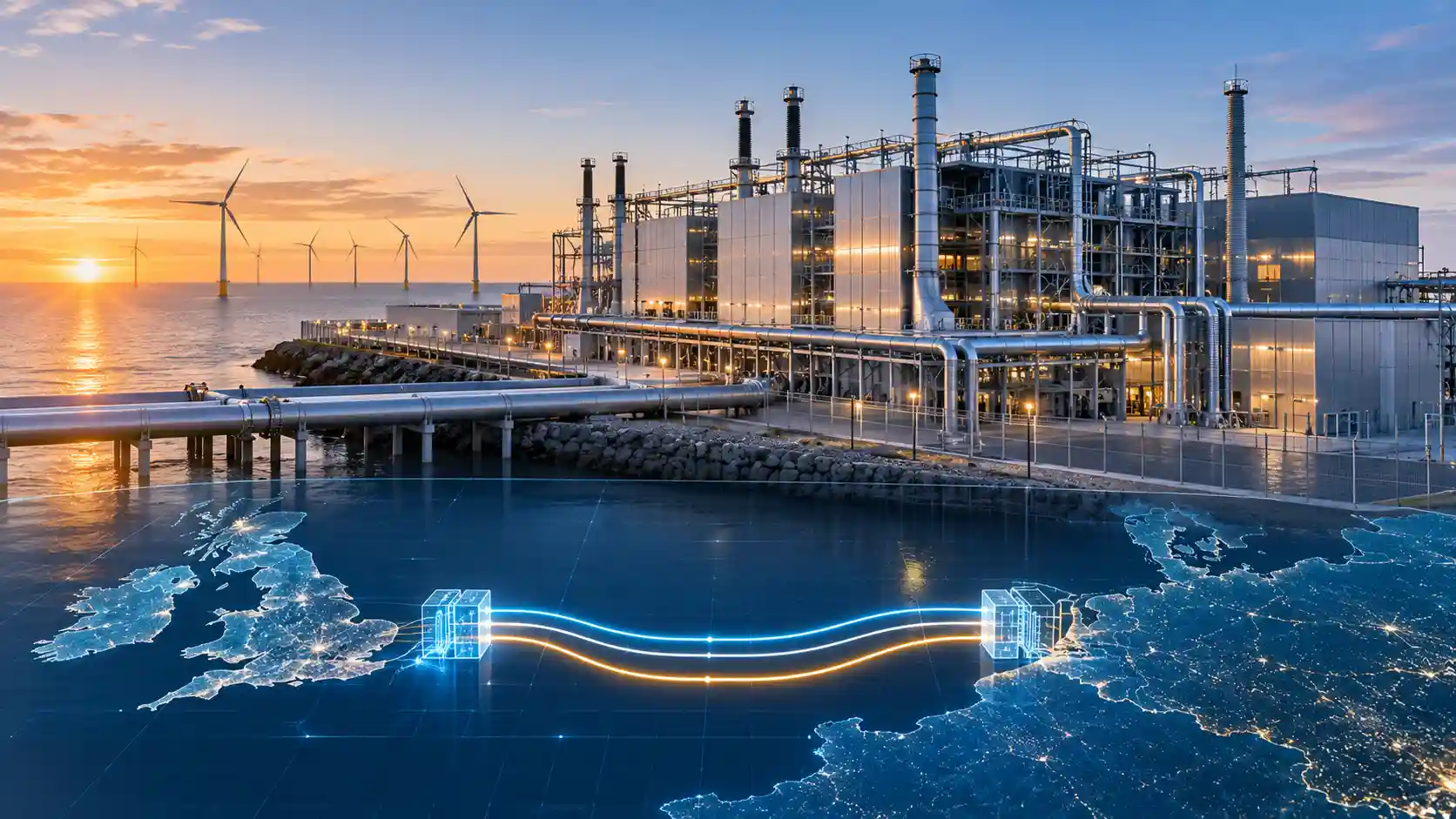
The argument over Britain’s relationship with European energy markets is usually conducted in the language of sovereignty and sentiment. The engineering and the economics are more specific. Electrons cross the Channel and the North Sea over a handful of subsea high-voltage direct current (HVDC) cables; carbon allowances are priced in two registries that do not recognise one another; and the legal instruments that govern subsidy, network planning and market coupling are written in Brussels and implemented, in part, in Westminster. Each of those layers has its own mechanism and its own failure mode. This article separates them, quantifies what can be quantified, and sets out what a closer UK-EU alignment would change for regulatory lawyers, clean-tech investors and infrastructure analysts.
A caution on status. The UK and the EU agreed in 2025 to work towards linking their emissions trading systems and to seek mutual arrangements on carbon border costs and electricity trading, and the detailed legal text, timetable and conditions remain subject to negotiation. The analysis therefore proceeds by scenario, not by prediction. Numerical examples are illustrative planning figures built from stated assumptions, and readers should substitute current prices, volumes and contract terms before relying on them.
The Architecture of the Problem
Four distinct regimes shape the economics of UK-EU energy trade. The first is carbon pricing: the UK Emissions Trading Scheme (UK ETS) and the EU Emissions Trading System (EU ETS) each set a cap, issue allowances and clear a price, and the two prices have diverged. The second is carbon border measures: the EU Carbon Border Adjustment Mechanism (CBAM) levies a charge on the embedded emissions of specified imports, including electricity, while the UK has legislated its own CBAM, scheduled to begin in January 2027 for sectors such as aluminium, cement, fertiliser, hydrogen, and iron and steel. The third is electricity market design: since the end of the Brexit transition period, cross-border flows have been scheduled through explicit capacity auctions instead of implicit market coupling. The fourth is governance: subsidy control, network development planning and regulatory cooperation, which in the EU run through State Aid rules, the European Network of Transmission System Operators for Electricity (ENTSO-E) and the Agency for the Cooperation of Energy Regulators (ACER).
These regimes interact. A lower carbon price in Britain depresses the cost of fossil generation relative to the continent and shifts the merit order; the resulting price spread drives interconnector flows; the flows, if scheduled inefficiently, destroy welfare; and the carbon content of those flows is what a border mechanism then taxes. A change in any one layer alters the incentives in the others, which is why partial alignment can produce results that differ sharply from full alignment.
Standalone and Linked Carbon Markets
Why the price delta distorts capital allocation
A cap-and-trade system is a quantity instrument that produces a price. The cap determines scarcity; the covered sectors’ marginal abatement costs determine where the price settles. Two separate systems with different caps, different covered sectors and different market-stability provisions will clear at different prices, and the difference is not a trading anomaly but a structural consequence of separate quantities. For several years the UK ETS has cleared at a material discount to the EU ETS, reflecting a smaller and less liquid market, a different cap trajectory, a cost-containment mechanism and a lower marginal abatement cost in a power sector that decarbonised early through the closure of coal.
The price delta distorts investment in at least three ways. First, it distorts the revenue stack for low-carbon generation. A wind farm that sells into a market in which wholesale prices are set by gas-fired plant benefits from the carbon cost embedded in the marginal price. If that carbon cost is lower, the infra-marginal revenue is lower for the same physical output, and the required subsidy per megawatt-hour under a Contract for Difference (CfD) rises. Second, it distorts capture economics. Consider an industrial carbon capture project with an all-in cost of, for example, £100 to £150 per tonne of carbon dioxide stored. At a carbon price of £45, the revenue gap that must be filled by public support is £55 to £105 per tonne; at an allowance price near £65, the gap narrows to £35 to £85. For a 1 million tonne a year facility, a £20 difference in allowance value corresponds to £20 million a year in avoided support or, equivalently, in improved project returns. Third, it distorts location. Emitters facing a lower carbon price on one side of the border have an incentive to concentrate emissions there, while those facing a higher price have an incentive to relocate production to the cheaper jurisdiction, which is precisely the carbon leakage that border adjustments are designed to prevent.
There is also a liquidity cost. A thinner market has wider bid-offer spreads, higher volatility for a given shock and less depth for hedging long-dated exposures. Corporate treasurers hedging a decade-long emissions obligation, or investors structuring a carbon-linked revenue stream, price that illiquidity into the cost of capital. A merged pool, which would be several times larger than the UK market alone, would reduce the liquidity premium and would improve the bankability of projects whose cash flows depend on the carbon price.
How linked registries actually clear
Linking is a legal and technical construct, not simply an agreement to trade. Under a full link, allowances issued in either system are accepted for compliance in both. Emitters in each jurisdiction can buy from, and surrender to, either registry, and arbitrage drives the two prices towards a single price, adjusted for residual frictions. The mechanics run through the registries: each system keeps its own registry of account holders and allowances, and the registries are connected through a transaction log that records transfers and checks that an allowance is surrendered once, in one place. When a UK emitter buys an EU allowance, the transfer is recorded in the log and the allowance is then surrendered against the UK obligation, while the corresponding emissions are retired from the combined cap.
The Swiss precedent is instructive. Switzerland’s system was linked to the EU ETS from 2020 after years of negotiation, and the agreement required mutual recognition of monitoring, reporting and verification rules, equivalence of the cap trajectory and the treatment of aviation, and provisions on market oversight. Linking is not a favour to either party; it requires each side to accept constraints on how its own cap, market stability tools and offset rules can change. For the UK, that means that unilateral tightening of the cap, adjustment to the Auction Reserve Price or cost-containment mechanism, or the introduction of new covered sectors would need to be consistent with the link, or negotiated through its governance.
The price outcome of a link depends on the relative stringency of the two caps. If the UK cap is tighter than the EU cap, the merged price would settle below the current UK price in some periods and the UK would become a net buyer of allowances; if looser, the reverse. The convergence is not free of distribution effects: UK emitters benefit from a larger pool of abatement options when the combined price is lower than the stand-alone UK price, but UK generators and carbon-linked assets lose when it is lower. Investors should model both outcomes and their path dependence, not assume that convergence means a uniform rise.
Carbon Border Mechanisms and the Electricity Trap
The EU CBAM entered its definitive phase in 2026, requiring importers of covered goods to purchase certificates priced by reference to the EU ETS allowance price, less any carbon price effectively paid in the country of origin. Electricity is within scope. An importer of UK-origin power must declare the embedded emissions and, absent an exemption, surrender certificates reflecting the gap between the EU allowance price and the UK carbon price paid. As an illustration, a UK grid-average emissions intensity of around 0.15 tonnes per megawatt-hour and a price gap of €25 per tonne produce a charge of roughly €3.75 per megawatt-hour on a gas-weighted flow; where default values are applied in place of verified data, the charge can be materially higher.
A charge of that size matters because interconnector margins are narrow. The price spreads that justify an HVDC link are often in the range of a few euros to a few tens of euros per megawatt-hour, and a border charge of €3 to €5 per megawatt-hour can eliminate a significant fraction of the profitable hours. Because power is traded by the hour and flows are not physically traceable to a particular generator, the regulatory treatment of the carbon content of a flow is as much a legal as a physical question. The CBAM framework addresses this by including a route to exempt electricity from third countries that are integrated with the EU electricity market through market coupling and that meet conditions on carbon pricing and regulatory alignment, subject to implementing acts. This is the provision that gives market coupling and an ETS link their combined value: together, they remove the border charge on the flows that matter most.
The UK’s own CBAM adds a mirror-image issue. A UK charge on imports from the EU would, in a linked world, be unnecessary for goods whose carbon cost is already priced at equivalent levels. Negotiators have therefore treated mutual exemption as the natural counterpart of an ETS link: each side recognises the other’s carbon price as equivalent, and neither imposes a border cost on the other’s goods. Without the link, exporters in both directions face a compliance burden and cash-flow cost, in addition to the tariff itself.
Interconnector Allocation and the Cost of Uncoupling
Explicit versus implicit trading
Before 2021, GB participated in the European day-ahead market through implicit coupling. In an implicitly coupled market, the cross-border transmission capacity is not sold separately; it is allocated by the same algorithm that clears the energy market. The pan-European algorithm (EUPHEMIA) takes all bids and offers and the available transfer capacities, and finds the allocation that maximises social welfare subject to network constraints. The consequence is that power flows from the low-price zone to the high-price zone until either the prices converge or the interconnector is full. Flows follow the price spread by construction.
Since the end of the transition period, the UK-EU interconnectors have used an explicit mechanism: market participants buy transmission capacity in an auction, and then separately trade energy in each of the two markets, nominating flows afterwards. The capacity is therefore priced before the energy prices on the two sides of the cable are known. Traders must forecast the spread, and forecast errors cause flows in the wrong direction, that is, from the higher-priced zone to the lower-priced zone. A flow in the wrong direction reduces welfare by the spread multiplied by the volume, because it replaces cheaper energy with dearer energy at the margin.
A simple calculation shows the scale. Suppose a 1 GW link experiences wrong-direction or unused flow relative to the optimal schedule for 20 per cent of hours, at an average absolute spread of €10 per megawatt-hour. The annual welfare loss is 1,000 MW multiplied by 1,752 hours (20 per cent of 8,760), or 1.752 TWh, multiplied by €10, which equals €17.5 million per link per year. Across a fleet of interconnectors of roughly 9 GW of nominal capacity, with larger spreads in stressed periods, the aggregate cost is plausibly in the hundreds of millions of pounds a year. Published assessments have produced figures of that order, though they depend on assumed spreads, liquidity and the efficiency of the alternative mechanisms in place; the exact number is contested and should be stated as a range.
| Interconnector | Counterparty | Nominal Capacity | Technology and Notes |
|---|---|---|---|
| IFA | France | About 2,000 MW | HVDC; the oldest of the links, subject to long-run ageing and maintenance outages |
| IFA2 | France | About 1,000 MW | HVDC; commissioned later with modern converter technology |
| ElecLink | France | About 1,000 MW | HVDC through the Channel Tunnel infrastructure |
| Nemo Link | Belgium | About 1,000 MW | HVDC; the first link between GB and Belgium |
| BritNed | Netherlands | About 1,000 MW | HVDC; a long-standing link to the Dutch market |
| North Sea Link (NSL) | Norway | About 1,400 MW | HVDC; connects GB wind to Norwegian hydro storage |
| Viking Link | Denmark | About 1,400 MW | HVDC; one of the longest subsea power cables in the world |
| Greenlink | Ireland | About 500 MW | HVDC; links Great Britain with the Irish market |
Transmission efficiency and what coupling restores
Physical efficiency and market efficiency are separate. An HVDC link has conversion losses at each end, typically around 0.5 to 1 per cent per converter station, plus cable resistive losses that rise with length and current; for a long link such as Viking Link, total losses of the order of 3 to 4 per cent at full load are a reasonable planning assumption. These losses are an unavoidable physical cost and enter the economic dispatch as a threshold: a link is only worth using when the spread exceeds the loss cost. The market-efficiency penalty from explicit trading is additional and arises from the scheduling error described above.
Implicit coupling removes the scheduling error. In the day-ahead stage, the algorithm sees both order books and the link’s capacity and finds the welfare-maximising flow. Intraday coupling and balancing cooperation extend the benefit closer to real time, in which wind forecast errors, unplanned outages and demand shocks are resolved. The effect is greater in a system with a large share of variable renewables, because the value of moving surplus wind to a neighbouring deficit zone is highest at exactly the moments when the spread is largest. Alternatives to full coupling, such as multi-region loose volume coupling, in which an algorithm sets the flow on the basis of anticipated prices, narrow the gap but do not eliminate it, since they depend on forecast prices and not on the final cleared prices.
For the North Sea, the relevant benefit is trapped surplus. When UK wind output is high and demand is low, the GB price can fall to levels that the continent would gladly import at, but an inefficient scheduling mechanism may leave capacity unused or flowing in the wrong direction. With efficient coupling, that surplus would be exported when it is valuable, which raises the capture price of wind assets, reduces curtailment payments, and decreases the volume of constraint costs borne by consumers. Conversely, imports during the winter evening peak, when GB is short, would be scheduled more reliably, which lowers the scarcity premia in the balancing market.
State Aid, the CfD and Policy Autonomy
The UK’s Subsidy Control Act 2022 replaced the EU State Aid regime after Brexit with a principles-based framework in which public authorities self-assess the compatibility of subsidies against seven principles and publish awards on a transparency database. It is lighter than the EU model, which relies on notification, prior approval by the European Commission for most schemes, and detailed guidelines such as the Climate, Energy and Environmental Aid Guidelines (CEEAG). Closer alignment would shift the UK from the first model towards the second, and the extent of that shift would depend on the form of the agreement. A bilateral treaty with a dispute-settlement mechanism could impose State Aid-equivalent disciplines enforced by an independent authority, as the EFTA Surveillance Authority does for Norway under the European Economic Area agreement. A looser arrangement could commit only to the principle of fair competition.
The Contracts for Difference scheme is the main object of that discipline. A CfD pays the generator the difference between a strike price and a reference market price, and it is a form of State Aid when funded by consumers or the Exchequer. Existing UK CfDs are already two-sided, meaning that generators pay back when the market price exceeds the strike, which aligns with the direction of the EU’s electricity market design reforms requiring two-sided CfDs for new support to certain generation. The friction would therefore lie less in the basic design than in the process and in the levers the Department for Energy Security and Net Zero (DESNZ) uses.
Three levers are particularly exposed. First, administrative strike prices: DESNZ sets these for each allocation round and may adjust them in response to cost changes, supply chain shocks or failed auctions. Under a notification regime, a material change to scheme parameters could require clearance in advance, adding time and legal risk to what is currently a ministerial decision. Second, budget and allocation design: the ability to set separate pots for emerging technologies, such as floating offshore wind, and to prioritise them over established technologies depends on a justification of the aid’s necessity and proportionality that would be reviewed externally. Third, domestic-content and supply-chain incentives: UK policy has used non-price factors, including clean industry bonus payments and supply chain plans, to support domestic manufacturing. EU rules limit local-content requirements that discriminate between suppliers by origin, while the Net-Zero Industry Act permits certain resilience and sustainability criteria. A UK under EU-aligned disciplines would have to reframe domestic-content incentives as resilience or sustainability criteria that apply to all suppliers on a non-discriminatory basis.
There is an offsetting benefit. Alignment with EU rules gives investors a more predictable legal environment, a recognised dispute process and the ability to benefit from EU funding and approved aid frameworks in cross-border schemes. For a venture investor, a CfD whose terms can only be modified through a transparent process is in some respects a better asset than a CfD whose terms depend on ministerial discretion. The trade-off, then, is between flexibility and credibility, and the question for each investor is which they value more in a given technology.
| Policy Realignment Scenario | Carbon Trading Infrastructure | Interconnector & CBAM Status | State Aid & Subsidy Autonomy | Primary Macroeconomic Impact |
|---|---|---|---|---|
| Standalone divergence (status quo) | Separate UK ETS and EU ETS; two registries; price divergence and liquidity fragmentation | Explicit capacity auctions; EU CBAM applies to UK electricity; UK CBAM begins in 2027 for selected sectors | Full autonomy under the Subsidy Control Act 2022; minimal external review | Recurring welfare loss on interconnectors; border cost friction; carbon-asset values compressed relative to the EU pool |
| Linked ETS with mutual CBAM exemption | Linked registries and mutual allowance recognition; converging price; larger combined pool | Mutual exemption from carbon border charges; electricity coupling pursued in parallel | Substantial autonomy, with commitments on fair competition and cap-governance consistency | Lower compliance burden; improved carbon-asset liquidity; limited capture of coupling benefits unless electricity is added |
| Electricity-market alignment with implicit coupling and ETS link | Linked ETS; shared auction and clearing rules | Implicit day-ahead and intraday coupling; electricity exempt from CBAM; coordinated balancing | Moderate constraint: State Aid-equivalent rules for energy schemes, with notification and review | Restored algorithmic optimisation; reduced curtailment; higher wind capture prices; reduced scarcity premia |
| Single-market style alignment | Full participation in the EU ETS or an equivalent linked system under common governance | Full integration in market coupling, network codes and balancing platforms; no CBAM | Full State Aid disciplines enforced by an independent authority; limited unilateral adjustment of CfD parameters | Deepest efficiency gain and investor certainty; greatest loss of regulatory discretion over domestic deployment frameworks |
Network Governance: ENTSO-E, ACER and the Meshed North Sea
The physical grid that carries the energy is planned in a framework that the UK has partly left. ENTSO-E coordinates the Ten-Year Network Development Plan (TYNDP), a pan-European assessment of system needs and candidate projects that underpins project selection for cross-border infrastructure. ACER oversees regulatory cooperation, approves methodologies such as capacity calculation and cost allocation, and settles cross-border disputes when national regulators disagree. Following Brexit, Great Britain’s system operator has retained an association with ENTSO-E but without the full rights and responsibilities of a member, and the UK regulator does not participate in ACER decision-making. Norway’s participation as an observer, without a vote, offers a model of partial engagement.
The practical consequence is that UK-connected projects have been outside the formal European planning loop. Projects of Common Interest (PCI) status under the revised TEN-E Regulation, which confers accelerated permitting and eligibility for Connecting Europe Facility funding, is not available to UK promoters. The TYNDP cost-benefit methodology, which assesses the socio-economic welfare of candidate links across the whole system, cannot count UK benefits in the same way. Restoring formal alignment would let UK interconnection and offshore grid projects be assessed alongside continental ones, would reopen access to PCI-like designations, and would give the UK system operator a voice in the scenarios and assumptions that shape future investment.
The strategic prize is a coordinated North Sea offshore grid. Present practice is radial: each wind farm connects by its own cable to shore, and separate interconnectors link national grids. A meshed approach would connect offshore wind clusters to multiple countries through hybrid assets, so that a cable serves both as export route for generation and as an interconnector between markets. The engineering is demanding: multi-terminal HVDC requires interoperable converter control, DC protection and common technical standards, and the market design must define the bidding zones for offshore assets and how congestion revenues are shared between the countries. Bilateral commitments, such as the North Seas Energy Cooperation framework and the declarations of North Sea governments on offshore wind ambition, have set targets for the next decades, but converting those targets into bankable assets requires shared regulation of cost allocation, cap-and-floor or equivalent revenue regimes, and a common planning process.
The UK has developed domestic mechanisms, notably the Ofgem cap-and-floor regime for interconnectors and the work on multi-purpose interconnectors, which can be made compatible with EU approaches. What alignment would add is mutual recognition of those mechanisms, a common basis for the cross-border cost-benefit analysis, and legal certainty for the allocation of revenues and obligations between jurisdictions. For a project sponsor, those features reduce the number of regulatory approvals and the risk that the regime on one side of the cable changes in a way that damages the economics on the other.
Grid Load Balancing in a Synchronised System
Balancing is the part of the system least visible in public debate and most sensitive to arrangements at the border. Great Britain is a synchronous island connected to the continent through asynchronous HVDC links, which means that the frequency of the GB system is not directly tied to that of continental Europe. This brings an advantage, since disturbances do not propagate across the link, and a cost, since GB cannot draw on the inertia and frequency response of the continental synchronous area and must procure its own stabilisation services. Participation in European balancing platforms for the exchange of frequency restoration reserves and replacement reserves would allow GB to share balancing resources, reducing the volume that each system must hold.
The scale of potential saving depends on the correlation of imbalances. If GB and neighbouring systems experience independent wind forecast errors, sharing reserves reduces the total reserve needed, in much the same way that pooling reduces the capital held against uncertain demand. With increasing wind penetration and a planned increase in interconnection, the benefits grow. But pooling is only effective if the link has spare capacity at the time the reserve is needed, and that capacity is allocated first to energy trade, which makes the design of the capacity reservation for balancing a technical and commercial challenge.
There are also security-of-supply implications. A system relying on imports during winter evening peaks must ensure that neighbours will have surplus capacity when it is needed, and that cross-border rules do not curtail exports during scarcity. Under EU rules, a minimum share of interconnector capacity must be made available for cross-border trade, and emergency measures are subject to coordination. Closer alignment would formalise those commitments, giving more certainty to the UK’s reliance on imports, at the price of sharing the burden when the neighbours are short.
Investor and Regulatory Implications
For regulatory lawyers, the central issue is the choice of legal architecture. An ETS link requires a treaty-level or equivalent agreement with provisions on dispute resolution, amendment and termination; it will raise questions about the role of the Court of Justice of the European Union, the enforcement authority and the treatment of future changes in EU law. The treatment of State Aid in the CfD framework depends on whether the UK commits to the substance of EU rules, to a process of notification, or only to general principles. Each choice affects the contract law around CfDs, the enforceability of agreements with generators and the potential for legal challenge by competitors.
For clean-tech venture capital, the main effect is on the cost of capital and the structure of revenue. A larger, more liquid carbon market and a coupled electricity market reduce the volatility and the discount applied to merchant revenue. Technologies whose economics depend on the carbon price, such as carbon capture, hydrogen and electrification of industrial heat, benefit most from price convergence at the higher level, while technologies that depend on stable domestic support, such as emerging offshore wind concepts, benefit from certainty but may lose the option of a bespoke domestic scheme. Investors should map their portfolios against the four scenarios and estimate the sensitivity of each asset’s internal rate of return to the carbon price, the interconnector spread and the availability of support.
For macro-energy infrastructure analysts, the central metrics are the capture price of wind and solar, the volume of curtailment and constraint payments, the net trade position in winter peaks and summer surpluses, and the system cost of balancing. The shift from explicit to implicit trading should reduce the first and third, improve the second and sharpen the fourth. The size of the change will depend on the build-out of interconnection, storage and flexible demand, which provide alternative routes to the same efficiency gains. If the UK builds large volumes of domestic storage and flexibility, the marginal value of coupling falls; if it relies on interconnection to manage surplus, the value rises.
Conclusion
UK-EU energy realignment is not a single decision but a bundle of choices across carbon pricing, border measures, market coupling, subsidy discipline and network governance. The financial case for linking carbon markets and removing border charges is strong and well-founded in the mechanics of arbitrage and the arithmetic of narrow interconnector margins. The case for restoring implicit coupling is equally grounded in the algorithmic basis of welfare maximisation, with plausible savings in the hundreds of millions of pounds a year. The cost lies in the constraint on policy autonomy, above all in the State Aid disciplines that would govern CfD design and domestic-content incentives, and in the governance obligations that accompany a role in ENTSO-E and ACER processes.
The correct frame is therefore a trade of discretion for efficiency and certainty. The value of that trade differs by asset class, by technology and by time horizon, and it should be assessed with explicit modelling of the scenarios set out above. The engineering evidence shows that the cables, converters and wind farms are ready for a more synchronised grid; the open question is whether the legal and regulatory architecture will follow.