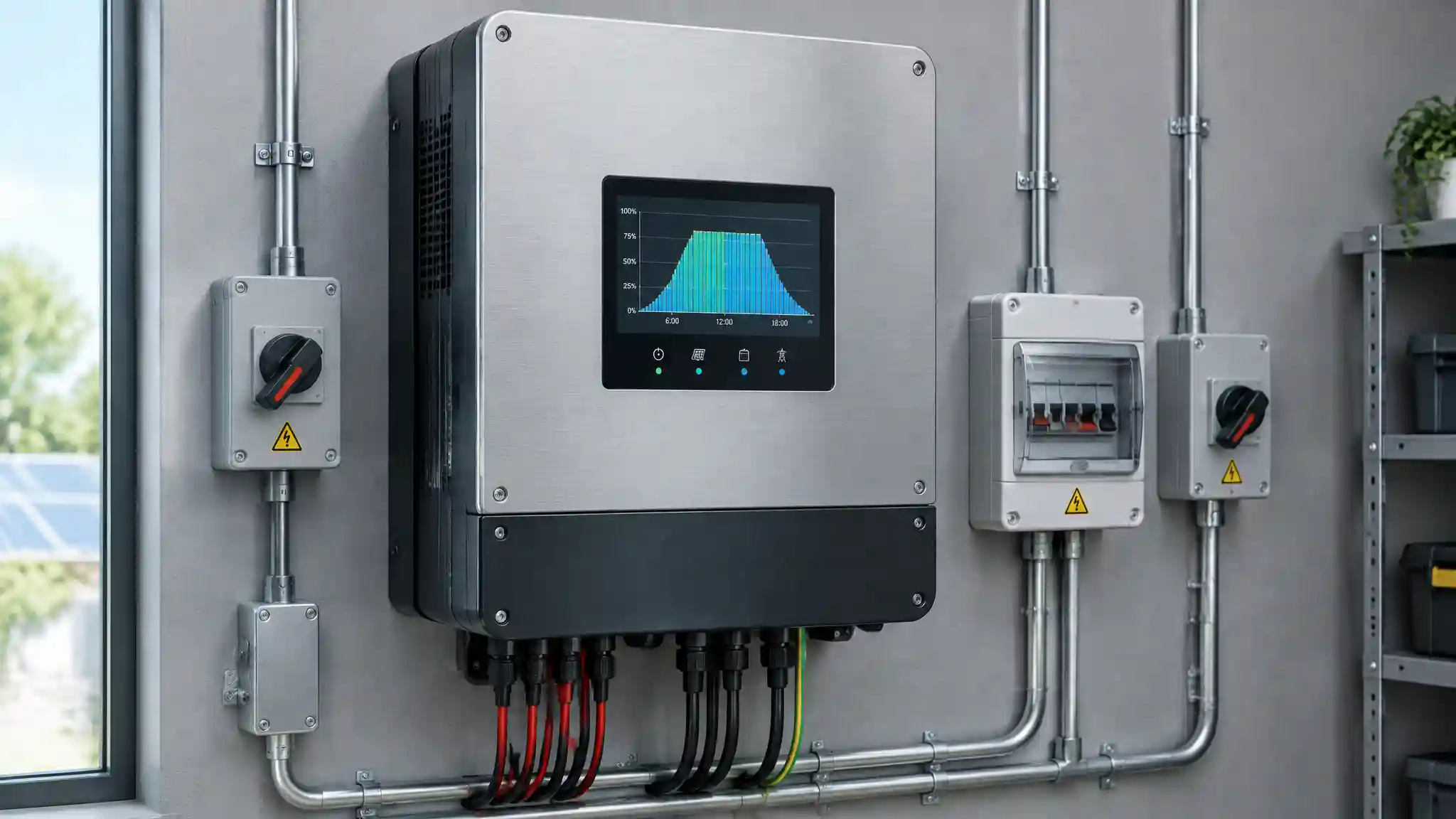
Residential solar arrays are rarely matched one-to-one with their inverters. Designers commonly specify a DC-to-AC ratio of 1.2 to 1.4, for example 5.5 kWp of panels on a 4 kW inverter. The reasoning is sound: UK panels seldom reach their nameplate rating, because of temperature losses, irradiance below laboratory test conditions, and orientation and tilt. A larger array raises output during the morning and late-afternoon hours and on overcast days, keeping the inverter working closer to its rated capacity for more of the year. Inverter export limits set by the network operator often make a modest AC rating the practical choice anyway.
The cost appears on clear, cool days around solar noon. When the array could deliver 5 kW but the inverter is rated for 4 kW, the inverter has to reject the surplus. It does this by moving the string’s operating voltage away from the Maximum Power Point (MPP), typically upwards towards open-circuit voltage, so the panels produce less current and less power. Nothing is damaged and no heat is dumped as waste. The energy is simply never harvested. On a typical UK system the annual loss is small, often a few percent, but it is concentrated in the highest-value summer hours.
DC-coupled storage offers a way to recover it. In an architecture such as Sigenergy’s SigenStor, the battery sits on the same DC bus as the PV input, ahead of the inverter’s AC conversion stage. Power above the AC rating can be sent directly into the battery at the same time as the inverter exports at full output, bypassing the AC bottleneck instead of being curtailed. The same DC bus underpins its 25 kW DC EV charger.
For design engineers, the outcome is a more aggressive yet efficient array ratio. Where a battery is not specified, a solar diverter can absorb surplus that is within the inverter’s capacity but would otherwise be exported.