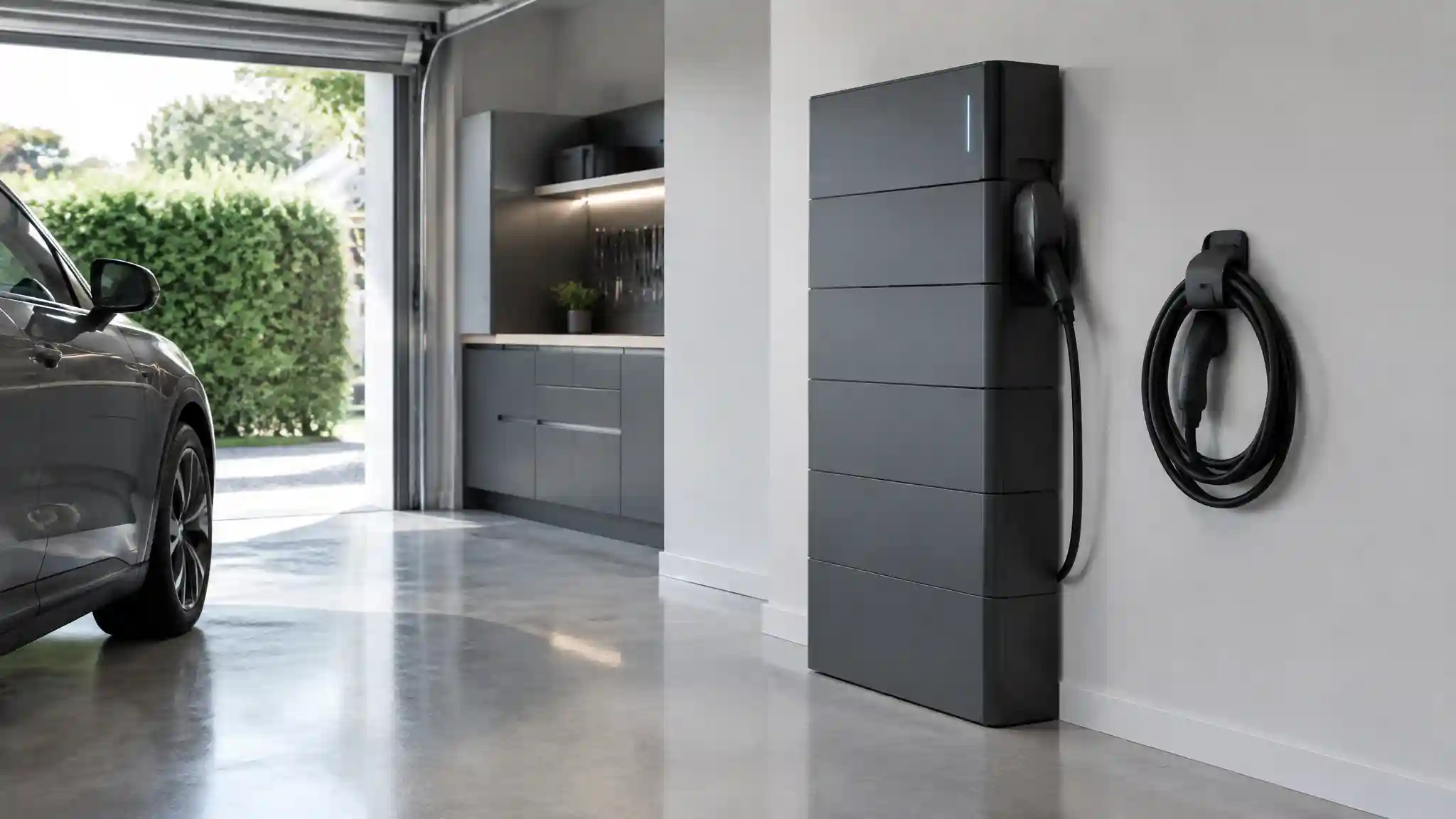
Every EV battery stores DC, but a home wallbox supplies AC. The conversion happens inside the car, in an onboard charger sized to fit the vehicle’s space, weight and cooling limits. On a UK single-phase supply that means a ceiling of about 7.4 kW (32 A), however capable the battery. A DC charger moves the conversion hardware out of the car and into the home, feeding the battery directly through the CCS connector and bypassing the onboard charger. It is the same architecture as a public rapid charger, scaled down to domestic size.
The difficulty is supply capacity. A typical UK home has a single-phase 60 to 100 A main fuse that is also serving showers, hobs and heating, so it cannot deliver 25 kW to a car on its own. The SigenStor approach is to treat the grid as just one of several sources. Grid import is capped by dynamic load balancing to whatever headroom the household load allows. The rest comes from the system’s shared DC bus: solar generation and discharge from the stacked battery modules go straight to the car without an intermediate AC conversion. Full 25 kW output therefore depends on the battery’s state of charge and the available solar, and once the stored energy runs out, the charge rate falls back towards the grid allowance.
The hardware is also designed to be bidirectional. A DC charger that can export as well as import is the foundation for Vehicle-to-Home (V2H), where the car powers the house during peak periods or outages, and Vehicle-to-Grid (V2G), where it sells flexibility back to the network. Using either requires a compatible vehicle, network operator approval and a suitable tariff, but installing the hardware now prepares the home for them.
For installers and consultants, the specification shifts from simply fitting a charger to designing an integrated DC energy system. See our EV hub for more on home charging.