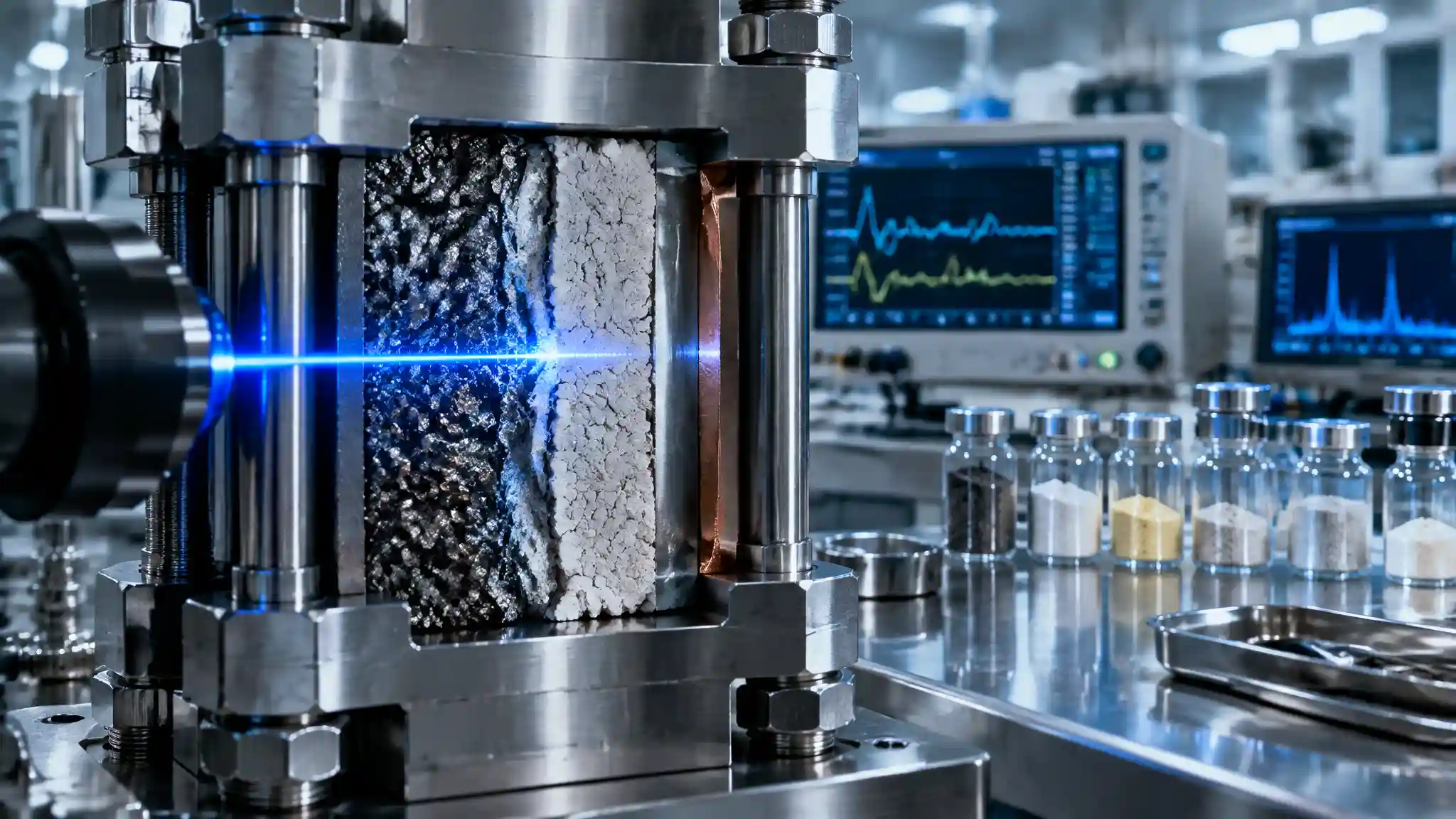
The 2027 pilot headlines overstate readiness. CATL's own investor disclosures place its sulfide solid-state technology at Level 4 of 9 on the Technology Readiness Level scale, which denotes basic laboratory prototype validation, not scaled factory capability. A pilot line demonstrates a process; it does not demonstrate yield, durability or cost at automotive volume.
The underlying constraint is interface physics. A liquid electrolyte wets the electrode and keeps current uniform, whereas a solid matrix loses sub-micron contact and cracks as cells expand and contract under high-C charging. BYD's late-July patents describe a structural patch: a dual-electrolyte cathode in which small halide particles pack around larger sulfide crystals, like sand around gravel, to hold an artificial 60% surface-contact threshold during expansion.
| Platform | Mechanical Parameters | Critical Current Density | Cell Cost Multiplier | Mass-Production Target |
|---|---|---|---|---|
| Liquid LFP Blade (Baseline) | Liquid electrolyte wets electrodes perfectly; uniform current profiles. | > 15.0 mA/cm² (Not structurally limiting) | 1.0x (Commercial Baseline) | Active Mass Production |
| CATL (Sulfide, TRL-4) | Rigid sulfide matrix; high risk of sub-micron contact loss and micro-cracking. | ~2.0 to 3.0 mA/cm² | ~5.0x | Post-2030 Commercial Scale |
| BYD (Dual-Electrolyte) | Small halide particles packed around large sulfide crystals; 60% contact patch threshold. | ~2.5 to 3.5 mA/cm² | ~5.0x | 1,000-unit Pilot in 2027; Mass Scale 2030 |
| Toyota (Idemitsu Sulfide) | Highly brittle solid sulfide separator; requires external mechanical pressure chassis. | ~2.5 to 3.5 mA/cm² | ~4.0x to 6.0x | 2027-2028 Pilot Fleet Integration |
| QuantumScape (Anodeless Ceramic) | Solid ceramic separator layer; zero-anode manufacturing minimises volumetric expansion. | ~4.0 to 5.0 mA/cm² | ~3.0x to 4.0x | 2026 Alpha/Beta Testing; Mass Scale 2029 |
Cost is the second bottleneck. Sulfide-based cells cost roughly five times as much to produce as standard lithium iron phosphate (LFP) cells, and the specialised materials are priced at many multiples of liquid equivalents. That premium explains why BYD is capping its 2027 launch at a 1,000-unit fleet across its luxury Yangwang and Denza models: the amortisation of tooling cannot be absorbed by mainstream pricing.
For material specifiers and powertrain managers, the conclusion is measured. Solid-state remains a credible post-2030 chemistry, but standardised, affordable adoption depends on solving contact mechanics and materials cost first. Until then, liquid LFP sets the commercial benchmark.