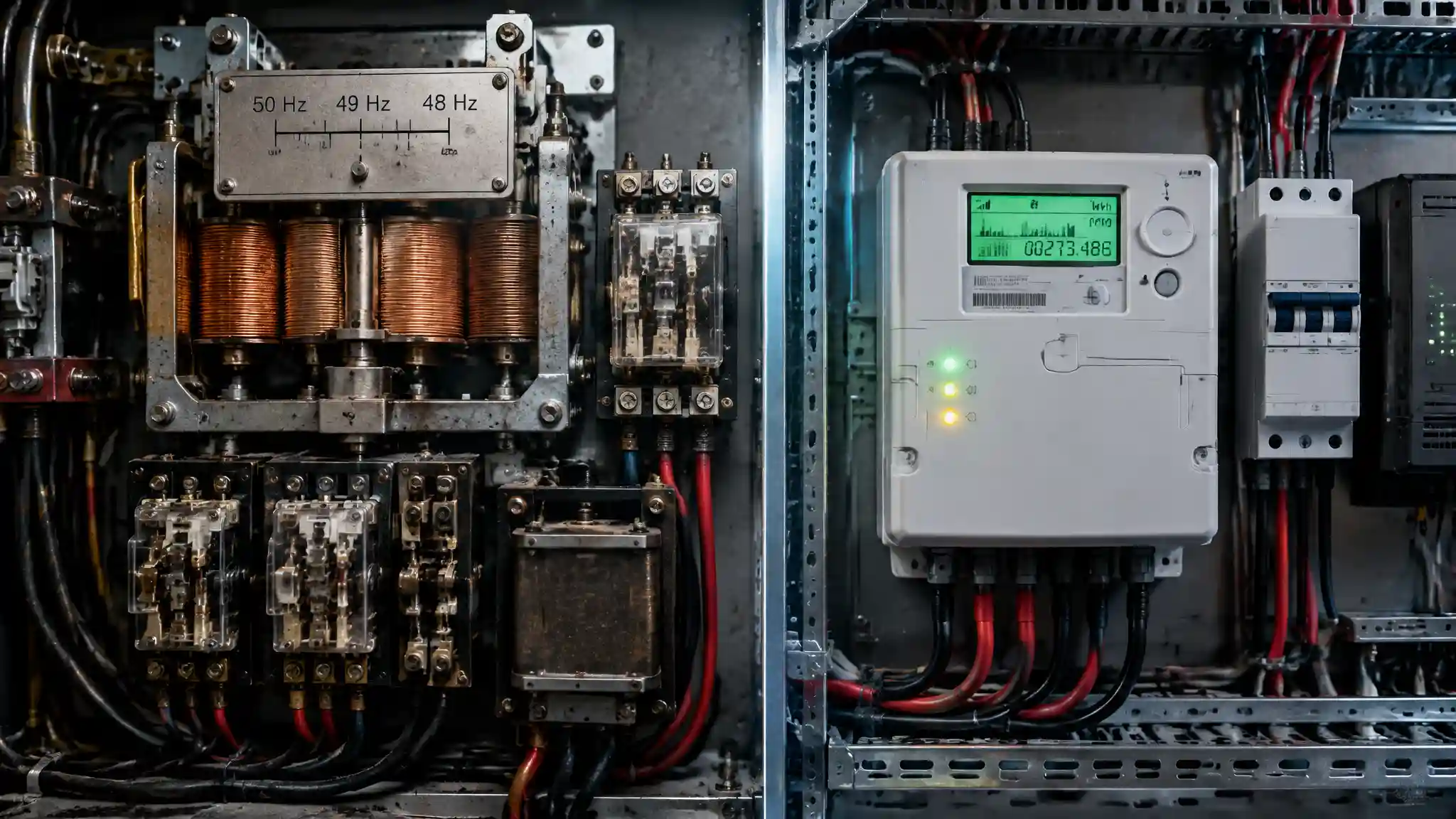
Ripple control is electromechanical telecommunication at its most direct. Injection plants superimpose audio-frequency control signals, typically 100 Hz to 1 kHz, directly onto the AC voltage waveform. Receivers on the same network decode the tone and flip mechanical relays, so no external cellular network is required. The method is physically robust, but the signal is attenuated and absorbed by network loading, which demands specialised plant at each injection point.
Radio Teleswitching extended the same one-way logic nationally. Metering equipment decoded a BBC 198 kHz longwave signal to switch multi-rate tariffs and storage heaters. The track proved robust but rigid: with no return path, it cannot observe or respond to dynamic solar or wind export surges, and the RTS sunset leaves the dependent load without a standardised replacement trigger.
| Architecture | Signal frequency | Latency | Data directionality | Primary failure modes |
|---|---|---|---|---|
| Ripple Injection | Audio frequency, typically 100 Hz to 1 kHz, superimposed on the AC waveform | Seconds to tens of seconds, set by the injection cycle | One-way (broadcast) | Injection plant outage; signal attenuation or absorption on the network |
| Radio Teleswitching (RTS) | BBC 198 kHz longwave carrier | Broadcast-cycle dependent; not suited to dynamic dispatch | One-way (broadcast) | Transmission withdrawal or signal loss; rigid, non-adaptive schedules |
| Smart Meter (SMETS2) | Cellular WAN and mesh radio, routed through the DCC | Seconds to minutes | Bidirectional | Network latency, DCC routing delays and dropped packets |
SMETS2 reverses the trade-off. It delivers bidirectional, granular visibility, yet commands travel across cellular WAN networks and Data Communications Company (DCC) routing, introducing latency that often stretches from seconds to minutes. For a coordinated load-shedding event, that spread matters: uneven delivery risks the phase imbalances and transformer overloads described above.
For power systems engineers and grid asset investors, the conclusion is a design requirement, not a criticism. Smart metering must be treated as an asynchronous control layer, with local fallback logic and latency budgets, until its timing characterisation matches the deterministic behaviour of the legacy systems.