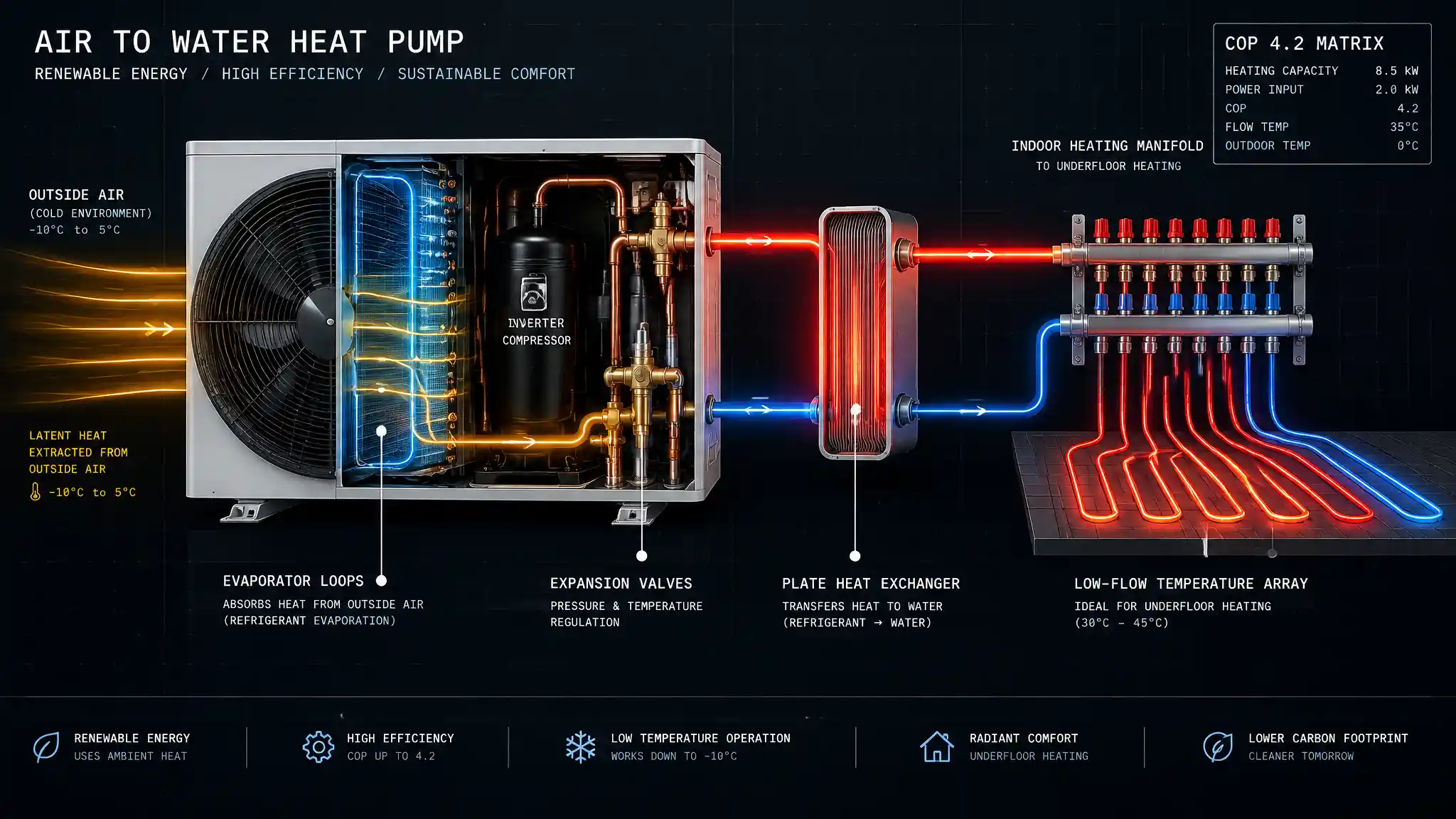
The Vapor Compression Cycle: A Fridge Running Backwards
Four components, one refrigerant, one continuous loop. Every heat pump, air-to-water or air-to-air, runs the same cycle.
Evaporator
Liquid refrigerant, held at low pressure, flows through the outdoor evaporator coil. Even in sub-zero outdoor air, there is still usable low-grade heat in it. The refrigerant absorbs that heat and boils into a low-pressure gas — its boiling point is engineered to sit well below outdoor air temperature specifically so this happens.
Compressor
The low-pressure gas is drawn into an electrically driven compressor. Compressing a gas doesn't just raise its pressure — it raises its temperature sharply too, the same reason a bicycle pump gets warm in your hand. The refrigerant leaves the compressor as a high-pressure, high-temperature gas.
Condenser
That hot gas passes through a plate heat exchanger — the condenser — sitting against the home's hydronic circuit: radiators, underfloor heating, or a domestic hot water cylinder. The refrigerant gives up its latent heat into that circuit and condenses back into a liquid, still at high pressure.
Expansion Valve
High-pressure liquid refrigerant throttles through a narrow expansion valve. Pressure and temperature both drop sharply on the other side. The refrigerant is back to a cold, low-pressure liquid, ready to enter the evaporator and start the cycle again.
Decoding COP and SPF: The Myth of 100% Efficiency
The Coefficient of Performance is the whole efficiency story in one ratio:
COP = Thermal Energy Output ÷ Electrical Energy Input
A gas boiler burns fuel and converts its chemical energy directly into heat. Combustion physics caps that conversion hard: flue gas losses and incomplete heat transfer mean even the best modern condensing boiler tops out around 0.92 efficiency — 92%. It can never exceed 100%, because it isn't moving energy from anywhere else. It's manufacturing all of it from fuel.
A heat pump isn't making heat at all. It's moving heat that already exists in the outdoor air, and electricity only pays for the moving, not the heat itself. That's why a heat pump routinely delivers a COP of 3.0 to 4.5 — 300% to 450% efficiency — figures that sound impossible until you realise they were never measuring the same thing a boiler's efficiency rating measures.
COP alone is a snapshot, though — a single moment, a single outdoor temperature. The Seasonal Performance Factor (SPF), also called Seasonal COP (SCOP), averages real performance across an entire 12-month heating season: cold January nights, mild October evenings, and everything in between. SPF is almost always lower than a manufacturer's headline COP, because that headline figure is usually measured at a single, favourable lab test condition — SPF is what the system actually delivers, averaged over a real UK winter.
The Flow Temperature Crux: Why System Design Dictates the Bill
Every heat pump's real-world ceiling is set by the Carnot limit — the hard thermodynamic maximum for any heat engine working between two temperatures:
Carnot COP = Thot ÷ (Thot − Tcold), temperatures measured in Kelvin.
The smaller the gap between outdoor air temperature and the system's flow temperature — the water temperature sent to your radiators — the smaller that denominator, and the higher the ceiling. Two worked examples, both at a real-world efficiency of roughly 45–55% of the Carnot limit, which is what a well-matched compressor actually achieves:
- Low flow temperature (40°C), mild cold (5°C outdoor): 278K and 313K. Carnot COP = 313 ÷ 35 ≈ 8.9. At roughly 50% of that limit, a real system delivers a COP around 4.0–4.5.
- Legacy boiler flow temperature (70°C), a UK cold snap (−3°C outdoor): 270K and 343K. Carnot COP = 343 ÷ 73 ≈ 4.7. But pushing a compressor across that much larger pressure ratio also degrades its own real-world efficiency, typically down to 35–40% of Carnot under that load — landing the actual COP at roughly 1.6–1.9.
That's the entire flow-temperature argument in two numbers. A 35°C to 45°C low-flow design, paired with correctly oversized radiators or underfloor heating, keeps the compressor working across a small gap and a high COP. Forcing a heat pump to hit a legacy 65°C to 75°C flow temperature — because the radiators were never upsized when the boiler was swapped out — drags the COP down toward 1.5–2.0, and every one of those lost COP points shows up directly as extra electricity consumption on the bill.
Systemic Environmental Limits and Defrost Cycles
Below 0°C ambient, a new physical problem appears: moisture in the outdoor air condenses and freezes onto the evaporator fins, exactly like frost on a car windscreen. Left alone, that ice layer blocks airflow across the coil and chokes the system's ability to absorb heat at all.
The fix is a reverse-cycle defrost. The system briefly runs its refrigeration cycle backwards — the same trick an air conditioner uses — pumping heat out to the outdoor coil for a few minutes to melt the ice, before switching back to normal heating operation. During that window, the system is momentarily pulling a small amount of stored heat back out of the building rather than adding to it.
Correct system sizing accounts for this in advance: a defrost derating factor in the heat loss calculation, and enough thermal mass in the building or a buffer tank to absorb that brief dip without the home ever feeling the difference. A heat pump sized only for its best-case, frost-free output will leave a house genuinely cold every time a defrost cycle runs.
Foundational Inter-Silo Cross-Linking
Every figure this site quotes elsewhere for heat pump running costs, grant economics, or bill comparisons traces back to the physics on this page. This is the technical metric baseline for our entire heating database.
Once you understand the baseline physics of a standard compressor loop, read our technical audit on non-heat-pump options like Tepeo ZEB and Battery Combi Alternatives.