Domestic cooking is a small share of household energy use, but it is a distinctive one. It is concentrated into short, high-power events, it is closely tied to the evening demand peak and, in much of the United Kingdom, it is one of the last gas appliances to be replaced when a home is electrified. The choice of electric hob technology therefore matters more than its modest share of annual kilowatt-hours might suggest. It determines how much electricity a household draws at 6 pm, how much waste heat is released into the kitchen, how much the electrical supply must be upgraded and whether the cook accepts the replacement of a flame with a glass plate. Public discussion of the subject tends to dwell on aesthetics and price. The more useful analysis is thermodynamic: where does the electrical energy go, how much of it ends up in the food, and how quickly and precisely can the cook control the process? This article, the electrified hearth, audits four electric hob architectures on exactly those terms: magnetic induction, ceramic radiant, halogen and solid cast-iron plate.
The analysis is written for residential building services specifiers, clean-tech appliance designers and domestic carbon-reduction consultants. It first deconstructs the physics by which each technology converts electricity to heat and delivers that heat to a pan. It then converts the efficiency differences into kilowatt-hours using the energy required to boil a fixed volume of water, and quantifies the standby and residual-heat losses that conventional metrics omit. It examines control latency and the practical limits of pan compatibility, profiles the safety and maintenance characteristics of each surface, and considers the implications for electrical installation and grid demand. A comparative matrix consolidates the results. Efficiency figures are representative ranges drawn from typical test conditions, and individual products, pans and cooking practice will produce different results.
The thermodynamic framing: what efficiency means on a hob
The efficiency of a hob is the fraction of the electrical energy drawn from the supply that is absorbed by the contents of the pan. The remainder is lost, either as heat transferred to the hob body, the surrounding worktop and the room, or as heat that leaves the pan without warming the food, through the sides and the uncovered surface. The conventional laboratory test, a variant of which is used in standards for comparing hobs, heats a defined mass of water in a standard pan from a starting temperature to a defined end point and compares the energy absorbed by the water with the electrical energy consumed. Because the test uses a flat-bottomed, well-fitting pan on a suitable zone, the results represent a reasonably favourable case, and real kitchens, with warped pans and mismatched zone sizes, will fall short of them.
The theoretical minimum provides a useful anchor. Water has a specific heat capacity of about 4.186 kilojoules per kilogram per kelvin. Heating one litre, which is one kilogram, from 20°C to 100°C requires 4.186 multiplied by 80, or roughly 335 kilojoules. One kilowatt-hour equals 3,600 kilojoules, so the ideal energy requirement is 0.093 kWh. That number is fixed by physics, and every hob consumes at least that much. The difference between 0.093 kWh and the electrical energy actually drawn is the loss, and it is the quantity that the choice of hob technology controls. The same calculation scales linearly with volume: two litres need 0.186 kWh in the ideal case.
The physics of heat generation and delivery
Magnetic induction: heat generated inside the vessel
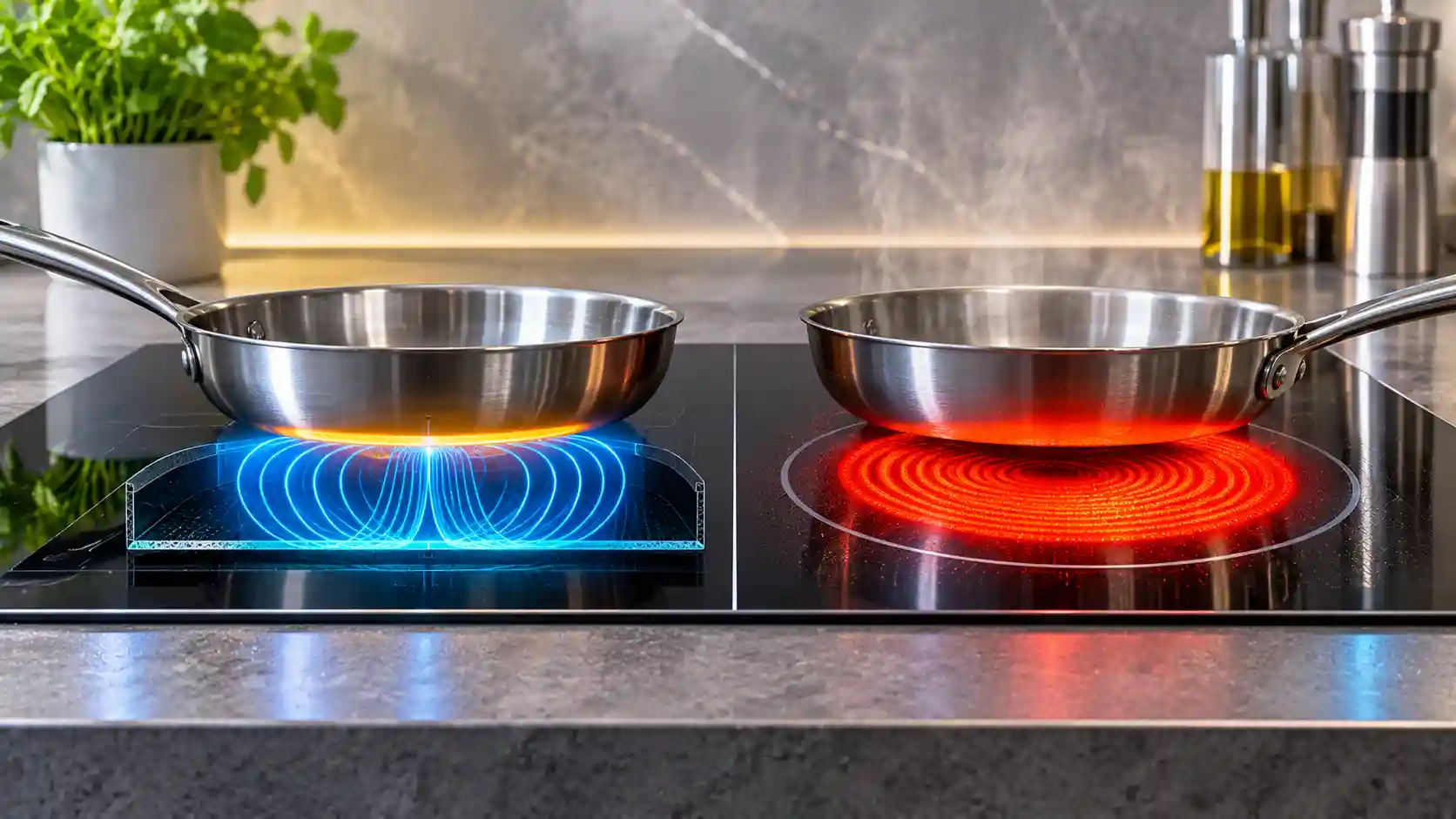
An induction hob contains a flat spiral coil of copper wire, often made from many fine insulated strands known as litz wire to limit losses at high frequency, mounted beneath the glass-ceramic surface with a ferrite layer behind it to concentrate the magnetic field upward. A power electronics stage, usually an inverter built around insulated-gate bipolar transistors, converts the mains supply to a high-frequency alternating current, typically in the range of 20 to 100 kHz, and drives it through the coil. By Ampère's law, the alternating current produces an alternating magnetic field around the coil, and by Faraday's law of induction, a changing magnetic field induces an electromotive force in any conductor within it.
When a ferromagnetic pan is placed on the hob, its base lies within that field. The induced voltage drives circulating loops of current, known as eddy currents, through the metal of the base. Because the metal has electrical resistance, the eddy currents dissipate power as Joule heating, at a rate equal to the square of the current multiplied by the resistance. The heat is generated directly within the pan base, not delivered to it from outside. Skin effect concentrates the induced current in a thin layer near the lower surface of the pan, whose depth, the skin depth, falls as frequency and magnetic permeability rise. A ferromagnetic material has a high relative permeability, which means the skin depth is small, typically a fraction of a millimetre at cooking frequencies, and the current is confined to a layer in which the effective resistance is high. This yields strong heating for a given current.
A second mechanism contributes in ferromagnetic materials. As the alternating field repeatedly reverses the magnetisation of the iron domains, energy is lost in each cycle as hysteresis, and this also appears as heat in the pan. Hysteresis loss is generally the smaller contribution at cooking power levels, with eddy-current Joule heating dominant, but it is a real effect and one reason ferromagnetic cookware heats so effectively. It also explains why the heating stops when the pan reaches the Curie temperature, above which the material loses its ferromagnetism, although cooking temperatures remain far below that point for common cookware steels. The phrase that induction excites iron molecules is a simplification: the physical mechanism is the combination of induced eddy currents and magnetic hysteresis within a conductive, ferromagnetic base.
The power transferred depends on how closely the coil and pan are coupled. The efficiency of the energy transfer from the inverter to the pan is high, commonly in the range of 85 to 90 per cent in test conditions, because the inverter and coil losses are modest, usually a few per cent each, and almost all of the induced power appears in the pan. The glass is heated only indirectly, by conduction from the hot pan base, so surface temperatures stay close to the pan temperature and well below the temperatures reached by resistive elements.
Nichrome ribbon: radiant ceramic hobs
A ceramic radiant hob, often called a ceramic or glass-ceramic hob, uses an electric resistance element beneath a glass-ceramic plate. The element is typically a coil or ribbon of nickel-chromium alloy, commonly known as Nichrome, chosen for its high resistivity and its ability to withstand repeated heating to red heat without oxidising away. An electric current passing through the ribbon dissipates power as Joule heating, and the ribbon rises to a temperature at which it glows. The heat it emits is delivered upward in two ways. A proportion is transmitted as infrared radiation through the glass-ceramic plate, which is designed to be transparent in the infrared, and the remainder is conducted through the glass, heating the plate itself. The plate in turn transfers heat to the pan by conduction across the contact area and by radiation and convection across any gap.
Several losses arise in this chain. The element heats its own insulating base and the hob body below it. The glass-ceramic plate is heated to high temperatures, which it radiates and convects into the room around the pan, and the exposed surface of the zone continues to lose heat. The pan must absorb the heat through its base, and any gap or warp reduces transfer. The thermal mass of the element and plate means the system has a substantial time constant, so that heat continues to flow into the pan after the power has been reduced, and equally it takes time to build when power is increased. Typical test efficiencies for radiant ceramic zones lie in the range of 60 to 70 per cent, which is consistent with the figure of around 65 per cent often quoted, though the value varies with pan fit and zone design.
Halogen: faster radiant delivery with the same fundamental limits
Halogen hobs are a variant of the radiant ceramic hob in which the heat source is one or more tungsten halogen lamps in place of, or in addition to, a resistive ribbon. The tungsten filament is heated to a very high temperature in a sealed envelope containing a halogen gas, which maintains the filament by redepositing evaporated tungsten, and it emits a large proportion of its output as visible and near-infrared radiation. The advantage is that the filament has very little thermal mass, so that the radiation begins within a fraction of a second of switching on, and the glass-ceramic plate, being transparent to short-wavelength infrared, transmits a larger fraction of the energy directly to the pan base than a cooler ribbon does. The practical result is a hob that visibly lights on demand and responds faster than a ribbon element.
The fundamental limits remain. A proportion of the infrared is absorbed by the glass and reflected by the pan, shiny pan bases being poor absorbers, and some radiation falls outside the pan footprint. The plate and surrounding structure still warm and retain heat, and the lamps are fragile and have a finite life. Efficiencies are broadly in line with other radiant technologies, with some improvement in response but only a modest gain in energy delivered to the food. The halogen hob is best understood as an optimisation of radiant delivery and not as a different heat-transfer mechanism.
Solid cast-iron plates: thermal mass as a design feature and a liability
The solid-plate hob, familiar from many older cookers, is a thick cast-iron disc with a resistive element embedded in or fixed beneath it. The element heats the iron by conduction, and the iron heats the pan by conduction from its upper surface. Cast iron is chosen for its robustness and its high heat capacity, and this thermal mass is simultaneously its defining property and its principal drawback. A plate with a mass of several hundred grams must be heated through its full thickness before it delivers much heat to the pan, which can take several minutes, and because the plate holds a large quantity of energy at high temperature, it continues to radiate and convect that energy long after the power is switched off.
The plate is also exposed. Its upper surface and its edge radiate into the room at temperatures that may reach several hundred degrees Celsius, and the portion of the plate not covered by the pan loses heat directly. Pan fit is critical, because a warped or undersized pan makes poor contact with the plate and wastes a large proportion of the heat. Typical efficiency under test conditions is around 55 to 60 per cent, with real-world performance often worse owing to the combined effect of long heating times, excess energy retained in the plate after cooking and mismatched cookware.
Electricity use and grid energy consumption
Boiling a litre: the arithmetic of efficiency
The efficiency percentages can be converted into units that households recognise. Taking the ideal requirement of 0.093 kWh to heat one litre of water from 20°C to 100°C, the electrical energy drawn is the ideal figure divided by the efficiency. At 90 per cent, induction needs roughly 0.103 kWh. At 85 per cent, it needs 0.109 kWh. At 65 per cent, a ceramic hob needs approximately 0.143 kWh. At 55 per cent, a solid plate needs approximately 0.169 kWh. In relative terms, the solid plate consumes roughly 60 per cent more electricity than induction for the same task, and the ceramic hob roughly 30 to 40 per cent more.
For a two-litre pan, the figures double, giving about 0.21 kWh for induction, 0.29 kWh for ceramic and 0.34 kWh for a solid plate. Applied across a year of cooking, the absolute differences are modest per boil but accumulate. A household that uses the hob for the equivalent of one litre of water boiled per day, plus other cooking of similar energy intensity, may use of the order of a hundred kilowatt-hours a year of hob electricity with induction, and perhaps 150 to 180 kWh with a legacy radiant or solid plate, though actual use varies widely with diet and habits. At current unit prices of the order of 25 to 30 pence per kWh, the annual operating cost difference is typically in the range of tens of pounds, which is real but small, and the main economic argument for induction relies on the combination of lower consumption, lower waste heat and faster cooking and not on running cost alone.
These figures consider only the heating of water to the target temperature. Real cooking includes simmering, in which a pan is held at a constant temperature against continuous heat loss from its sides and surface. In that regime the efficiency advantage of induction is generally maintained, because the energy supplied matches the loss from the pan, but the absolute power is low and the proportionate loss in a poorly matched radiant zone can be higher still, as the large idling element radiates heat to the room continuously.
Residual heat and ambient leakage
The test efficiency captures only the energy transferred while the pan is on the hob. It omits the energy stored in the hob after the power is removed. A solid plate may hold hundreds of kilojoules at the moment of switch-off and release it to the room over a period of ten to twenty minutes. A ceramic radiant hob stores less, but the glass-ceramic plate and the element remain hot for several minutes, and a hot zone indicator remains lit while this occurs. In principle, a skilled cook can exploit residual heat by switching off early and allowing the stored energy to complete the cooking, but in practice most households do not do this consistently, and the residual heat is lost to the kitchen.
Induction has almost no equivalent. When the coil is switched off, or when the pan is removed, the generation of heat stops within milliseconds, because the heat is produced in the pan and not in the hob. The only residual heat in the glass is the small amount conducted from the base of the pan, and that is lost to the pan and the room within moments. Induction hobs also detect the absence of a pan and cut the power to the coil automatically, so that an empty zone draws only the standby power of the electronics. This is the sense in which induction has a near-instant zero-load shutoff, and it is the reason the dissipation of heat into the room, sometimes a nuisance in summer and an extra cooling load in an air-conditioned home, is lower with induction than with any of the other three technologies.
Kitchen heat gains and the whole-building effect
Wasted heat does not vanish; it becomes an internal gain. In a winter kitchen the gain offsets some heating demand, which has led some commentators to describe resistive hob losses as costless. That is a misleading simplification. The gain is delivered to the room where cooking occurs, at the time of cooking, whether or not heating is wanted, and it is usually extracted by the extractor hood, which discharges the warm air outdoors. In a well-insulated, airtight home, the kitchen is a space where unwanted heat gain can cause overheating in warm weather. Lower waste heat therefore reduces the burden on ventilation and on summer comfort, which is a consideration for building services specifiers designing to modern energy standards. The more efficient the hob, the more of the electricity is converted to useful heat in the food and the less is dispersed through the building envelope in an uncontrolled manner.
Control granularity and usability
Response latency across the four platforms
The control experience is determined by how quickly the heat delivered to the pan changes after the user changes the setting. This is a function of the thermal inertia between the point of heat generation and the food. The solid cast-iron plate has the highest inertia and the most sluggish response. Heating from cold to full operating temperature can take several minutes, a reduction in setting may take many minutes to take effect, and the plate remains hot after switch-off. A cook accommodates this by anticipating changes well in advance, or by moving the pan off the plate, which in itself is a recognised technique with legacy hobs.
The ceramic radiant hob is somewhat faster, with a ribbon element that glows within several seconds and delivers meaningful heat to the pan within perhaps 10 to 30 seconds, but the glass plate and element retain heat, so that reducing the setting produces a slow decline. The halogen hob is faster in heating, because the lamp radiates almost immediately, but its cooling is limited by the glass plate in the same way as the ceramic hob. Induction responds within a fraction of a second, because the inverter changes the power delivered to the coil within a few milliseconds and the pan base heats almost at once, limited only by the thermal mass of the pan itself. The result is a degree of control that is, in practical terms, digital: a simmer can be reached and held without overshoot, and the power can be changed in small steps, with many hobs offering a dozen or more levels and some with continuous adjustment. The final comparison with gas is reasonable in this respect, since a gas flame also responds nearly instantly, and induction matches it with a more consistent, repeatable output and without a naked flame.
Pan selectivity and its practical limits
The principal usability constraint of induction is pan compatibility. The system depends on coupling between the coil and a conductive, preferably ferromagnetic, pan base. Cast iron, enamelled steel and most stainless steels with a magnetic base layer work well. Pans made of aluminium or copper alone are poor candidates, because these materials are non-magnetic and have very low resistivity, so that the induced eddy currents encounter little resistance and generate little heat at standard frequencies, and the hob may not detect the pan at all. A simple test is whether a magnet sticks firmly to the base. Many modern pans address the limitation by incorporating a ferromagnetic stainless disc into the base, and some hobs use specialised high-frequency modes or interface discs, with reduced efficiency, to heat non-magnetic cookware. Households replacing a hob with induction should therefore audit their cookware, and the cost of replacing incompatible pans should be included in the economic assessment. By contrast, ceramic, halogen and solid-plate hobs work with any pan, although flatness of the base remains critical.
Pan size and position also matter. Induction zones detect the pan diameter and may refuse to operate below a minimum size, and small pans may be heated less efficiently on large zones. Flexible or bridging zones, which combine several coils under a larger area, allow large griddle plates and oval pans to be used, and they allow the pan to be moved with the heating following it. The physical noise of induction is a minor usability consideration: a high-pitched hum or buzz can occur when the pan base vibrates in the magnetic field or when two zones operate at nearby frequencies, and it is generally more noticeable with pans of lower quality at high power.
Safety and maintenance vectors
Surface temperature and burn risk
The surface temperature profile differs sharply between technologies. On a radiant ceramic or halogen hob, the glass-ceramic plate over the active zone is heated directly by the element and may reach 500°C or more at full power, and the plate remains dangerously hot for many minutes after switch-off, which is why hot-zone indicators are mandatory. A solid plate surface may reach several hundred degrees Celsius, and it presents an obvious hazard that remains for a long time after use. In each case, a person or an item contacting the surface can suffer severe burns or ignition, and the hot surface will carbonise anything spilled on it.
On an induction hob, the glass is heated only by conduction from the base of the pan, so its temperature cannot meaningfully exceed that of the pan base and generally remains lower. After the pan is removed, the glass cools quickly, usually within a minute or two, since only a thin film of residual heat remains. This does not mean that the glass is cool during use. A pan holding boiling water or hot oil conducts considerable heat to the glass beneath, which may be 100°C or more, and the hob still displays a hot-surface warning. It does, however, reduce the severity and the duration of the hazard materially, and it removes the risk of a cold zone that appears safe while remaining a heat source. Induction also removes the risk of switching on an empty zone with an item resting on it, because the system detects the absence of a suitable pan and does not generate heat, and unsuitable items such as paper, plastic or a wooden spoon on the hob are not heated by the field. A metal object, such as a knife or a ring, on an active zone can be heated, so that this is not an absolute protection. Medical device compatibility should also be assessed for individuals with implanted pacemakers, since induction coils generate strong fields in the immediate vicinity, and manufacturers publish guidance on minimum distances.
Food-burning, polymerisation and cleaning
The surface temperature has a direct effect on cleaning. When a sugary or fatty spill reaches a very hot glass surface, it is rapidly dehydrated and polymerised into a hard, carbonised deposit that adheres strongly to the glass and may require scraping, specialised cleaning products and effort, and in severe cases may leave permanent marks. On an induction hob, a spill near the pan lands on a surface that is much cooler, and its carbonisation is limited, so that most spills wipe away with a damp cloth. The comparison is greatest with a solid plate, on which a spill is burnt on at once and the plate itself needs periodic cleaning and sometimes re-blacking, and where residues can smoke and produce odours.
The maintenance profile of each technology has other dimensions. A radiant hob has a simple structure, its elements are replaceable and the main failure modes are broken glass and failed elements or control switches. A halogen lamp has a finite life and may need replacement. A solid plate is mechanically robust but prone to rust if left wet, and its elements can fail, though replacement is simple and cheap. An induction hob has no moving parts or hot elements, but it contains power electronics, with capacitors and semiconductors that are sensitive to heat and to supply quality, and it relies on a fan to cool the electronics. Repair is more specialised and may be more costly, and the glass-ceramic top is prone to scratching from rough pan bases and to cracking from impact in the same way as radiant hobs. A reputable manufacturer's warranty and the availability of spare parts are therefore important criteria for specifiers who expect a product life of ten years or more.
Comparative matrix: four electric hob architectures
The matrix below consolidates the engineering contrasts discussed above. Efficiency ranges reflect typical test conditions with a well-fitting, flat-based pan, and real-world values will usually be lower, particularly for radiant and solid-plate technologies. Power figures are representative of domestic products in the UK market.
| Hob Technology Topology | Core Heat-Transfer Mechanism | Typical Thermal Efficiency Range | Electrical Power Demand & Control | Usability & Maintenance Profile |
|---|---|---|---|---|
| Induction: litz copper coil and ferrite beneath glass-ceramic, driven by a high-frequency inverter | Alternating magnetic field at roughly 20 to 100 kHz induces eddy currents and hysteresis loss directly in the ferromagnetic pan base; heat is generated in the vessel. | Approximately 85 to 90 per cent; about 0.10 to 0.11 kWh to bring one litre of water from 20°C to boiling. | High peak power per zone, commonly 2 to 3.7 kW with boost modes, and total hob ratings up to roughly 7.2 kW on a dedicated circuit; response within milliseconds, with zero load when no pan is present. | Requires magnetic cookware; cool, easily cleaned glass; lowest burn risk; electronics repair more specialised; possible audible hum; pacemaker guidance applies. |
| Ceramic radiant: Nichrome ribbon element beneath glass-ceramic plate | Resistive heating of the ribbon; infrared radiation through the plate and conduction through the glass to the pan. | Approximately 60 to 70 per cent; about 0.14 kWh per litre. | Zone ratings of roughly 1.2 to 2.4 kW; energy regulator cycles the element, giving slower power adjustment; heats and cools over tens of seconds to minutes. | Works with any flat pan; hot glass for several minutes after use; spills carbonise; simple, replaceable elements and controls. |
| Halogen: tungsten halogen lamps, often combined with a ribbon, beneath glass-ceramic | Short-wavelength infrared emitted by the lamp, largely transmitted through the plate to the pan base, with conduction from the heated glass. | Approximately 60 to 70 per cent, comparable to ceramic; slightly faster delivery of heat, with a similar overall loss to the room. | Similar zone ratings to ceramic; near-immediate light output and rapid heating, but a slower decay while the glass cools. | Any flat pan; very hot surface; fragile lamps with finite life; shiny pans absorb radiation poorly. |
| Solid plate: resistive element embedded in a thick cast-iron disc | Conduction from element to iron mass to pan base, with substantial radiation and convection from the exposed plate. | Approximately 55 to 60 per cent; about 0.17 kWh per litre, before residual heat is counted. | Plate ratings of roughly 1 to 2 kW; extreme thermal lag, with several minutes to heat or cool and long residual heat release. | Any flat-based pan; durable but exposed, scorching surface; burnt-on spills; rust and re-blacking; simple cheap repair. |
The pattern is that induction diverges from the other three in the location of heat generation, and everything else follows from that difference. Moving the heat source from a hob element, which must heat itself and its surroundings before it heats the pan, to the pan base itself eliminates the intermediate thermal mass. That change simultaneously raises efficiency, shortens latency, reduces residual heat and lowers surface temperatures. The three legacy technologies differ from each other mainly in the speed of their response and in the degree to which heat is retained, and they share a structural dependence on heating a hob surface first.
Electrical installation and grid demand
Efficiency does not remove the need to consider electrical load. Induction hobs achieve fast cooking by delivering high power into a small area, and a four-zone hob may have a rated input of around 7 kW, with boost functions that raise individual zones above their normal output. In the United Kingdom, a hob of this rating is normally installed on a dedicated circuit protected by a 32 A device, and in many homes this circuit already exists for a previous electric cooker. Properties that have cooked with gas have no such circuit, so the upgrade may involve a new cable run, a consumer unit modification and, in a few cases, an assessment of the incoming supply capacity. Specifiers should check the existing supply, the diversity applied to cooking appliances, and the effect of other loads such as electric vehicle charging and heat pumps, which may be operating at the same time.
Many induction hobs include power management, which limits the total power drawn by sharing it across zones, so that the maximum simultaneous demand can be restricted to a lower value, such as 3.6 kW or 4.6 kW, to suit a 16 A or 20 A circuit or a constrained supply. The trade-off is slower cooking when several zones are used at maximum. Because cooking events are short, the effect on the cook is generally modest, and the capability gives the specifier a means of electrifying cooking without a major supply upgrade in homes where one would be costly.
From a grid perspective, cooking demand coincides with the early evening peak, when overall demand is already high. A single hob in operation at several kilowatts for 20 minutes is a small load, but aggregated across millions of homes, the shift from gas to electric cooking adds to the evening peak, and the efficiency of the hob has a direct effect on the amount. Because induction needs less energy for the same task, and delivers it more quickly, it reduces both the energy and, in many cases, the duration of the load compared with the other electric options. The overall peak implication of kitchen electrification should be understood in the context of other electrification loads, and managed through measures such as smart tariffs, power management in appliances and, in time, demand flexibility, though cooking is a poor candidate for load shifting because the timing is dictated by mealtimes.
Carbon implications and the comparison with gas
The carbon case for electric cooking depends on the carbon intensity of the electricity supply and the efficiency of the appliance. Gas hobs typically convert a lower proportion of the energy in the fuel to useful heat in the pan than induction does to the electricity, with figures often quoted in the range of 40 to 55 per cent, because much of the combustion heat passes around the pan and into the room. Even when gas has a lower primary energy cost per unit than electricity, the efficiency difference narrows the gap in running cost and, as the electricity grid decarbonises, widens the gap in carbon emissions. The fact that gas combustion releases nitrogen dioxide and other pollutants into the kitchen, and that these are associated with respiratory effects, is an additional consideration for indoor air quality, and induction removes that source from the home.
For carbon-reduction consultants, the sound approach is to compare appliances on delivered-heat basis. An induction hob that needs 0.10 kWh of electricity to heat a litre of water emits, at a grid intensity of around 150 grams of CO2 per kWh, approximately 15 grams. A gas hob delivering the same heat at 50 per cent efficiency draws about 0.19 kWh of gas, which at around 180 to 200 grams of CO2 per kWh emits roughly 35 to 40 grams. These are illustrative figures, and the grid intensity changes by the hour and by year, but the direction of the comparison is consistent, and it moves further in favour of induction as the electricity supply decarbonises. By the same reasoning, replacing a gas hob with a radiant ceramic hob at 65 per cent efficiency also reduces the carbon emissions of cooking, but by less than induction, and it forgoes the efficiency and safety gains that make induction more effective as a decarbonisation measure.
Recommendations for specifiers, designers and consultants
The audit supports a set of practical recommendations. They are intended as a starting point for specification and advice, and they should be adapted to the particular dwelling, the occupants and the supply.
- Default to induction in new and refurbished kitchens. Specify induction where cookware compatibility, supply capacity and budget allow, as the highest-efficiency, lowest-residual-heat and lowest-burn-risk option.
- Audit cookware before specifying. Test existing pans with a magnet, account for the cost of replacements and provide guidance to occupants on suitable materials, including pans with magnetic bases.
- Check the electrical supply early. Confirm the existing circuit, the incoming supply capacity and the diversity of other loads, and use the hob's power-management settings where a supply upgrade would be disproportionate.
- Treat radiant options as a constrained choice. Where induction is unsuitable, for example because of budget, vulnerable users who rely on non-magnetic cookware or specialised applications, prefer ceramic or halogen over solid plates, and advise on pan fit, lids and residual-heat use to limit waste.
- Specify for safety and cleaning. In homes with young children, older occupants or people with limited mobility, the reduced surface temperature and shorter cooling time of induction offer material safety benefits, subject to pacemaker guidance where relevant.
- Plan for ventilation and indoor air quality. Even with electric cooking, frying and grilling produce particulates and moisture, so an effective extraction system remains necessary, and the lower heat output of induction may allow smaller airflow rates in some designs.
- Design for the whole system. Consider the hob alongside the oven, the extraction, the tariff and any on-site generation or storage, so that kitchen electrification supports and does not strain the household's wider energy strategy.
Where the evidence is thin
Several caveats apply to the figures in this article. Laboratory efficiency figures are measured under controlled conditions with well-matched pans, and real-world efficiency depends heavily on pan fit, lids, volume and cooking technique, so that the gap between technologies in practice may differ from the gap in tests. Published efficiency ranges vary between sources and test methods, and the figures of 55 and 65 per cent for solid-plate and ceramic hobs, and 85 to 90 per cent for induction, are representative values and not guarantees. Annual energy use depends on household behaviour in ways that are difficult to generalise, and the carbon comparison depends on grid intensity, which varies continuously. The long-term reliability of induction power electronics in domestic use is still being established as the installed base ages. These uncertainties do not alter the direction of the conclusions, but they argue for a measured presentation of savings to householders and for the use of ranges instead of single figures.
Conclusion: the efficiency of generating heat where it is needed
The central finding of the audit is simple and physical. A hob that heats its own surface before it heats the pan loses energy at every stage, in the element, the plate, the exposed surface and the residual heat that lingers after cooking. A hob that generates heat inside the pan loses very little of it. Induction achieves this by using a high-frequency magnetic field to induce eddy currents and hysteresis loss directly in the base of a ferromagnetic vessel, which raises test efficiency to 85 to 90 per cent against roughly 65 per cent for ceramic and 55 per cent for solid plates, reduces the electricity needed to boil a litre of water by roughly a quarter to two-fifths, stops generating heat the instant the pan is lifted and leaves a glass surface that is far cooler and easier to clean.
The trade-offs are practical and manageable: a requirement for magnetic cookware, a higher peak electrical demand that may call for a dedicated circuit or power management, and a more specialised repair profile. For residential building services specifiers, clean-tech appliance designers and domestic carbon-reduction consultants, the conclusion is that induction is the engineering-led default for electrified cooking, that the legacy radiant technologies are acceptable only as constrained alternatives, and that the benefits of the technology are realised most fully when the hob is specified as part of a coordinated approach to supply, cookware, ventilation and household energy use.