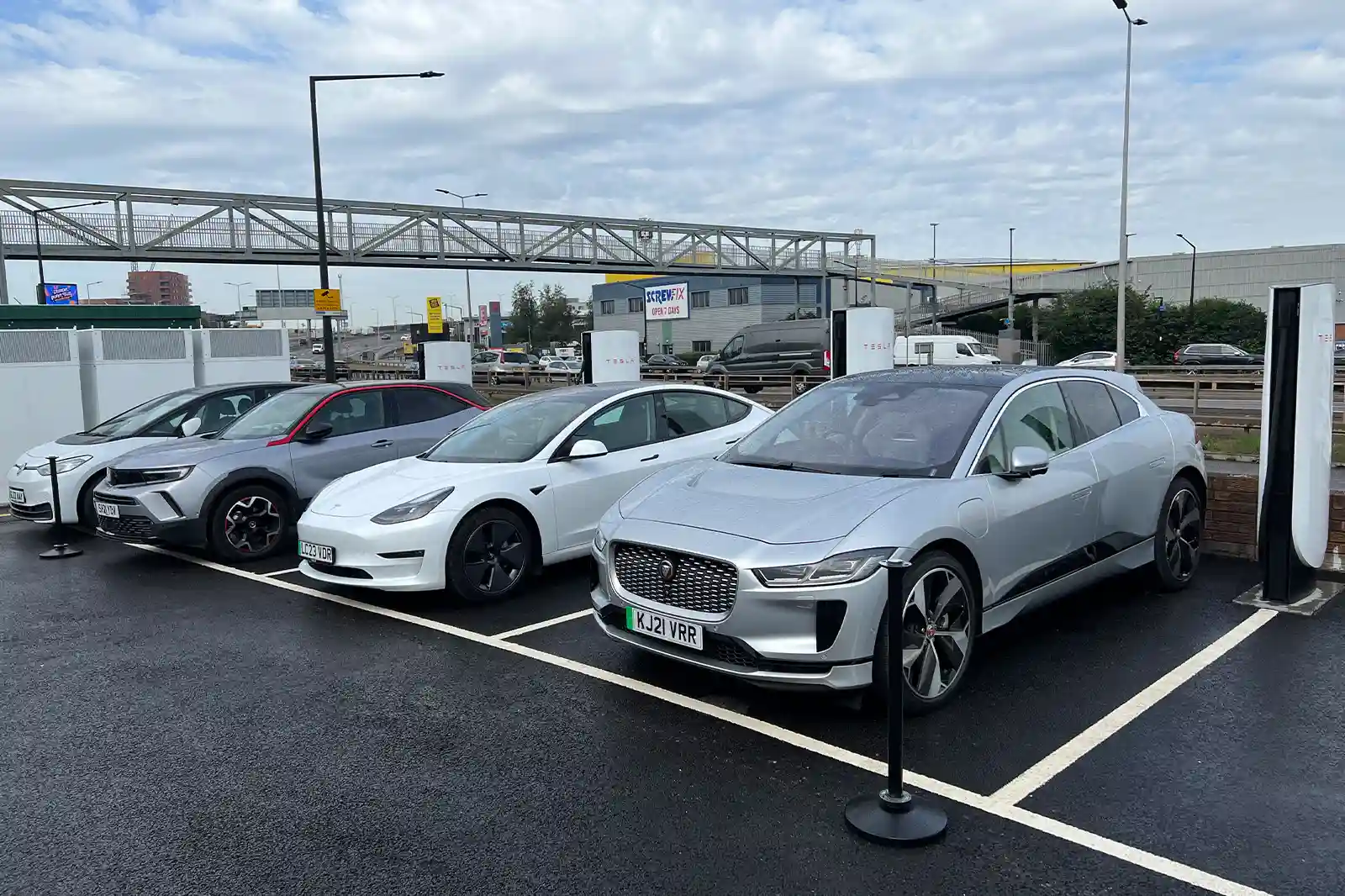
Opening the Tesla Supercharger network to other manufacturers has turned the UK's most densely engineered rapid-charging estate into a shared asset. For fleet managers, EV logistics specifiers and technology deployment analysts, the headline appeal is straightforward: high availability, consistent uptime and competitive pricing. The operational reality, however, is determined less by software and more by stall generation, cable geometry and tariff structure. This audit deconstructs each of the three.
Hardware generations: from V1 to V4
The Supercharger estate is not a homogeneous fleet. It is a layered deployment of four architectures installed over more than a decade, and each imposes different constraints on a non-Tesla vehicle. Identifying the generation before arrival is the single most effective way to remove charging friction from a route plan.
The earliest V1 units, rated at 90 or 120 kW, share their power electronics between paired posts, so output falls when a second vehicle connects to the neighbouring charger. They are legacy infrastructure and rarely encountered on active trunk networks. V2 stalls, at 120 or 150 kW, retain the same paired-cabinet power sharing and use twin-tethered lines, and non-Tesla configurations must align exclusively with the CCS2 option. In practice, a V2 site can quietly halve a vehicle's charging rate if the neighbouring bay is occupied, which matters for any schedule that assumes a fixed dwell time.
V3 is the architecture that most non-Tesla drivers will encounter. Rated at 250 kW, it uses a thinner, lighter, liquid-cooled cable and delivers peak power straight to a single vehicle channel without the traditional paired-cabinet split. Liquid cooling is what allows a slim conductor to carry high current without excessive resistive heating, but it also constrains the practical cable length to roughly 1.98 metres. V4, at 325 kW, is the first generation designed with open access in mind: a longer cable, a revised and taller structural profile, and integrated contactless bank card readers that bypass app-only mandates.
| Generation | Power Output | Technical & Operational Characteristics |
|---|---|---|
| V1 | 90 or 120 kW | Power output reduced when another vehicle is plugged into the paired, typically neighbouring, charger. Highly legacy infrastructure rarely encountered on active trunk networks. |
| V2 | 120 or 150 kW | Power output reduced when another vehicle is plugged into the paired, typically neighbouring, charger. Twin-tethered lines where non-Tesla configurations must align exclusively with the CCS2 option. |
| V3 | 250 kW | Equipped with a thinner, lighter cable that utilises liquid cooling. Delivers peak power straight to single vehicle channels without traditional paired cabinet splits. |
| V4 | 325 kW | Equipped with a longer cable for charging non-Tesla vehicles easily. Features a revised, taller structural profile incorporating integrated contactless bank card readers to bypass app-only mandates. |
Note that rated power is a ceiling on the post, not a guarantee at the vehicle. Actual delivery is bounded by the vehicle's own maximum DC acceptance rate, battery temperature and state of charge, and the 400-volt or 800-volt architecture of the pack. A vehicle limited to 150 kW gains nothing from a V4 post's 325 kW rating other than the geometric and payment benefits.
Cable geometry and the parking-bay conflict
The operational friction of the open network is strictly dictated by vehicular geometry. Drivers of electric vehicles utilising a rear-left charge port placement can utilise standard V2 and V3 supercharging architecture exactly like a native Tesla, parking forward normally without straining the infrastructure. However, vehicles with opposing charging port layouts—such as a rear-right or front-left configuration—create acute layout conflicts. To make the 1.98-metre liquid-cooled V3 cable reach their vehicle's inlet, these drivers are structurally forced to position their car in the adjacent bay. This effectively hijacks the charging post intended for the neighbouring spot, taking a second charging asset offline and inducing significant congestion friction during high-demand periods. This geometric bottleneck is only eliminated through the deployment of newer V4 infrastructure hardware, which mounts an extended, uncooled over-the-top cable track that easily bridges the entire length of the vehicle regardless of port placement.
From a systems perspective, the consequence is a reduction in effective site capacity. Every non-conforming vehicle consumes two bays for the output of one, which lowers throughput per square metre of hardstanding and can push queue times beyond what the site was designed for. Fleet operators running mixed vehicle types should therefore characterise each model in the fleet by port position and cable reach, and maintain a standardised list of which vehicles can safely use V2 and V3 sites without blocking a neighbouring stall. Reversing into a bay, or parking nose-out, is sometimes used to bring an inlet closer to the post, but it is not a reliable substitute for cable length and may conflict with site markings.
The V4 design choice of an uncooled, over-the-top cable track trades a degree of current-carrying efficiency for reach. Without liquid cooling the conductor must be thicker and heavier, but because the track supports the weight, the user handles a cable that is mechanically manageable while spanning the full vehicle length. It is a considered engineering compromise that favours universal access over a marginal reduction in cable mass.
Payment, access and the contactless shift
Early access for non-Tesla vehicles has depended on a smartphone app, with account creation, payment method registration and a stable mobile signal at the site. For commercial fleets this introduces avoidable points of failure: driver devices, account ownership and expense reconciliation. The contactless bank card readers integrated into V4 posts remove the app dependency, simplify reimbursement through standard card statements and reduce the time between arrival and the start of charging. Until V4 is widespread, fleets should assume the app route remains the default and plan for it in onboarding.
Subscription financial math: the £9.99 tipping point
Non-Tesla drivers pay a higher per-kilowatt-hour rate than native Tesla owners unless they take a monthly membership at £9.99. The membership is a fixed fee that buys a lower unit rate, so the economic question is the break-even volume: the monthly energy throughput at which the cumulative per-kWh saving equals the fee.
The break-even equation is simple: monthly fee divided by per-kWh saving. A £9.99 fee divided by a saving of roughly 14 pence per kWh gives approximately 70 kWh per month. Below this volume, the fixed fee exceeds the saving and the pay-as-you-go rate is cheaper. Above it, every additional kilowatt-hour widens the advantage, and the effective fee is diluted to a negligible per-unit cost. A driver consuming 70 kWh has effectively neutralised the fixed fee and gains per-kWh parity with native Tesla fleets, though only the active member rate is relevant to this calculation and the exact pence figures should be verified against the live tariff at the point of purchase.
To put 70 kWh in context, a typical mid-sized EV consuming around 17 to 20 kWh per 100 km would use that energy to add approximately 350 to 400 km of range. Any driver or vehicle that rapid-charges for even one long journey per month will exceed the threshold. For a fleet of vehicles that cover significant motorway mileage without access to depot charging, the membership is almost always the correct choice per vehicle, whereas for drivers who charge at home and use rapid charging only occasionally, pay-as-you-go remains cheaper.
Fleet managers should model this per vehicle rather than per fleet, because the fee is levied per account. A balanced approach is to take memberships only for the vehicles that reliably exceed the threshold and to monitor monthly kWh drawn so that accounts can be switched on or off as duty cycles change. This is a straightforward form of asset-optimisation: align fixed cost with measured utilisation.
Engineering verdict
The open Supercharger network is a strong proposition for non-Tesla vehicles, with reliability and pricing that few operators can match. Its weaknesses are concentrated and predictable. Rear-left inlet vehicles operate on near-equal terms; vehicles with other inlet positions will frequently occupy two bays on V2 and V3 sites; and V4 removes both the cable and payment constraints. The recommended deployment is therefore to map the fleet by inlet position, prioritise V3 and V4 sites in route planning, avoid paired V2 posts when schedules are tight, and adopt the £9.99 membership only where monthly throughput exceeds approximately 70 kWh.