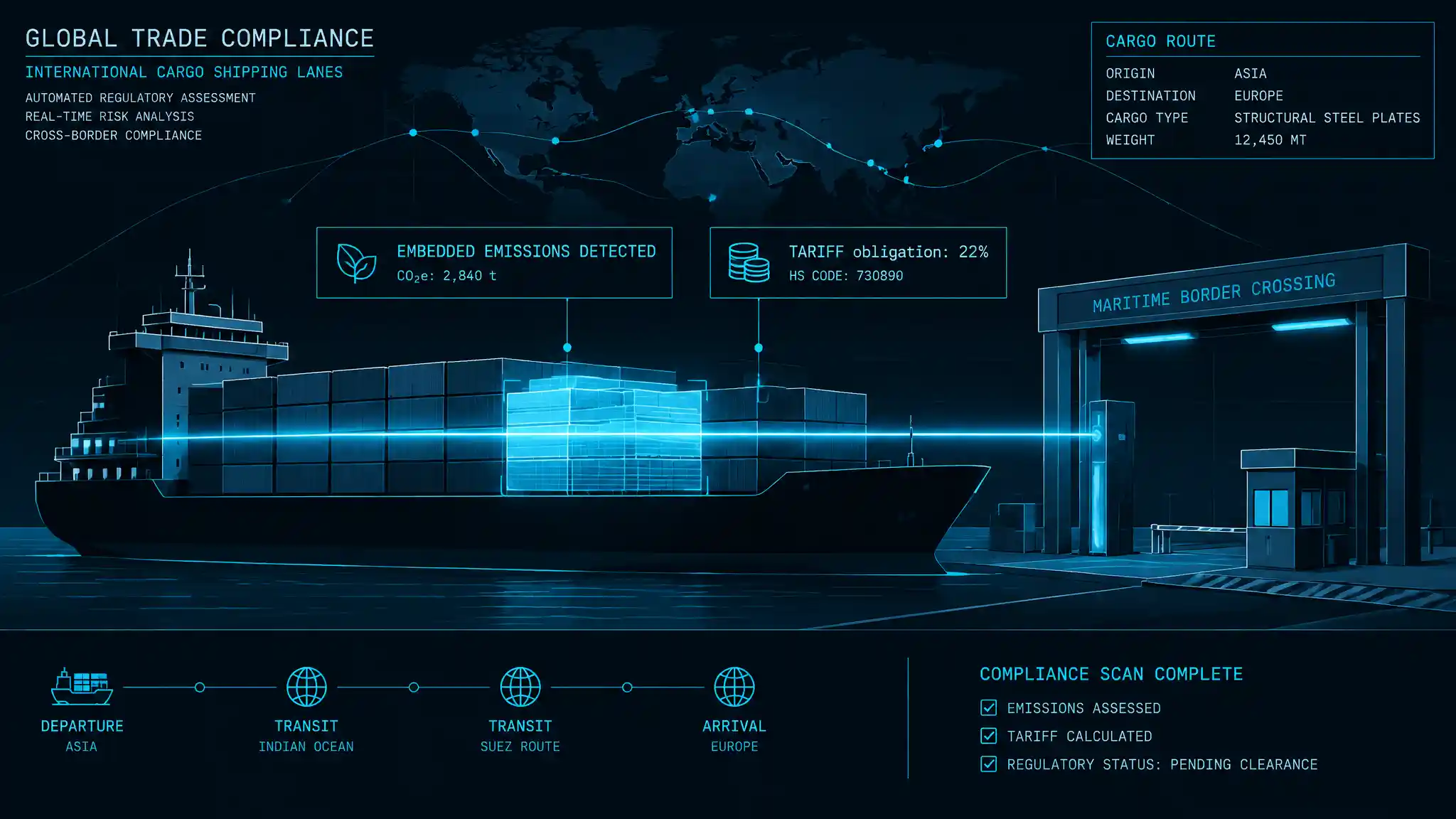
Breaking the Embedded Emissions Monopoly
CBAM is not a tariff in the conventional trade-defence sense. It is a balancing tariff, built to close one specific loophole: a domestic producer paying full UK/EU ETS carbon prices competing against an overseas foundry paying none.
Before CBAM, that gap was pure arbitrage. A European steelmaker prices carbon into every tonne it produces, via allowances purchased or surrendered under the EU Emissions Trading Scheme. A coal-powered foundry outside that scheme prices in nothing. The imported tonne wins on price for a reason that has nothing to do with productivity, labour cost, or capital efficiency — it wins because its embedded emissions are invisible to the ledger.
CBAM makes them visible, and priced. The mechanism now covers six core material categories: steel, aluminium, cement, fertiliser, electricity, and hydrogen — the sectors where EU ETS carbon pricing already bites hardest domestically, and where an unpriced import was doing the most competitive damage.
One regulatory distinction matters here, and most coverage of this glosses over it. The EU CBAM is the regime already in definitive, financial force, as of 1 January 2026. The UK's own CBAM is legislated but not yet live — it is due to start 1 January 2027. A UK manufacturer today faces CBAM exposure as an exporter into the EU, under the EU's regime, a full year before its own domestic imports face the same certificate obligation. Treating the two as a single, simultaneous event is a compliance-planning error.
Actuarial Realities: Calculating the Embedded Carbon Premium
Run the math on a real procurement decision: 500 tonnes of structural steel plate, sourced from an unmitigated, coal-powered Blast Furnace–Basic Oxygen Furnace (BF-BOF) foundry with no domestic carbon price of its own.
BF-BOF steel carries embedded emissions of roughly 2.1 tCO2 per tonne of finished plate — coke performing double duty as both fuel and chemical reducing agent, exactly the route this report's companion analysis on the EAF transition sets out in full. At a representative certificate price of £70/tCO2, tracking the weekly average EU ETS auction price CBAM certificates are pegged to, that shipment carries a certificate liability of:
500 tonnes × 2.1 tCO2/tonne × £70/tCO2 = £73,500 in CBAM certificates, on top of the commercial contract price.
Expressed per tonne, that is £147 added to the landed cost of every tonne of plate. Against a representative £550–650/tonne contract price, the certificate liability alone is a 22%–27% cost uplift — landing directly on the buyer's structural margin line, not the seller's.
Critically, that liability is not fixed. CBAM's default methodology assigns a punitive, above-average emissions intensity to any shipment without verified supplier data. An importer who cannot produce certified emissions figures pays the assumed-worst-case rate, not the actual one. The certificate cost above is the floor a compliant supplier can prove, not the ceiling an unverified one gets charged.
The Phase-Out of Free Allowances
None of this border liability is static. For domestic EU and UK manufacturers, a second regulatory mechanism is moving in lockstep with the border tariff: the phased withdrawal of free allocations. Historically, heavy domestic industries received a baseline pool of no-cost carbon allowances under the UK/EU ETS to protect them from international carbon leakage.
As CBAM transitions into full certificate enforcement, these free allowances are being systematically drawn down to zero. A domestic producer cannot simply look to wait out the border adjustment; their own regulatory shielding is being dismantled at the exact same rate overseas competitors are forced into the compliance architecture.
The Sourcing Pivot: De-risking the Supply Chain
The procurement response is not a hedge against price volatility. It is a structural change to what gets bought, and from whom.
- Audit supplier carbon intensity data now, not at the next contract renewal. A supplier who cannot produce tonne-for-tonne emissions figures is, by default, the highest-liability supplier CBAM's methodology can assign.
- Demand certified Environmental Product Declarations (EPDs) on every material line covered by CBAM. An EPD is the verified alternative to the default value — the single document that converts an assumed worst-case certificate bill into an actual, defensible one.
- Shift sourcing toward the two pathways that actually clear the embedded-carbon bar. For virgin steel, that is hydrogen-fed Direct Reduced Iron (DRI): hydrogen used as a chemical reducing agent has no viable substitute in primary iron metallurgy, which is exactly why our own analysis of the green hydrogen debate rates it the one industrial hydrogen use case that survives round-trip-efficiency scrutiny. For everything that doesn't need virgin ore, that is scrap-fed Electric Arc Furnace (EAF) steel — a route that cuts direct site emissions by upwards of 85% against legacy BF-BOF, detailed in full in our EAF transition report.
Cross-Linking Continuity
CBAM does not reward switching suppliers for the cheapest unmitigated tonne. It rewards designing the embedded-carbon liability out of the bill of materials before the certificate bill is ever calculated.
This platform's own chassis architecture, detailed in Part 3: The Monolithic Chassis & Form, does exactly that by accident of a different objective: replacing 140+ stamped steel components with two aluminium megacastings and unpainted flax-fibre body panels doesn't just delete a body shop and a paint line, it deletes most of a CBAM-exposed steel bill of materials in the same stroke. One caveat is worth stating precisely, since Part 3 doesn't: aluminium is itself a CBAM-covered material, and a megacasting's embedded-carbon advantage depends entirely on sourcing recycled or hydro-smelted aluminium rather than a coal-grid primary smelter — the exact same sourcing discipline this report applies to steel applies, unchanged, to the casting alloy itself.
- ← The EV Blueprint Index
- Part 3: The Monolithic Chassis & Form — the megacasting and flax-fibre bill of materials this pivot describes →
- Electrifying British Steel: The EAF Transition and the UK Grid's Peak Load Problem →
- The UK Green Hydrogen Industrial Decarbonisation Fallacy — why DRI steelmaking is the exception, not the rule →