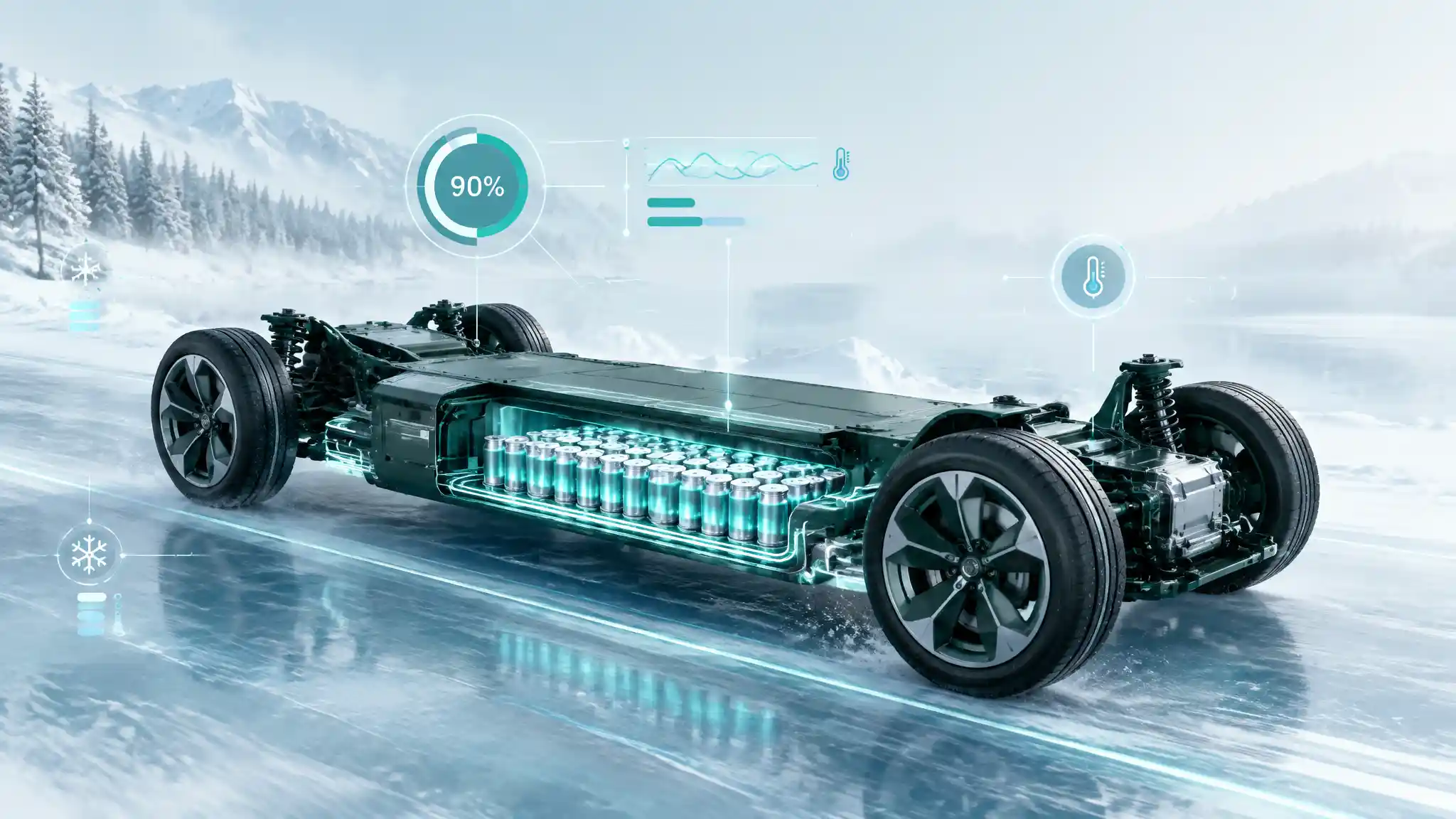
Every winter, the same story repeats across British EV forums: a driver plugs in a route that should easily clear their battery's rated range, and watches it evaporate. Standard ev winter range loss comparison data is brutal reading for current lithium-based cars — drivers routinely lose 20% to 35% of their highway range the moment temperatures dip toward 0°C.
The industry's usual answer is better software: smarter pre-conditioning, more aggressive route planning, bigger buffer margins. That treats the symptom, not the cause. The cause is chemical, not software. And it points to a contrarian conclusion: sodium-ion isn't just a cheaper alternative to lithium — from a thermal physics perspective, it's a genuinely superior cold-climate chemistry.
The Physics of Freezing: Internal Resistance Explained
Every battery chemistry suffers from the same core limitation in the cold: internal resistance battery cold temperature behaviour spikes as the mercury drops. How badly it spikes, and what the car has to do about it, is where the chemistries diverge sharply.
LFP battery winter degradation follows a well-documented pattern. The liquid electrolyte in a standard Lithium Iron Phosphate cell becomes measurably more viscous in the cold, slowing lithium-ion diffusion between the electrodes. Push current through a cold LFP cell too aggressively and you risk lithium plating — metallic lithium depositing on the anode surface instead of intercalating properly, a failure mode that permanently and irreversibly damages the cell. To prevent it, the vehicle's battery management software aggressively throttles both charging and discharging rates the moment cell temperature drops, which is exactly the range and charging-speed penalty drivers feel.
Sodium-ion cells don't share that failure mode in the same way. Sodium ions maintain high desolvation kinetics and mobility through hard-carbon anodes even at extreme sub-zero temperatures — the ion simply moves through the structure more freely in the cold than lithium does, one of the manufacturing advantages we unpack in full in our sodium-ion revolution deep dive. Industry benchmarks now show 90% capacity retention at -20°C, with functional discharge capability persisting down to -40°C. That's not an incremental improvement. It's a different category of cold-weather behaviour.
The Efficiency Asymmetry: Thermal Management Overheads
The range lost to cold isn't just about slower ion movement — it's about where the energy actually goes. This is the hidden cost inside every battery thermal management system EV (BTMS) in a lithium-based car.
To keep an LFP or NMC pack inside its happy operating window — typically 15°C to 35°C — the car has to actively warm it. That means diverting 3kW to 7kW of power from the main traction battery into resistive PTC heaters or a heat pump, purely to bring the cells up to a temperature where they'll behave predictably. That's energy taken directly from the range budget before a single mile is driven.
Sodium-ion breaks that trade-off. Because the chemistry functions naturally at low temperatures, its BTMS can stay passive, or run at minimal power, through a cold start:
- No large upfront energy spend just to bring the pack "online."
- No aggressive derating of charge/discharge rates while the pack slowly warms.
- The electricity a lithium car would spend warming its battery is instead spent propelling the car.
That's the efficiency asymmetry in one sentence: lithium chemistries spend energy fighting the cold; sodium-ion chemistries largely ignore it.
150kW Rapid Charging in the Cold: No Pre-Conditioning Required
Every UK EV driver knows the specific frustration of rolling up to a charging hub in December and watching a "150kW-capable" charger deliver 30kW, because the pack is cold and the car won't accept more. Getting a lithium pack to accept genuine high-power charging in winter requires minutes of active pre-conditioning — ideally started well before arrival, and often skipped or mistimed on shorter journeys.
Sodium-ion sidesteps the problem at its root. Because internal resistance stays low even in freezing conditions, a sodium-powered vehicle can accept strong 150kW rapid charging winter EV rates almost immediately on plugging in — no lengthy pre-conditioning cycle required. For a driver on a real winter road trip, that's the difference between a 15-minute top-up and a 40-minute wait for the pack to "warm up enough" to charge properly.
Conclusion: The UK Climate Consensus
Britain is a maritime nation with winter temperatures that consistently hover in the single digits — rarely catastrophically cold, but cold enough, for long enough, to matter every single day for months at a time. That's precisely the climate lithium chemistries are worst equipped to handle gracefully, and precisely the climate sodium-ion was never going to struggle with in the first place.
A sub-£30k EV shouldn't force a working driver to choose between heating the cabin and reaching their destination. Sodium-ion doesn't patch that problem with smarter software or bigger buffer margins — it removes it at the chemistry level. For a country with Britain's climate, that's not a niche technical footnote. It's the whole argument.