Every used EV on the market is, underneath the paintwork, a battery pack with a chassis attached. Unlike a combustion engine, which fails gradually and visibly, a lithium-ion pack degrades silently — and the only way to know how much capacity a car has actually lost is to measure it directly. That measurement is called State of Health, and learning to read it before you hand over a deposit is the single highest-leverage check in used EV buying.
What Is Battery State of Health (SOH) in a Used EV?
SOH is a ratio, not an absolute figure. It compares the pack's current maximum usable capacity (measured in kWh) against its original, factory-rated capacity, expressed as a percentage:
- SOH = (Current Maximum Capacity ÷ Original Rated Capacity) × 100
- A brand-new pack starts close to 100% (sometimes fractionally under, due to initial formation cycling at the factory).
- Most manufacturers consider a pack "end of life" for automotive use around 70–75% SOH, at which point it's typically still viable for second-life stationary storage.
- SOH is distinct from State of Charge (SoC) — SoC is how full the tank is right now; SOH is how big the tank still is.
Some manufacturers (notably Hyundai, Kia, and newer Renault and BMW models) expose an SOH percentage directly in the infotainment or instrument cluster energy menu. Most — including Tesla, Nissan, VW Group, and older Renault models — do not surface it natively, which is exactly why independent diagnostic tools exist.
The Used EV Battery Health Checklist
Use this table to translate a raw SOH reading into a real-world buying decision. Treat the price adjustment column as a starting negotiation position, not a fixed rule — always weigh it against the car's age, mileage, and remaining manufacturer warranty.
| Battery SOH % | Real-World Range Retention | Rapid Charging Implications | Warranty Coverage Safety | What to Pay / Price Adjustment |
|---|---|---|---|---|
| 95–100% | Effectively unchanged from new; WLTP figures still broadly achievable in mild weather. | Full rated DC rate typically still available; no throttling observed. | Comfortably inside almost all 8-year/100,000-mile packs; low claim risk. | No adjustment — price against market as a low-risk example. |
| 90–94% | 5–10% range loss; still very usable for daily commuting and most road trips. | Minor DC charge curve softening past ~50% SoC; charge times slightly longer. | Still within warranty on most packs; confirm remaining mileage/years. | Negotiate 2–5% off asking price if warranty is expiring soon. |
| 85–89% | 10–15% range loss; noticeable on longer motorway journeys. | Visible DC taper earlier in the charge curve; rapid sessions less efficient. | Borderline — check exact warranty terms, some brands gate cover below 90% SOH. | Negotiate 5–10% off, or request a battery health certificate as a condition of sale. |
| 80–84% | 15–20% range loss; route planning becomes necessary for long trips. | Meaningfully slower DC charging; thermal management working harder. | Frequently at or below the manufacturer's warranty replacement threshold. | 10–15% reduction, or verify a warranty claim/replacement has already been processed. |
| 75–79% | 20–25% range loss; usable mainly as a second/urban car. | Rapid charging often restricted by the BMS to protect remaining cell health. | Likely outside standard warranty; independent certificate strongly advised. | 15–20%+ reduction; price should reflect near-term replacement risk. |
| Below 75% | Significant, obvious range loss; unsuitable for most primary-car use. | Heavily throttled or DC charging disabled entirely on some platforms. | Outside warranty; treat as approaching end-of-life for automotive use. | Price as salvage/second-life value, or walk away unless the deal reflects a full pack replacement cost. |
The Physics: Cyclic Degradation vs Calendar Degradation
Every lithium-ion pack loses capacity through two distinct, overlapping mechanisms. Understanding which one dominates in a specific car tells you a lot about how it was owned.
Cyclic Degradation
Cyclic degradation is wear caused by the act of charging and discharging itself — mechanical and electrochemical stress generated every time lithium ions shuttle between the anode and cathode. It accelerates sharply under high-voltage rapid (DC) charging:
- Lithium plating — at high charge currents, especially in cold conditions, lithium ions can't intercalate into the graphite anode fast enough and instead plate onto its surface as metallic lithium, permanently removing usable lithium from the cycle.
- SEI layer growth — the Solid Electrolyte Interphase, a protective film on the anode, thickens with every rapid charge cycle, consuming electrolyte and increasing internal resistance.
- Mechanical stress — repeated fast expansion and contraction of the graphite lattice under high current causes micro-fracturing over thousands of cycles.
A car that has spent its life almost exclusively on 100kW+ public rapid chargers will typically show faster cyclic degradation than an identical car charged mainly on a 7kW home wallbox.
Calendar Degradation
Calendar degradation happens regardless of use — it's the pack aging in the same way a battery in an unused phone drawer still loses capacity over months. Its main drivers are:
- Storage temperature — heat accelerates unwanted side reactions between the electrolyte and electrodes even while the car sits idle.
- Storage state of charge — a pack left at 100% SoC for extended periods degrades faster than one stored around 20–60%.
- Simple elapsed time — electrolyte decomposition and cathode structural changes progress slowly but continuously from the day the cell was manufactured.
In practice, most used EVs show a blend of both. A high-mileage rapid-charging fleet car and a low-mileage but very old EV can arrive at a similar SOH through completely different physical routes — which is exactly why a direct SOH reading is more useful than mileage or age alone.
How to Check SOH Yourself With an OBD2 Scanner
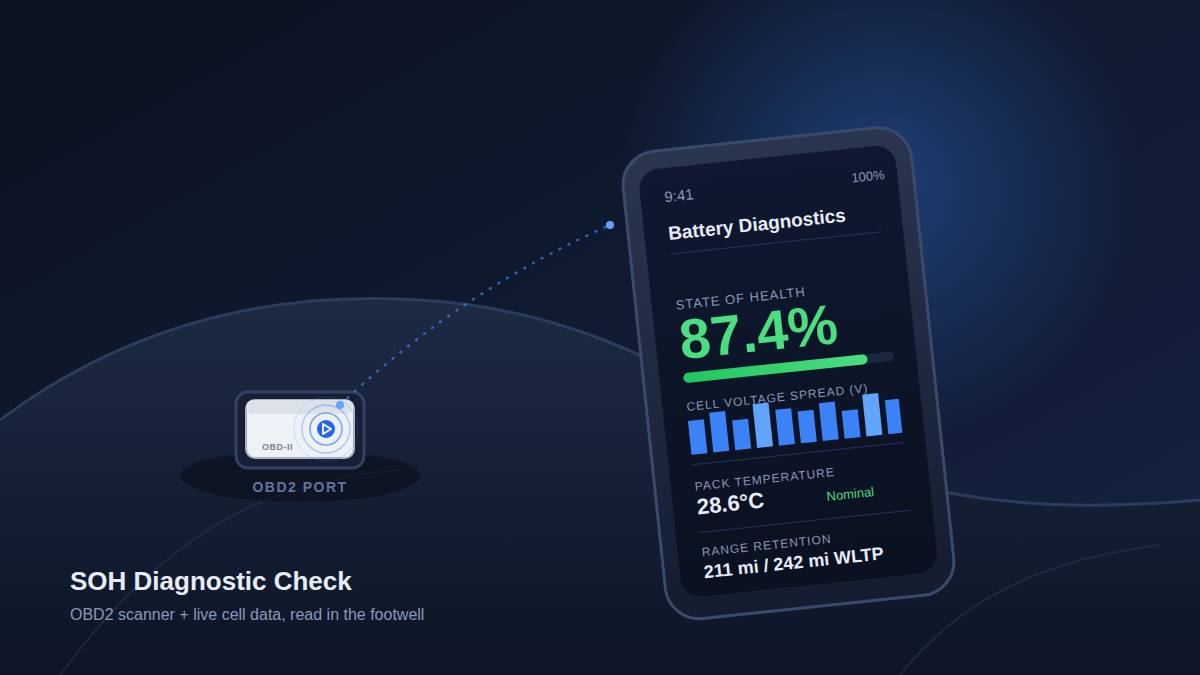
A viewing on the manufacturer's own energy screen (where available) is a useful first look, but it's often coarse-grained. For a proper diagnostic-level reading, a cheap Bluetooth OBD2 adapter paired with the right app gives access to the same battery management system (BMS) data technicians use.
- Step 1 — Buy the right dongle. A generic ELM327 Bluetooth or Wi-Fi OBD2 adapter (£10–£25) covers most Car Scanner Pro use cases. Nissan Leaf owners specifically need an OBD2 dongle compatible with LeafSpy's extended PID set.
- Step 2 — Install the app. LeafSpy (Leaf-specific, deep cell-level detail) or Car Scanner Pro (broader make/model coverage, including many Renault, Hyundai, Kia, VW Group, and Tesla-adjacent PIDs via plugins) are the two most widely used consumer tools in the UK.
- Step 3 — Locate the OBD2 port. Almost always under the dashboard in the driver's footwell, sometimes behind a small trim cover.
- Step 4 — Power up and pair. Turn the ignition to "on" (accessory/ready mode, engine/motor not required to run) and pair the dongle via Bluetooth in your phone settings, then open the app.
- Step 5 — Pull the key figures. Read SOH %, individual cell voltages (look for a tight spread — a wide gap between the highest and lowest cell is an early warning sign), and pack temperature.
- Step 6 — Cross-check against the checklist. Compare the reading against the SOH bands above before finalising an offer.
When to Request a Formal Battery Health Certificate
For higher-value purchases, or when a seller won't allow a pre-purchase OBD2 check, an independent third-party certificate adds a layer of accountability an app reading can't. In the UK, providers including Altelium and Mava offer standalone battery health inspection and certification services — typically a short on-site diagnostic session producing a formal, shareable report on SOH, cell balance, and remaining expected lifespan, sometimes with warranty or insurance backing attached. Expect to pay a modest fixed fee, but treat it as cheap insurance against a four- or five-figure battery replacement bill further down the line — and use the report itself as leverage in price negotiation.
Buying With Certainty Instead of Risk
A thorough SOH check narrows the risk on a used EV considerably, but it can't eliminate it entirely — you're still relying on a snapshot reading and the honesty of the selling process. For buyers who would rather remove battery-condition uncertainty altogether, ordering new is the alternative: a factory-fresh pack, a full manufacturer battery warranty from day one, and no diagnostic step required at all.
Buyer Incentive — Tesla
Ordering a New Tesla?
Secure exclusive vehicle order discounts, cash off, or free Supercharging credits by placing your order through our verified independent research link.
Claim My Referral LinkWhichever route you take, the principle is the same: never buy a used EV on badge, mileage, or seller assurance alone. Insist on an SOH reading, understand whether its degradation looks cyclic, calendar-driven, or both, and price the car against what its battery can actually still do — not what it could do when it left the factory.