What is now heading toward showrooms is a different engineering exercise entirely: a compromise platform, internally tracked under the codename Project NV9, that reuses Model 3 and Model Y tooling to hit an affordable price point without the capital risk of an all-new factory process. Understanding that distinction is the difference between reporting on Tesla's affordable-car strategy correctly and repeating two years of media confusion.
1. The Pivot: From "Unboxed" to Parts-Bin Hybrid
The original low-cost Tesla was never meant to be a cheaper Model 3. It was designed around Project Redwood, a next-generation manufacturing concept that would have eliminated the traditional linear body line in favour of parallel "unboxed" sub-assembly cells—front structure, rear structure, battery pack, and interior module all built simultaneously and married at the end of the process, rather than one body shell moving sequentially down a single line. Tesla's own manufacturing team projected this approach could cut factory footprint and line costs by roughly 40% relative to a Model Y-style process, which was the actual engineering justification for a sub-$25,000 sticker price—not battery chemistry, not motor design, but the elimination of conventional body-line capex.
That standalone-platform, standalone-factory plan is the version Musk shelved. Reporting through 2024 indicated the dedicated low-cost model had been pulled from Tesla's roadmap as the company redirected engineering resources toward robotaxi development and autonomy compute, with Musk publicly disputing the framing while Tesla's own subsequent actions—cancelling dedicated tooling orders and reassigning the Redwood-adjacent engineering group—lined up with the reporting. The "unboxed" process itself has not been abandoned outright; it has been demoted from a near-term production requirement to a longer-horizon manufacturing R&D goal, most likely resurfacing at Gigafactory Mexico or a future Giga Texas expansion once the concept is de-risked at smaller scale.
Project NV9 is what filled the resulting gap. Rather than betting capital on an unproven line process, NV9 takes the known-good Model 3/Model Y "Gen-2" underbody and structural battery architecture and shrinks it—swapping a new factory for a new stamping and tooling package that slots into existing Fremont, Shanghai, and Berlin lines. It is a compromise engineered to protect near-term capital expenditure and 2026–2027 delivery timing, at the cost of the more dramatic cost curve the original unboxed concept promised.
2. The Hard Hardware Scaling
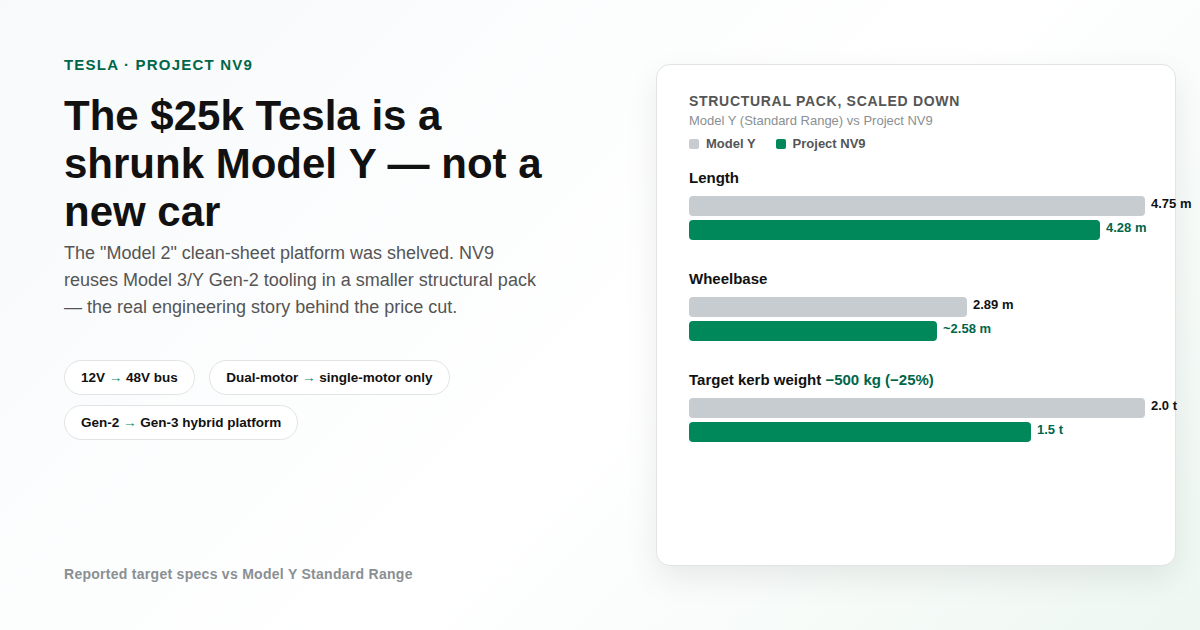
Project NV9 is not a trim level or a software-locked base Model Y—it is a physically smaller vehicle built on a modified structural pack. The scale of the cuts is the clearest evidence of that.
| Spec | Model Y (Standard Range) | Project NV9 (reported target) |
|---|---|---|
| Length | ~4.75 m | ~4.28 m |
| Wheelbase | ~2.89 m | ~2.55–2.60 m (est.) |
| Target kerb weight | ~2.0 tonnes | ~1.5 tonnes |
| Platform generation | Gen-2 (legacy Model 3/Y architecture) | Gen-3 hybrid — shared tooling, shrunk structural pack |
| Body/battery structure | Structural 4680 pack, steel-reinforced underbody | Structural 4680 pack, narrowed cell count, lighter subframe |
| Drive configuration | Single- or dual-motor | Single-motor only (reported) |
| Low-voltage architecture | 12V legacy harness | 48V centralised bus |
| Production line | Dedicated Model Y line | Shared/retooled Model 3 & Model Y lines |
| Target market position | Mid-size crossover | B-segment compact crossover |
A roughly 500 kg reduction at this scale is not achieved by trimming equipment lists—it requires cutting into the structural pack itself, which is the load-bearing element of the whole vehicle in Tesla's architecture.
3. How Tesla Is Stripping Cost Out of the Chassis
This is not a "base Model Y with fewer options"; it is a distinct structural and electrical engineering exercise, built around three levers.
Mass reduction
- Shaving roughly 500 kg off the body allows a proportionally lighter structural frame, since Tesla's structural-battery design ties chassis stiffness directly to pack mass and cell count.
- A lighter body permits smaller-diameter suspension components, thinner control arms, and reduced-capacity brakes, none of which are option-list features—they are downstream consequences of the mass target and cannot be retrofitted to a full-size platform.
- Lower structural loading also reduces the cell count and physical footprint of the structural 4680 pack itself, which is the single largest lever on the vehicle's bill of materials. Structural 4680 cost has always scaled with pack volume and cell count more than with chemistry, so shrinking the pack—not just cheapening it—is the real cost story here.
Powertrain optimisation
- A natively smaller single-motor, lower-kilowatt drive unit draws less peak current than Model Y's motor options, which cascades through the entire power-electronics bill: smaller inverter switching devices, reduced busbar cross-section, and cheaper thermal management hardware.
- Lower peak current also permits thinner-gauge internal wiring throughout the vehicle, cutting both copper cost and harness assembly labour—a meaningful line-item at scale given copper's price volatility.
- The trade-off is straightforward: reduced peak output and a narrower performance envelope in exchange for a materially cheaper drive unit and power-electronics stack.
48V low-voltage architecture
- NV9 is expected to inherit the centralised 48V low-voltage bus first deployed on Cybertruck and refined for the Robotaxi/Cybercab programme, replacing the legacy 12V architecture still used on Model 3 and Model Y.
- A 48V bus carries the same power at roughly a quarter of the current of a 12V system, permitting dramatically thinner-gauge wiring across body control, lighting, and infotainment circuits—cutting both material cost and, more importantly, the labour and complexity of harness routing and assembly.
- This is the single biggest manufacturing-complexity reduction in the whole vehicle: fewer discrete wiring branches, simplified body-control-module integration, and a harness that is meaningfully cheaper to build and install than anything on the current Model 3/Y line.
4. Market Position: The Compact SUV Reality
Forget the low-slung hatchback silhouette that circulated in early Model 2 renders—that vehicle was tied to the abandoned Redwood platform and unboxed process, and it is not what is coming. Built on a shrunk Gen-2-derived structural pack shared with existing lines, the production vehicle will land as an ultra-minimalist, scaled-down sub-compact crossover, positioned to compete directly with the European B-segment EV field—cars like the Renault 5, Citroën ë-C3, and VW ID.2all—rather than against traditional city hatchbacks.
That positioning is the point of the whole pivot. By reusing Model 3/Y line infrastructure instead of waiting on an unproven unboxed factory process, Tesla sidesteps the slow, capital-intensive infrastructure build-out that pure Robotaxi/Cybercab deployment still requires, while still shipping an affordable, owner-driven passenger car within a realistic late-2027 to 2028 window due to Cybercab manufacturing prioritisation and AI5 computing hardware dependency. It is a smaller car than originally promised, on a less radical platform than originally promised—but it is also a car that can actually reach a production line that already exists, which is the one variable the original Model 2 programme never solved.