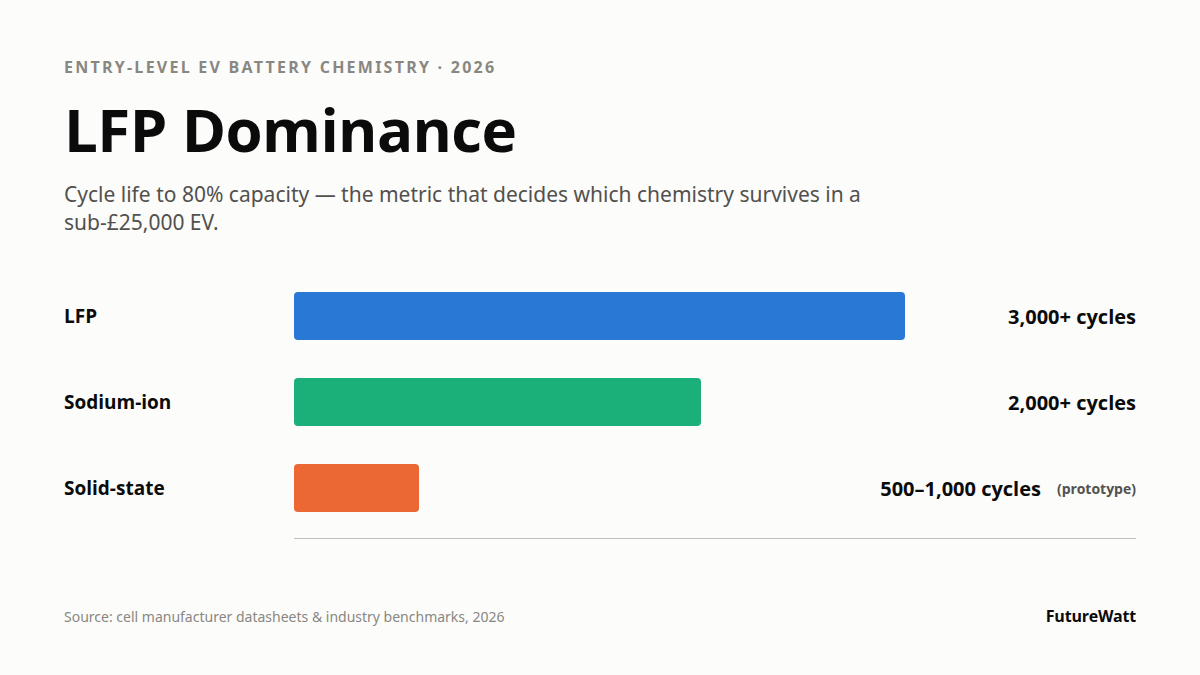
Solid-state prototypes routinely post 400–500 Wh/kg in laboratory pouch cells, roughly double what an entry-level lithium-iron-phosphate pack delivers today. That figure is real, and it is also almost entirely irrelevant to the sub-£25,000 EV segment for the rest of this decade. A solid-state cell's sulfidic or oxide electrolyte demands multi-tonne stack pressure to hold the anode interface together, gigapascal-tolerant manufacturing lines, and dry-room conditions an order of magnitude stricter than existing lithium-ion gigafactories — and even at that cost, current prototype cycle life sits at 500–1,000 cycles before 80% capacity, roughly a third of what a budget buyer already expects from a cheap LFP pack. Multi-billion-pound capital lines built for today's liquid-electrolyte chemistry cannot simply be retooled; solid-state requires a parallel manufacturing base built from first principles, and nobody has proven that base at automotive volume. Tesla's Project NV9 and the wave of European B-segment hatchbacks now reaching production are not waiting for that proof. They are built on lithium-iron-phosphate, because LFP is the only chemistry that currently clears the triple bar of low cost, high cycle life and manufacturable-today status at gigawatt-hour scale. Solid-state is a premium-tier bet for the 2030s; LFP is the entry-level market's settled answer now.
The Cost and Longevity Ledger
| Battery chemistry | Cell-level energy density (Wh/kg) | Raw material cost factor | Cycle life (to 80% capacity) | Primary scaling bottleneck |
|---|---|---|---|---|
| LFP (lithium-iron-phosphate) | 160–200 | Low | 3,000+ | Low cold-weather voltage stability |
| Solid-state (sulfidic/oxide prototype) | 400–500 | Ultra-high | 500–1,000 (current prototypes) | Dendrite formation under high-rate charging; ambient-pressure requirements |
| Sodium-ion (Prussian blue / layered oxide) | 140–160 | Lowest (zero lithium) | 2,000+ | Low energy density limits it to urban transit |
Read across the table and the entry-level market's decision-making becomes mechanical rather than aspirational. Cost and cycle life, not peak energy density, are the two variables that determine what chassis a £20,000–£25,000 EV can actually be built on.
Why LFP Dominates the Sub-£25k Packaging Matrix
- Thermal and structural stability. LFP's olivine crystal structure holds its oxygen far more tightly than nickel-rich cathodes, which is why it resists thermal runaway even under cell-level abuse. That stability margin lets engineers strip out the heavy, multi-loop active cooling architecture NMC packs require and move to dense cell-to-pack (CTP) construction, where the cells themselves form part of the structural floor. The saved mass and part count go straight back into either price or range — a budget-segment trade LFP wins by default.
- The degradation arbitrage. Entry-level buyers are longevity-sensitive in a way premium buyers are not; a cheap EV has to outlast a finance term, not flatter a spec sheet. LFP cells routinely tolerate 3,000–5,000 full charge-discharge cycles and, critically, can be charged to 100% daily without the accelerated degradation that forces NMC-pack owners to cap routine charging at 80%. In practical terms, the battery is engineered to outlast the rest of the car.
- Parts-bin integration. Tesla's upcoming NV9 platform and comparable European B-segment programmes lean on LFP precisely because it lets a manufacturer hit an aggressive target price without touching structural reliability or warranty exposure. No exotic thermal system, no premium binder chemistry, no supply-constrained nickel or cobalt sourcing — just a mature, high-yield cell format that scales on existing gigafactory tooling.
Sodium-Ion: The Only Real Contender to LFP's Throne
Sodium-ion is not positioned as a range solution; its 140–160 Wh/kg cell-level density keeps it firmly in short-range, urban-cycle territory. What it offers instead is a clean break from lithium's resource physics. Sodium is abundant in seawater and evaporite deposits worldwide, geographically undominated by any single supply bloc, and structurally immune to the lithium carbonate price spikes that have repeatedly disrupted cell-cost forecasting over the past five years. A sodium-ion pack has no exposure to a lithium shortage, a cobalt export restriction, or a nickel-refining bottleneck, because none of those materials are in the cell.
It also solves a problem LFP does not: cold-weather voltage stability. Sodium-ion cells retain a materially higher proportion of usable capacity at sub-zero temperatures than LFP, which loses significant discharge voltage in cold conditions — a known weak point noted in the ledger above. Combined with zero reliance on critical minerals and a manufacturing process that shares most of its tooling lineage with existing lithium-ion lines, sodium-ion is positioned as the most credible disruptor to LFP's entry-level dominance specifically in the urban B-segment micro-transit bracket, with meaningful volume expected by late 2027 into 2028 rather than this model year. Until then, LFP holds the sub-£25,000 EV market without a serious challenger.