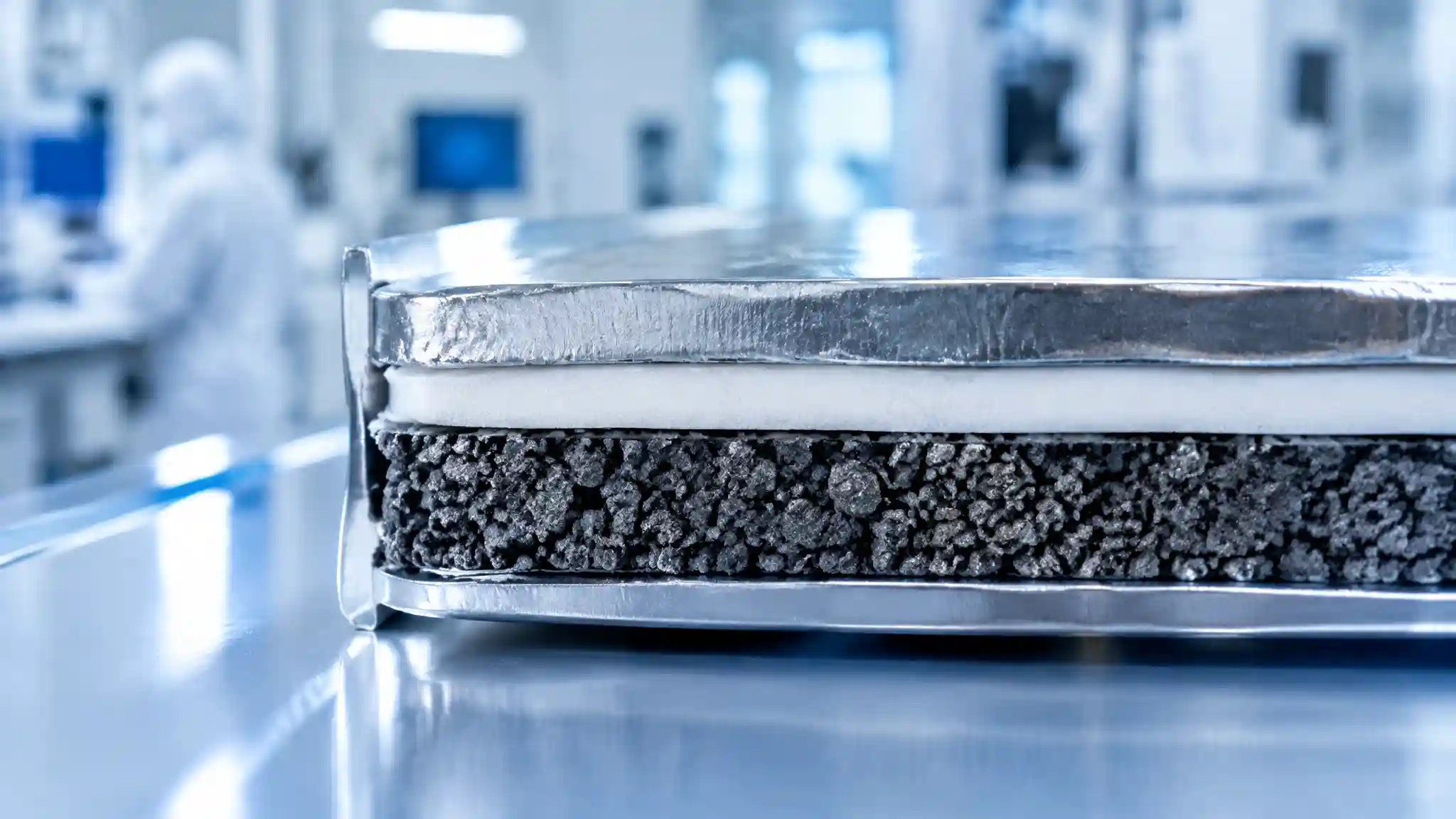
Every solid-state programme begins with a choice of electrolyte, and each choice brings its own failure modes. Oxide ceramics offer excellent thermal and electrochemical stability, but they are brittle. Rigid ceramic-to-electrode contact leaves microscopic gaps, which raise interfacial resistance and widen as electrodes expand and contract during cycling. Sulphides are soft enough to press into intimate contact and conduct lithium ions well, but they react with moisture and release hydrogen sulphide. Production therefore needs ultra-dry rooms that are far more expensive to run than lithium-ion lines.
ProLogium has taken the oxide route. Its Gen4 cell pairs a ceramic electrolyte with a 100% silicon composite anode, and in September 2026 Mercedes-Benz signed a joint testing agreement for it. An earlier 185.4 Ah Gen 3.5 cell reached 381 Wh/kg in independent TÜV testing. The Dunkirk plant, however, has slipped to a 2028 start at just 0.8 GWh, reaching 4 GWh only in 2030.
Developer | Chemistry | 2026 Status | Scaling Wall |
|---|---|---|---|
ProLogium | Oxide ceramic electrolyte; Gen4 with 100% silicon composite anode | Joint testing agreement with Mercedes-Benz (September 2026); Gen 3.5 185.4 Ah cell independently tested at 381 Wh/kg | Dunkirk start moved to 2028 at 0.8 GWh; 4 GWh targeted for 2030 and 12 GWh by 2032 |
QuantumScape | Oxide ceramic separator; anode-free lithium metal | Eagle Line pilot shipping QSE-5 B-samples; royalty-bearing licence with VW PowerCo | Volume depends on licensees industrialising its Cobra separator process |
Factorial Energy | Quasi-solid polymer (FEST); full solid-state in development | Mercedes EQS test vehicle covered 1,205 km on one charge; Stellantis demo fleet | Quasi-solid design is not all-solid; full solid-state cells still at sample stage |
Toyota | Sulphide electrolyte (with Idemitsu) | Prototype cells; launch targeted for 2027–28 | Moisture-sensitive sulphides need dry rooms; first fitments expected on low-volume premium models |
QuantumScape is pursuing a licensing model rather than building its own gigafactory. Its automated Eagle Line ships QSE-5 B-samples, and PowerCo holds a royalty-bearing licence to manufacture the cells itself. Factorial is hedging with a quasi-solid polymer: a Mercedes EQS fitted with its cells covered 1,205 km on a single charge. Toyota, working with Idemitsu on sulphides, is targeting 2027 to 2028 for a first launch.
The common barrier is economic. Matching the cost of liquid cells requires high-yield, heavily automated lines, and no developer has yet demonstrated one at gigawatt-hour scale. Until that happens, solid-state cells will be confined to low-volume premium halo models, with mass-market adoption unlikely before roughly 2030.