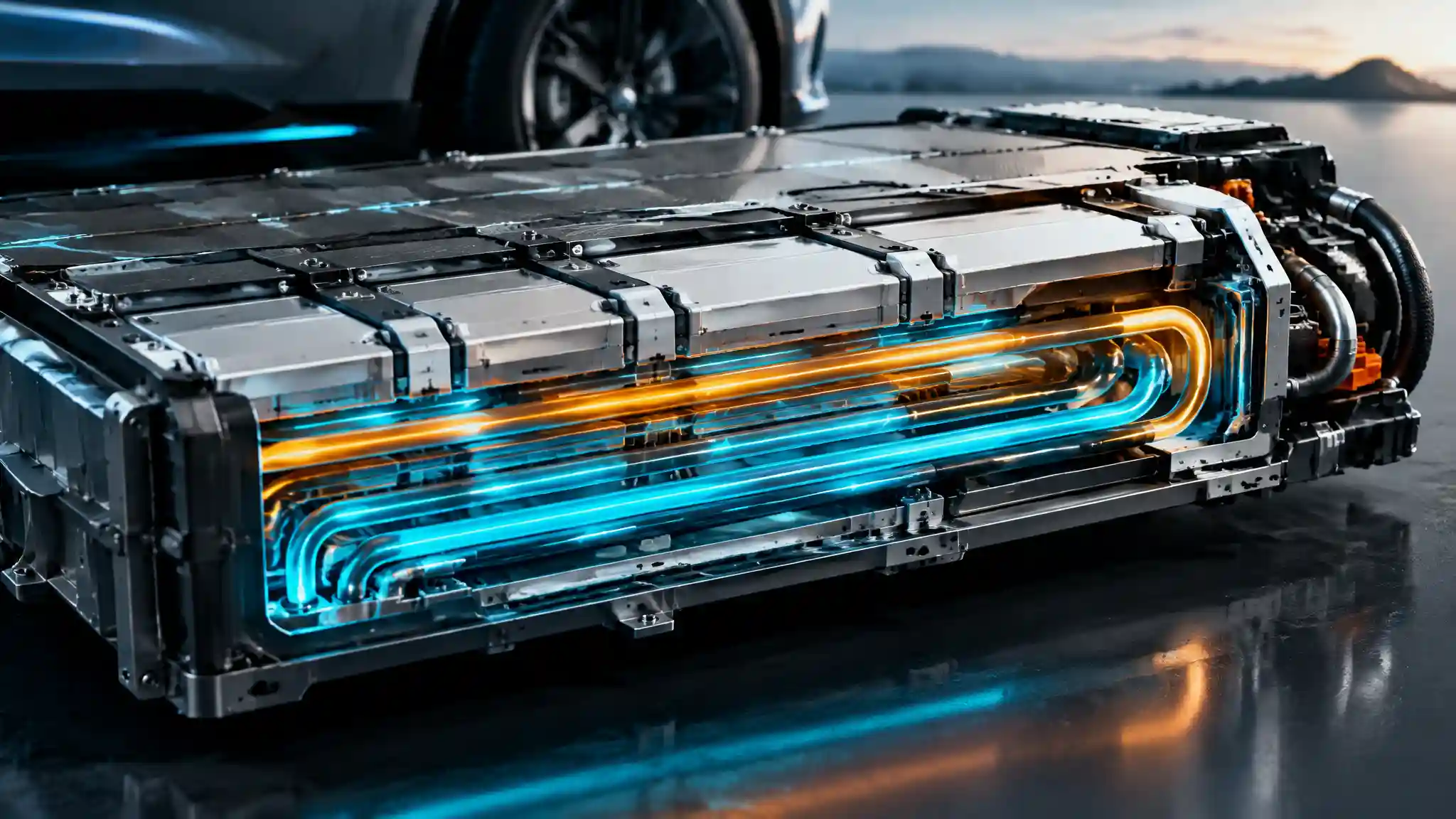
Sodium-ion's cost advantage is not matched by immunity to cold-charging physics. As cell temperature falls, the organic carbonate electrolyte becomes markedly more viscous, ionic conductivity drops and internal resistance climbs. Each Na⁺ ion must also shed its solvent shell before entering the anode, and that desolvation step slows exponentially in the cold. Na⁺ has a lower desolvation energy than Li⁺, which helps, but it does not remove the limit. When charge current exceeds the rate at which sodium can intercalate into the hard carbon matrix, ions accumulate at the surface and deposit as metallic sodium. The risk is acute because hard carbon stores much of its capacity on a low-voltage plateau sitting close to the sodium plating potential. Plated sodium consumes inventory, thickens the SEI and drives permanent capacity fade.
Heating the pack must be cheap in energy terms. In a sub-£30k EV, the efficient architecture is thermal scavenging: waste heat from the electric drive unit's motor and inverter is captured in a shared glycol loop, upgraded by the cabin heat pump where needed, and routed directly to the battery cooling jacket rather than rejected through the front radiator.
Hardware is useless without timing. The BMS must coordinate with the sat-nav so that, once a rapid charger is set as a destination, active thermal preparation starts around 20 minutes before arrival, lifting core temperature into the 25°C to 35°C window where the BMS can release full charge current.
Deconstructing the 144kW High-Plateau Charging Curve
Clearing a 20% to 80% charge in exactly 15 minutes on a 60kWh sodium-ion battery pack requires a net delivery of 36kWh in 0.25 hours, demanding a sustained average charging rate of 144kW (a net 2.4C current across the window). Unlike lithium-ion alternatives that feature a sharp early peak followed by an aggressive taper, pre-conditioned sodium-ion cells leverage superior desolvation kinetics and low internal resistance to hold a significantly flatter charging plateau deeper into the cycle. To hit this 15-minute metric safely, the Battery Management System (BMS) manages a high-plateau stepped profile rather than a flat line:
- 20% to 50% SoC: Peaks early at 160kW (~2.6C) while the hard-carbon anode matrix is empty and ion receptivity is maximized.
- 50% to 70% SoC: Stabilizes into a flat, high-density current plateau right around 145kW.
- 70% to 80% SoC: Tapers down to a controlled 120kW to restrict localized internal cell pressure as it approaches the upper voltage cutoff.
Sustaining this 144kW average generates intense kinetic heat. If a sub-£30,000 UK-built EV lacks a high-capacity refrigerant-to-glycol active cooling plate assembly, the cell cores will rapidly drift past their 45°C safety boundary. This thermal spike forces the BMS into aggressive protective current-throttling, causing the vehicle to miss its 15-minute window entirely.
Parameter | Unconditioned Cold Charging | Pre-Conditioned State |
|---|---|---|
Cell Core Temperature | 0°C to 5°C after an overnight park or short urban trip | 25°C to 35°C on arrival at the charger |
Electrolyte Viscosity & Ionic Conductivity | High viscosity, depressed conductivity, slow Na⁺ transport | Low viscosity, near-rated conductivity |
Charge-Transfer & Desolvation Resistance | Sharply elevated; large overpotential at the anode surface | Minimised; anode potential stays safely above the plating threshold |
BMS Charge Current Limit | Heavily throttled, often a fraction of rated peak | Full rated C-rate available from the start of the session |
Plating & Degradation Risk | High if current is not derated; metallic sodium deposition and capacity fade | Low; sodium intercalates into hard carbon faster than it arrives |
For powertrain teams, the conclusion is clear: in a UK winter, cold-weather rapid-charge performance is decided less by cell chemistry than by thermal integration and software orchestration. A sodium-ion pack that arrives at the charger warm will charge at its rated speed. One that arrives cold will not, whatever its datasheet promises.