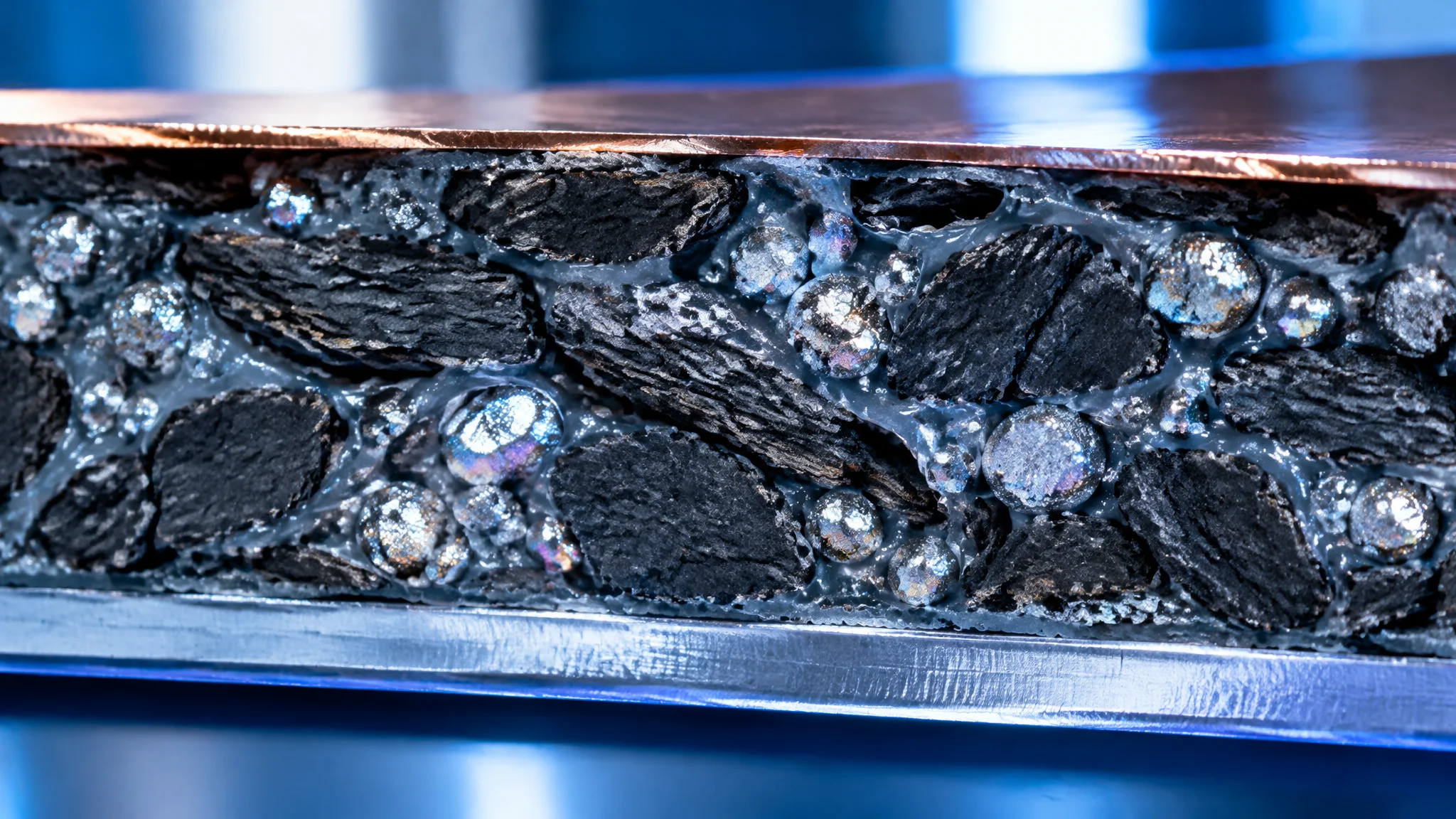
Lithium-ion storage at the anode is a question of host chemistry. Graphite intercalates lithium between its graphene layers and holds at most one lithium atom per six carbon atoms (LiC6), which caps its theoretical capacity at 372 mAh/g. Silicon alloys with lithium instead. At room temperature each silicon atom can take up to 3.75 lithium atoms (Li15Si4), giving roughly 3,579 mAh/g. Graphite also lithiates at around 0.1 V versus Li/Li+, perilously close to the plating threshold under high current. Silicon reacts at a higher potential, around 0.4 V, which leaves more voltage margin. Its higher capacity also allows thinner electrodes, so ions travel shorter diffusion paths.
| Metric | Pure graphite | Si-graphite blend (5–15% Si) | SiOx/C composite |
|---|---|---|---|
| Theoretical specific capacity | 372 mAh/g | ~530–850 mAh/g | ~1,300–1,700 mAh/g (SiOx phase) |
| Lithiated phase | LiC6 | LiC6 + Li15Si4 | LixSi in Li-silicate/oxide matrix |
| Volumetric expansion | ~10% | Moderate, buffered by graphite | ~150–200%, contained in carbon shell |
| Plating margin at XFC rates | Low (~0.1 V) | Improved | Improved |
| Main degradation marker | Lithium plating | SEI regrowth at Si sites | First-cycle lithium loss, SEI growth |
The trade-off is mechanical. Full lithiation swells silicon by up to 300%, and each charge-discharge cycle drives this “cell breathing” at particle scale. Repeated expansion and contraction pulverises particles, electrically isolating fragments from the conductive network. It also fractures the Solid Electrolyte Interphase (SEI), exposing fresh silicon that re-forms SEI and consumes active lithium each time, causing rapid capacity fade.
Commercial cells work around this wall in two ways. Manufacturers either blend 5% to 15% silicon into existing graphite matrices, or use silicon sub-oxide (SiOx) nanoparticles wrapped in elastic carbon shells, held together with flexible polymer binders. Both approaches accept a fraction of silicon's theoretical capacity in exchange for cycle life that is commercially viable under fast charging. For powertrain analysts and investors, the anode formulation, not the pack voltage alone, increasingly determines real-world charge curves.