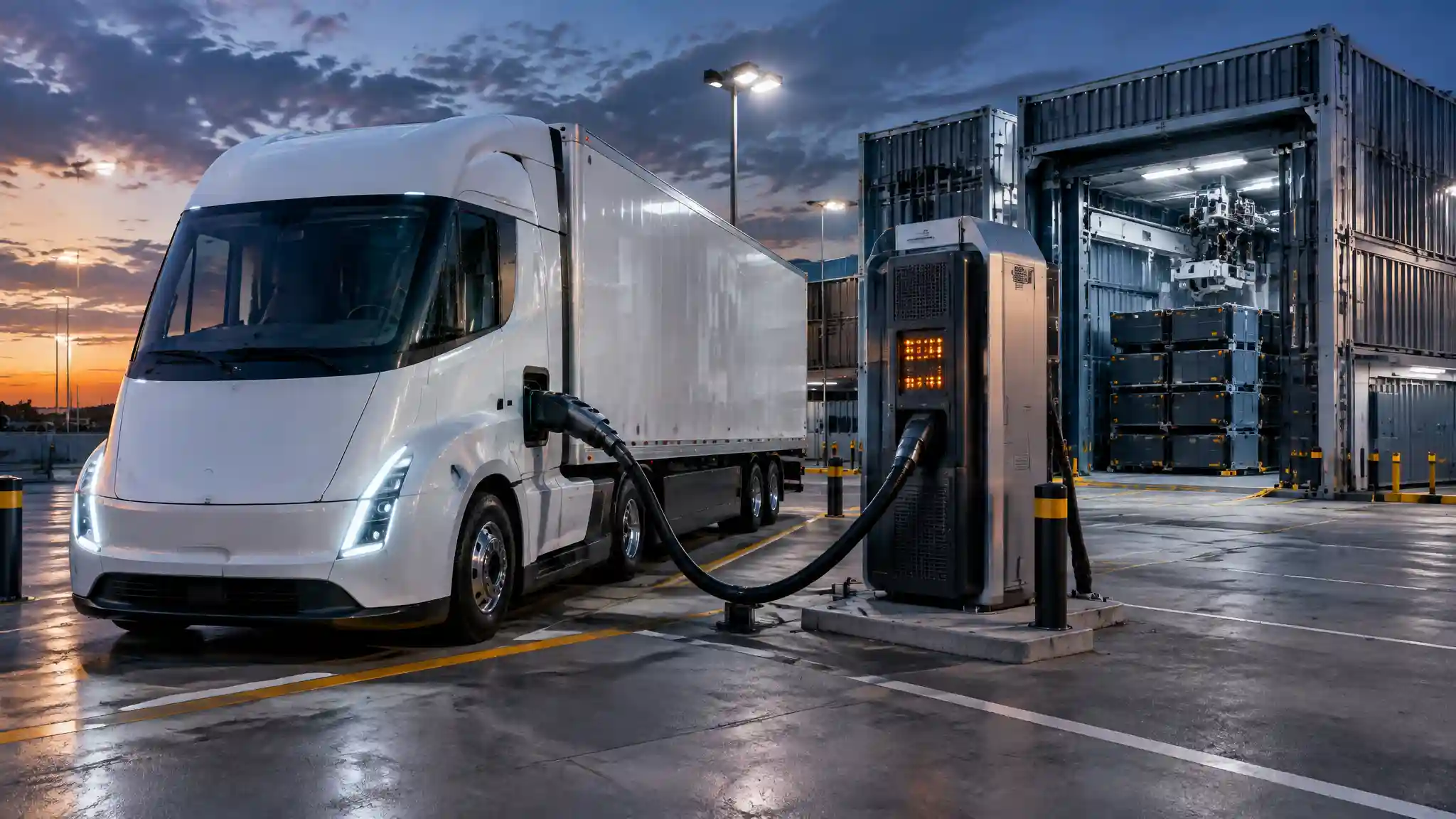
A long-haul electric tractor unit needs roughly 600 kWh of storage. At today's pack-level energy densities, that adds 3 to 4.5 tonnes of mass compared with a diesel driveline. Under the UK's 44-tonne gross limit, every extra kilogram of battery is a kilogram of freight lost, although zero-emission weight allowances partly offset the penalty. Tesla attacks the problem through efficiency rather than capacity. The Semi's tri-motor powertrain uses one motor for steady cruising and engages the other two for acceleration and gradients. Tesla claims consumption of about 1.7 kWh per mile, which allows a smaller pack for a given range.
Charging speed is the second constraint. IEC TS 63379, published in February 2026, defines a single liquid-cooled connector rated for 3,000 A at 1,250 V, or 3.75 MW, although most early sites will run at 1 to 1.5 MW. Tesla's closed alternative pairs V4 cabinets with dedicated posts delivering 1.2 MW each. Tesla says this recovers up to 60% of the Semi's battery in 30 minutes, within a statutory driver break.
Either way, the grid connection is the bottleneck. A depot with ten megawatt stalls needs a new high-voltage connection and on-site substation, and in the UK that can mean years in the connection queue.
This is where Swaptopus changes the calculation. The Octopus–CATL joint venture plans its first UK mega-hubs from 2027, with more than 30 targeted by 2035. Each hub holds a buffer of packs that can be charged when power is cheapest and most abundant, which makes the hub a grid-balancing asset as well as a fleet efficiency tool. The open question is standardisation: European OEMs are backing MCS, Tesla runs a closed ecosystem, and swapping only works if truck makers adopt a common pack format.