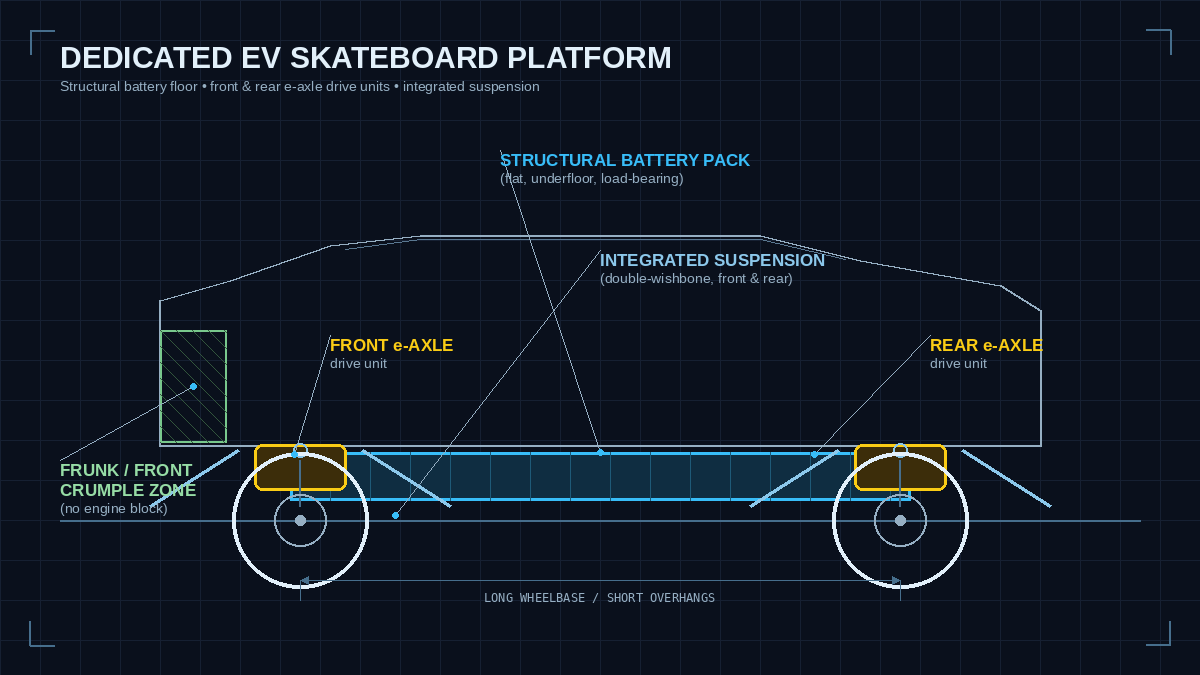
Every electric car body sits on one of two fundamentally different foundations. The first is a clean-sheet "skateboard" platform, engineered from a blank page around a flat battery slab and a pair of compact e-axles. The second is a multi-energy chassis — originally drawn for a combustion engine, a transmission tunnel, and a fuel tank — that has been adapted to also accept a battery pack. Both can look similar in a showroom. Underneath, they are solving completely different structural problems, and the compromises baked into a converted platform show up in exactly the places that matter most: interior space, crash performance, and handling balance.
What Is a Dedicated EV Skateboard Platform?
A dedicated EV platform — the architecture behind cars like the Hyundai/Kia E-GMP family and the Tesla Model Y — is built as a flat structural "skateboard": a floor-mounted battery pack that spans almost the entire wheelbase, bonded and bolted into the chassis rails so it becomes a load-bearing member rather than a component sitting on top of one. A compact electric drive unit — motor, inverter, and single-speed gearbox integrated into one housing — sits at the front axle, the rear axle, or both. There is no engine block, no exhaust tunnel, and no mechanical link running the length of the car, so the entire volume above the battery deck is free for cabin space and the entire volume ahead of the front axle is free for crash structure.
What Is a Shared or Converted ICE Chassis?
A converted platform — BMW's CLAR architecture and Stellantis's STLA Medium are the most cited current examples — was drawn to accommodate an internal combustion engine, a longitudinal or transverse transmission, a driveshaft or transaxle, and a raised floor pan with a transmission tunnel already engineered into the body-in-white. To electrify it, engineers pack battery modules into whatever irregular volume is left: under the rear seats, around the tunnel, sometimes partially under the front seats. The result is a battery pack that is thicker, less uniform, and mounted higher than a purpose-built pack, because it has to fit around structure that was never designed to accommodate it.
Head-to-Head: Structural Comparison
Parameter | Dedicated EV Platform (e.g., Hyundai E-GMP / Tesla Model Y) | Shared/Converted ICE Chassis (e.g., BMW CLAR / Stellantis STLA Medium) |
|---|---|---|
Wheelbase-to-Length Ratio | High — axles pushed to the corners since no engine/transmission length is reserved | Lower — wheelbase constrained by legacy engine bay and driveshaft packaging |
Cabin Floor Flatness | Fully flat — battery deck replaces the floor pan with no tunnel | Raised and interrupted — transmission tunnel remains even when unused, or is filled by battery modules |
Front Overhang / Frunk Space | Short overhang; open volume ahead of the axle is usable as a frunk and crash structure | Long overhang reserved for engine block; little to no frunk volume, crash structure shares space with residual driveline |
Battery Structural Integration | Load-bearing structural member, bonded into chassis rails and contributing to torsional stiffness | Non-structural or semi-structural pack bolted into repurposed volume; stiffness must come from elsewhere |
Weight Distribution Handling | Near 50:50, low and central mass; low polar moment of inertia | Uneven, often nose- or tail-heavy depending on donor layout; higher polar moment of inertia |
The Physics: Polar Moment of Inertia and Low, Central Mass
The single heaviest component in any EV is the battery pack, typically 400–700 kg. Where that mass sits relative to the car's center of gravity and yaw axis determines how the chassis behaves under load — and this is where a dedicated platform's layout produces a measurable engineering advantage rather than a marketing one.
- Low center of gravity. Spreading the pack flat across the floor, rather than stacking it in whatever cavity is available, keeps the car's heaviest mass at its lowest possible point — typically below knee height — which directly reduces body roll and pitch under cornering and braking.
- Low polar moment of inertia. Polar moment of inertia describes how resistant a mass distribution is to rotation about the vehicle's vertical (yaw) axis. Concentrating the battery mass low and centrally, between the axles rather than pushed to one end, minimizes this figure. A lower polar moment of inertia means the chassis changes direction with less rotational resistance, so the same suspension tuning yields sharper, more predictable transient response — the car reacts to steering input rather than resisting it.
- Eliminated handling penalty. A converted chassis carrying an off-center, elevated battery mass fights its own inertia in every direction change. A skateboard platform's mass distribution works with the chassis instead, which is why heavy dedicated EVs routinely out-handle lighter converted-platform rivals despite carrying more total weight.
Crash Safety: What Happens When There Is No Engine Block
Front crash structures are designed to absorb kinetic energy progressively, converting a sharp deceleration into a controlled, extended collapse. An internal combustion engine block is a dense, largely incompressible mass that a converted platform's crumple zone has to be engineered around — the engine either becomes a hard stop that transmits load into the bulkhead early, or the crumple zone has to be shortened to leave clearance for it, or both.
A dedicated EV platform has no equivalent obstruction ahead of the front axle. Engineers can extend the crumple zone the full length of the available overhang and tune its collapse rate purely for occupant deceleration, without reserving space or stiffness for a component that no longer exists. Crash energy is absorbed progressively through a longer, purpose-built structure, and the load path can be engineered to route around the cabin rather than into it. The structural battery enclosure itself is typically built from high-strength steel or aluminum extrusions and doubles as an additional lower load path and side-impact barrier, spreading impact forces across the flat floor structure rather than concentrating them at isolated mounting points, as is often the case with a bolted-in retrofit pack.
Cabin Ergonomics: The Flat Floor Effect
The transmission tunnel is one of the least-discussed casualties of platform sharing. On a converted ICE chassis, the raised central spine that once carried a driveshaft or exhaust routing rarely disappears entirely — it either survives as unused structure, or it becomes the exact spot where battery modules have to be crammed because nowhere else is available. Either way, the center-rear passenger inherits a raised footwell, reduced knee clearance, and an awkward foot position that no amount of seat padding fully resolves.
On a dedicated skateboard platform, the battery deck itself is the floor. Because the pack is a uniform slab rather than an irregular fill-in-the-gaps volume, engineers can hold cabin floor height constant from door sill to door sill, including across the center console. That single geometric decision cascades into several practical benefits:
- True five-across seating is achievable on cars where a converted platform would force the center-rear occupant to straddle a tunnel.
- Lower hip points for a given roofline, since the floor doesn't need to be raised to clear a tunnel — this improves both headroom and the visual proportions of the cabin.
- Consistent underfloor storage is possible because the battery's flat upper surface, rather than a stepped ICE-derived floor pan, is what the interior trim sits on.
- Shorter dashboard-to-windshield depth is possible in some layouts because there's no need to route climate or driveline components around a transmission bell housing, freeing additional front legroom.
None of these are cosmetic wins. They are direct, geometric consequences of starting the design from a flat structural floor instead of inheriting one that was drawn for a different powertrain entirely — the same underlying reason a dedicated platform also wins on crash structure and yaw response.
Why This Matters for Buyers, Not Just Engineers
- More usable cabin space from the same exterior footprint, since a flat floor and pushed-out wheelbase remove the transmission tunnel and shrink the overhangs.
- More predictable, planted handling from a chassis engineered around, rather than in spite of, its heaviest component.
- Independently verified crash structures that are not constrained by clearance requirements for parts the car no longer carries.
- Better long-term platform flexibility, since a skateboard architecture can support multiple body styles on one structural floor without re-engineering the crash structure each time.
None of this means every converted platform is unsafe or every dedicated platform is flawless — chassis tuning, materials, and crash engineering quality still vary by manufacturer. But the starting point matters. A dedicated skateboard platform begins from a structural layout optimized for where an EV's mass actually needs to live. A converted chassis begins from a layout optimized for a drivetrain that is no longer there, and every subsequent engineering decision has to work around that original constraint.
Buyer Incentive — Tesla
Ready to Experience a Dedicated EV Platform?
If a purpose-built skateboard chassis is on your shortlist, secure exclusive vehicle order discounts, cash off, or free Supercharging credits by placing your order through our verified independent research link.