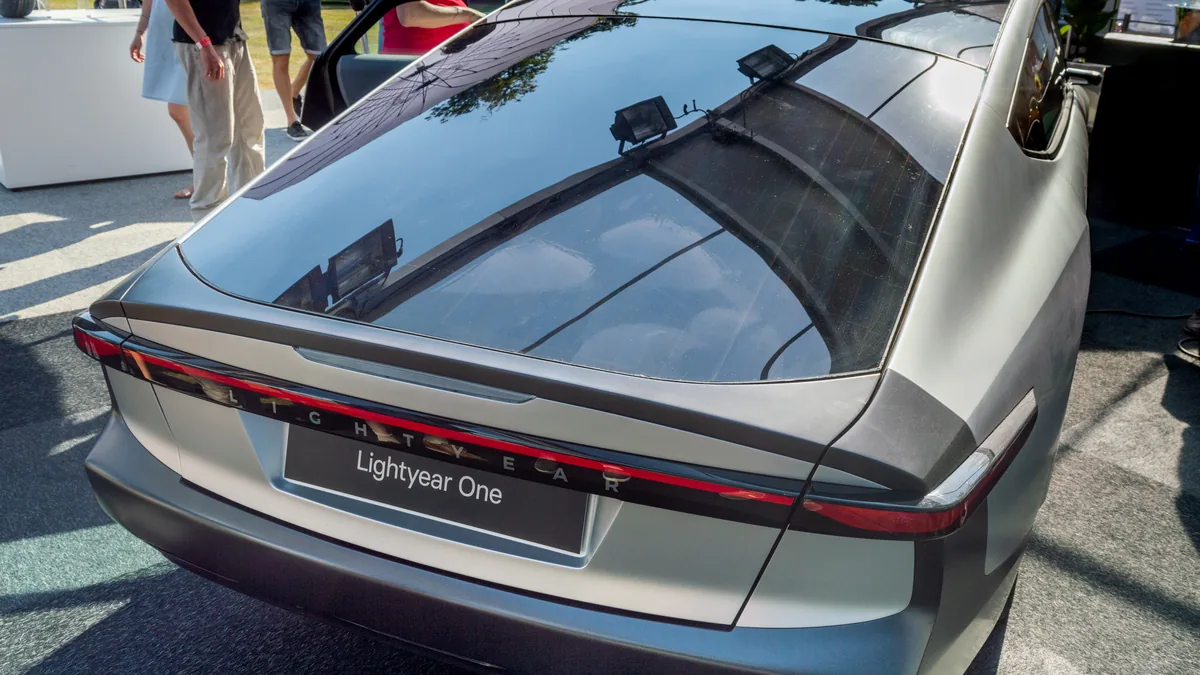
Every few years, a concept car resurfaces the same promise: a passenger vehicle that never needs plugging in, its roof and bonnet doing the work of a fuel pump. It is a compelling image, and it is also, for anything resembling a mainstream family EV, a fantasy built on a surface-area problem that no amount of engineering cleverness has solved. This article works through the actual numbers — irradiance, cell efficiency, vehicle mass, and drag — to show exactly why.
The Surface Area Problem, In Numbers
A typical passenger car offers around 2m² of roughly flat, unobstructed, forward-facing surface suitable for photovoltaic integration — the roof, plus perhaps a panoramic section of the bonnet on some designs. Compare that to a residential solar installation, which routinely covers 20–40m² of south-facing roof. A car carries roughly a tenth of the collection area of an ordinary home array, yet is expected to power something far more energy-hungry than a house on standby.
- Peak irradiance under ideal conditions: around 1,000 W/m² at solar noon, clear sky, mid-latitude summer — the industry-standard test condition figure.
- Commercial monocrystalline cell efficiency: roughly 21–22% for the high-grade IBC cells used in automotive-grade integrated arrays.
- Resulting peak output: 2m² × 1,000 W/m² × ~21% ≈ 400–450 watts — for a few hours, on a cloudless day, with the car parked directly facing the sun.
That figure never improves much no matter which cell chemistry gets used, because the ceiling is fixed by geometry, not technology. Cell efficiency has crept from roughly 15% a decade ago to over 22% today, and even a jump to the theoretical single-junction silicon limit of ~29% would only lift peak output to around 580 watts. The bottleneck was never the cell. It was always the roof.
What 400–500 Watts Actually Buys You
Watts are a rate, not a store of energy, so the number that matters for range is the daily harvest in kilowatt-hours. In the UK, even during an optimistic summer day, cloud interruption, low sun angles outside a narrow midday window, and the car rarely sitting perfectly perpendicular to the sun mean the array spends most of daylight hours well below its peak rating.
- Realistic UK summer harvest, parked outdoors all day: roughly 1.5–1.7 kWh.
- At a conservative 3.2–3.3 miles/kWh for a two-tonne passenger EV: that converts to around 4 to 5 miles of range per day.
- Under the UK's actual year-round average cloud cover — not the best-case summer day — realistic harvest falls closer to 0.5–0.6 kWh, or roughly 1.5–2 miles.
For context, the average UK commute is around 8.4 miles each way. A roof-mounted solar array, on its best day, cannot cover a single leg of an average commute — let alone the round trip, let alone a motorway journey.
The Thermodynamic Reality Matrix
The table below sets out the same calculation as a direct comparison between best-case conditions and the UK's actual average solar environment, holding surface area and cell efficiency constant.
Crucially, only two of the five rows in that table are within anyone's control. Surface area is fixed by the shape of a car roof; cell efficiency is fixed by the physics of silicon photovoltaics and improves only incrementally, generation over generation. Irradiance is set entirely by the weather, and the UK spends most of the year firmly in the "average cloud cover" column rather than the "perfect conditions" one. That leaves realized energy harvest and equivalent range as outputs, not inputs — there is no design decision an automaker can make that meaningfully moves them, short of covering more of the car in glass, which is exactly the approach the next section shows already failed commercially.
| Operational Variable | Perfect Conditions | UK Average Cloud Cover |
|---|---|---|
| Available Surface Area | ~2.0 m² (roof only) | ~2.0 m² (roof only) |
| Peak Solar Irradiance | ~1,000 W/m² | ~100–150 W/m² (daylight average) |
| Solar Cell Efficiency (baseline) | ~21% | ~21% |
| Realized Daily Energy Harvest | ~1.5–1.7 kWh | ~0.5–0.6 kWh |
| Equivalent EV Range | ~4–5 miles | ~1.5–2 miles |
Why the Kinetic Energy Demand Dwarfs the Supply
The other half of the equation is what a moving car actually consumes. A two-tonne EV cruising at UK motorway speed has to continuously overcome aerodynamic drag and rolling resistance, not just once but for every mile of the journey.
- Aerodynamic drag power at 70 mph, for a reasonably slippery EV (drag coefficient ~0.25, frontal area ~2.4m²), works out to roughly 11 kW — continuously, just to hold speed against air resistance.
- The kinetic energy required to accelerate a two-tonne vehicle from rest to 70 mph is around 0.27 kWh — more than the entire UK-average daily solar harvest, consumed in a single acceleration event.
- A modern two-tonne EV typically draws 250–350 kW from its battery under hard acceleration — roughly 500 to 800 times the peak output of its solar roof.
Put simply: the car's rooftop array could run for an entire week and still not store enough energy to replace what the traction motor draws in a few minutes of motorway driving. Solar panels on a car roof are not a power source for propulsion. At best, they are a very slow trickle-charger for a battery that is idle far more than it is driving.
The Industry Already Tried This — And It Didn't Scale
This isn't a hypothetical. Two well-funded automotive startups built their entire business case around solar-integrated passenger EVs, and both hit the same wall.
- Lightyear built the Lightyear 0, covering roughly 5m² of the car — roof, bonnet and tailgate — in 782 solar cells, more than double the area available on a conventional roof-only design. Even with that far larger array, extreme aerodynamics (a class-leading drag coefficient of 0.19) and aggressive lightweighting, the company claimed a best-case solar yield of around 70km (43 miles) per day only under ideal sunny conditions. The production arm filed for bankruptcy in early 2023, within about two months of the first customer deliveries, unable to scale a car priced from roughly €250,000.
- Sono Motors took a similar full-body approach with the Sion, wrapping 456 solar half-cells around the roof, bonnet, doors and rear. The company's own figures put average solar contribution at around 112km (70 miles) per week in a German climate — broadly comparable to the UK's — rising to 245km/week in sunnier regions. In February 2023, after a failed crowdfunding campaign, Sono cancelled the Sion passenger vehicle entirely and pivoted to licensing its solar body panels to other manufacturers as a B2B technology supplier instead.
Both companies covered far more of the vehicle than a conventional roof panel ever could, spent years optimising every gram of weight and every point of drag, and still could only deliver a supplementary trickle of range rather than genuine propulsion. Neither failure was really about the solar cells not working — it was that the economics of covering a whole car in premium photovoltaic glass never scaled down to a price a mass-market buyer would pay for a few extra miles a week.
Where Vehicle Solar Actually Makes Sense
None of this means integrated solar is worthless — it just means the honest use case is much narrower than the marketing suggests.
- Trickle-topping a parked car's 12V or auxiliary systems, offsetting standby drain without touching the traction battery.
- Extending range on vehicles that spend long periods stationary outdoors in strong sun — delivery vans, fleet vehicles, caravans.
- Marginal gains stacked over a year: even 4–5 miles a day, banked consistently through a UK summer, can offset a modest fraction of annual charging costs without ever functioning as a primary energy source.
The Bottom Line
The physics here isn't ambiguous. A car's available roof area is roughly a tenth of a modest home solar installation, and even under perfect UK summer sun it produces a peak output measured in hundreds of watts — not the tens of kilowatts a two-tonne vehicle needs to actually move. Two of the most technically ambitious, well-capitalised attempts to solve this problem by covering the entire body in cells still only managed a few dozen supplementary miles a week, and both folded commercially within the same twelve-month window. Solar panels can make an EV very slightly more efficient to own. They cannot, and likely never will, make one solar-powered.
If the physics of a solar roof aren't going to cut your charging bill, the practical lever that actually moves the needle is which EV you buy and how you order it — see the referral panel alongside this article for a genuine current discount on a new Tesla.