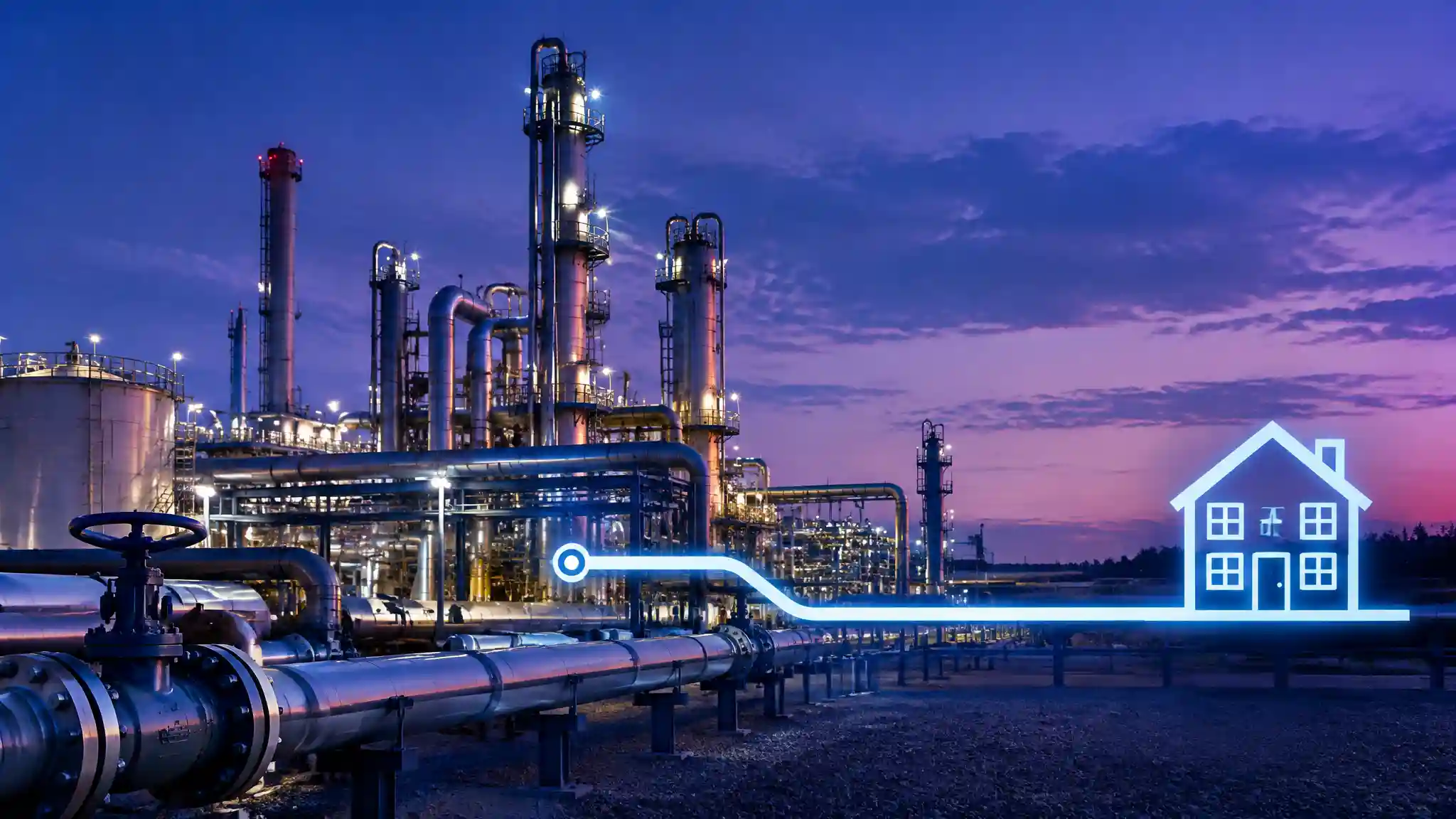
Most carbon accounting for domestic heating stops at the point of combustion, where burning natural gas releases roughly 0.18 kg of CO2 per kWh. That figure leaves out the whole supply chain. Gas has to be extracted offshore, compressed, and piped to shore, where processing terminals strip out water, heavier hydrocarbons and acid gases. It is then moved across the National Transmission System by gas-fired compressor stations before being stepped down through regional distribution networks. Every stage consumes energy and releases emissions of its own.
The source of the gas matters a great deal. UK and Norwegian pipeline gas from the North Sea has a comparatively low upstream intensity. Imported liquefied natural gas (LNG), now a structural part of UK supply, carries a much heavier penalty. Cooling gas to around minus 162°C typically consumes 8 to 12% of its energy content, and the cargo must then be shipped thousands of miles, boil-off managed, and the gas regasified at import terminals. As a result, the upstream footprint of LNG is typically several times that of domestic pipeline gas.
Methane is the most significant upstream factor. Unburned natural gas is mostly methane, a greenhouse gas with a global warming potential around 80 times that of CO2 over 20 years. Leaks from wellheads, venting, compressor seals and high-pressure transmission lines therefore add disproportionate warming before any fuel is burned. Studies of major producing regions suggest that leakage rates of 2 to 3% of throughput can erase much of gas’s claimed advantage over coal on a 20-year horizon.
For sustainability analysts and procurement managers, these upstream emissions fall under Scope 3 and are often underreported. Once the full chain is counted, gas heating performs worse than combustion-only figures suggest, and the case for electrified heat running on an increasingly low-carbon grid becomes stronger still.