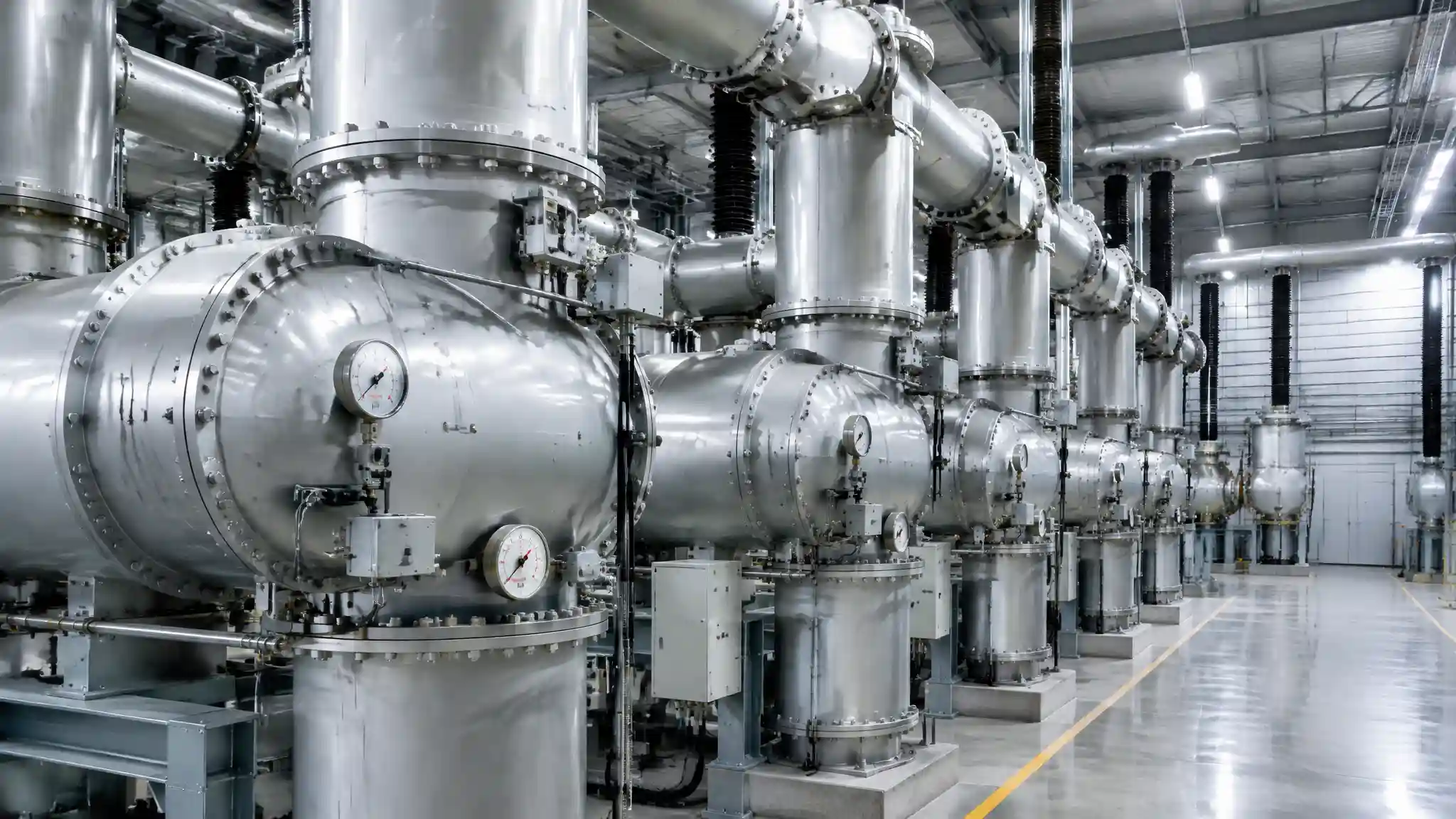
When a high-voltage breaker opens under load, current continues to flow through a plasma arc between the separating contacts. The breaker must extinguish that arc at a current zero and withstand the transient recovery voltage that follows. SF6 is exceptionally good at this because it is strongly electronegative: its molecules capture free electrons and form heavy, slow-moving negative ions. Removing electrons this quickly cools and de-ionises the arc channel, and the gap recovers its dielectric strength within microseconds. Its dielectric strength is around three times that of air, which makes very compact GIS bays possible in constrained urban and offshore substations.
That performance comes at a climate cost. One kilogram of leaked SF6 is equivalent to about 24.3 tonnes of CO₂. Gaskets, flanges and density monitors on equipment installed decades ago lose integrity over time. Each top-up of a leaking compartment therefore adds a measurable entry to a network operator's Scope 1 emissions.
Regulation is closing in. The EU F-gas Regulation (EU) 2024/573 bans SF6 in new medium-voltage switchgear up to 24 kV from 2026, extends the ban to 52 kV in 2030 and reaches transmission voltages by 2032. Great Britain is developing its own rules, but EU-based manufacturers dominate supply, so GB networks are moving in the same direction. New installations are only part of the problem. The installed base of legacy SF6 equipment will remain a leakage liability for decades unless it is retrofitted or replaced.
The leading alternative combines vacuum interrupters for current breaking with clean air, a nitrogen and oxygen mixture, for insulation. Breaking the current in a vacuum produces a metal-vapour arc that extinguishes rapidly at current zero, so the insulating gas no longer needs to quench arcs. Clean air has a global warming potential of zero, although it needs higher fill pressures or larger enclosures to match SF6's insulation performance. Asset managers should prioritise leak detection, gas recovery and replacement plans for the worst-leaking assets.