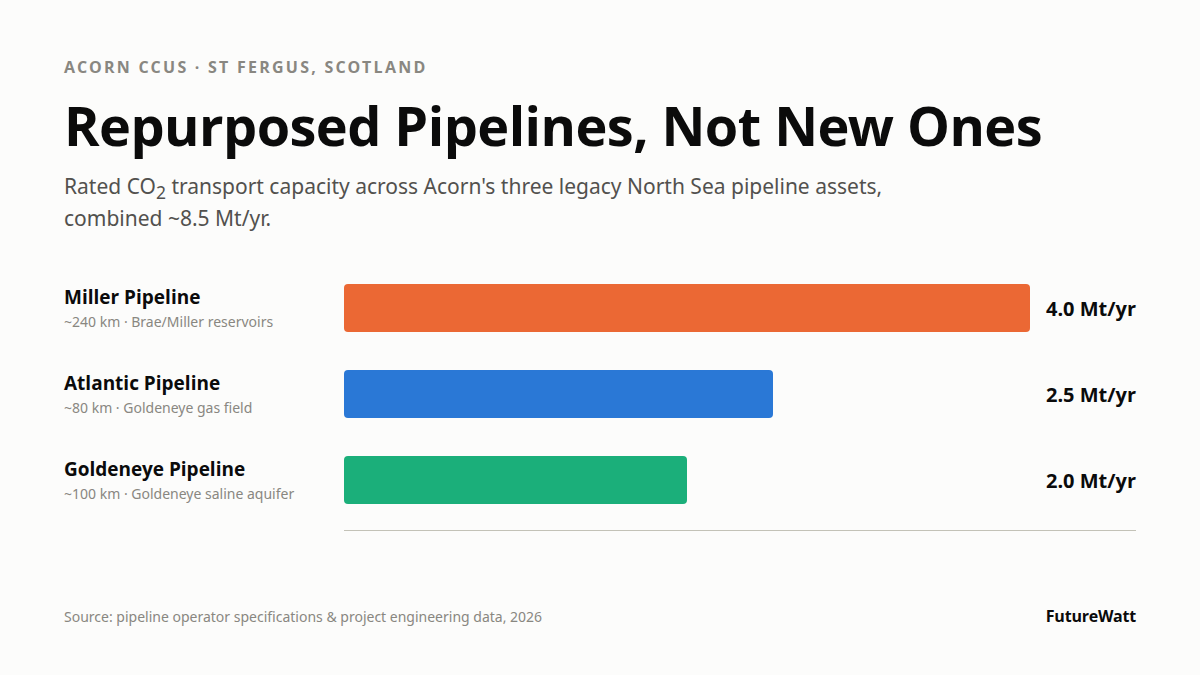
The Acorn Carbon Capture and Storage project, anchored at the St Fergus gas terminal on Scotland's north-east coast, is the UK's clearest test of whether decarbonisation infrastructure can be built on repurposed assets rather than fresh capital. Acorn holds Track-2 status within the UK's industrial decarbonisation cluster sequencing, the tier now working through the financial clearances — final investment decision, contracts for difference on transport and storage, and Treasury sign-off — needed to contribute meaningfully to the UK's Seventh Carbon Budget targets. Its central engineering advantage is not novel capture chemistry; it is geography and inheritance. By routing captured CO2 through legacy offshore oil and gas pipelines already in the ground beneath the North Sea, Acorn avoids the multi-billion-pound capital cost and multi-year consenting timeline of laying an entirely new subsea transport network. The pipes exist. The question is whether 1970s- and 1980s-era steel, welded for sweet natural gas, can be re-qualified to carry dense-phase CO2 without failing.
The Legacy Asset Conversion Matrix
| Pipeline asset | Original use case | Length (km) | Target offshore storage reservoir | Rated CO2 transport capacity (Mt/yr) |
|---|---|---|---|---|
| Atlantic Pipeline | Legacy offshore gas transport | ~80 | Goldeneye depleted gas field | ~2.5 |
| Miller Pipeline | Legacy sour gas transport | ~240 | Brae/Miller depleted reservoirs | ~4.0 |
| Goldeneye Pipeline | Dedicated offshore gas transport | ~100 | Goldeneye saline aquifer | ~2.0 |
Combined, the three assets are rated for approximately 8.5 Mt/yr of CO2 transport capacity — a figure set by the pipelines' original diameter and wall-thickness specification, not by anything intrinsic to carbon dioxide, which is precisely why re-qualification rather than replacement is the commercially decisive move.
Repurposing Physics: The Supercritical CO2 Challenge
- The phase control paradox. CO2 is transported not as a gas or liquid but in a supercritical state, held above 73.8 bar and 31.1°C throughout the entire transit route to maintain the high-density, low-viscosity flow characteristics that make pipeline transport efficient. Falling below either threshold anywhere along an 80–240 km route risks a phase change mid-pipe, producing density shocks and pressure transients that legacy steel was never stress-modelled against. Compressor and pressure-maintenance stations along the route exist for exactly one purpose: keeping the entire column on the correct side of that phase boundary, continuously, for the life of the asset.
- Metallurgy and corrosion risk. Pipelines qualified for sweet natural gas tolerate a wet gas stream without incident, because dry hydrocarbon gas does not react with residual moisture. CO2 does. Even trace water content combines with CO2 to form carbonic acid (H2CO3), which attacks carbon steel at rates legacy pipe was never designed to absorb. This is why the St Fergus dehydration facility carries a disproportionate share of the project's engineering risk: the dew-point specification on the CO2 stream has to be held to an aggressive, near-zero moisture tolerance before the gas ever reaches the legacy pipe, because there is no practical way to correct a corrosion problem 100 km offshore once it has started.
- Overpressure versus fatigue. Dense-phase CO2 injection is a continuous high-pressure duty cycle, and decades-old subsea welds were not fabricated with that specific loading profile in mind. Full-route ultrasonic testing of every legacy weld is required to confirm fatigue tolerance before re-qualification, because a weld that comfortably handled steady-state gas transport for thirty years is not automatically fit for a higher, more cyclically demanding pressure regime.
The Central North Sea Storage Advantage & Import Horizon
- Depleted field geometries. Goldeneye and the surrounding depleted hydrocarbon reservoirs offer something a saline aquifer cannot: a fully mapped, bounded structural trap with a caprock already proven to hold hydrocarbons under pressure for geological time. That removes the early-stage migration and containment uncertainty that dogs unproven saline aquifer storage sites, where seal integrity has to be inferred rather than demonstrated by decades of production history.
- The deepwater shipping terminal. Acorn's integration with the deepwater port at Peterhead extends its addressable market well past Scottish industrial emissions. The same reservoir and pipeline capacity that services onshore capture at St Fergus can, in parallel, accept liquefied CO2 delivered by specialised carrier ship from industrial clusters across continental Europe, positioning the North Sea storage complex as an import hub rather than a purely domestic sink. That optionality — storage capacity sold as a service to emitters who have captured CO2 but have nowhere geologically suitable to put it — is what turns Acorn from a national decarbonisation project into a piece of European carbon-management infrastructure, and it is the commercial logic behind treating the UK's depleted North Sea fields as a long-term geopolitical carbon sink.