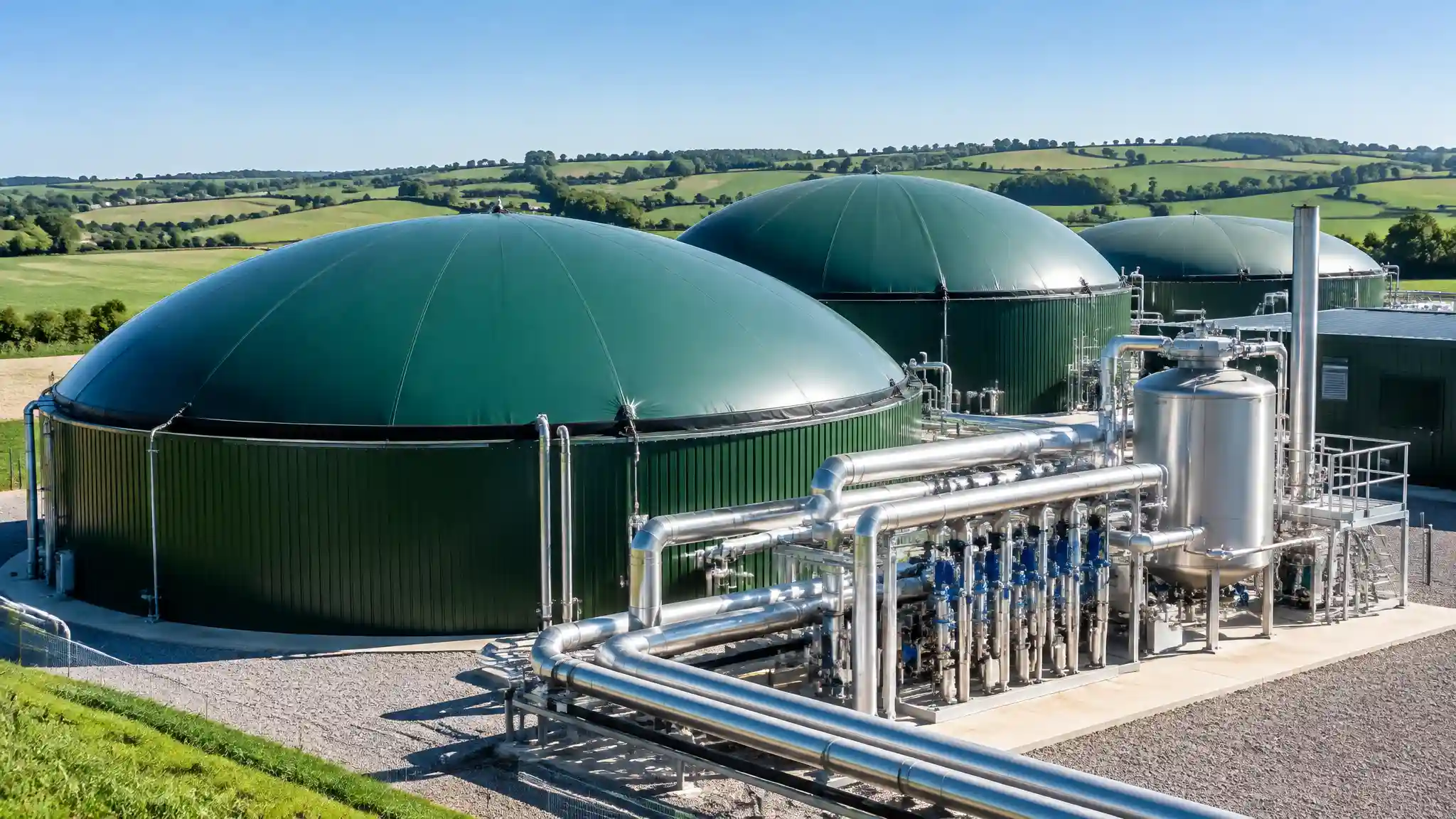
Anaerobic digestion relies on microbial consortia that break organic matter down into biogas, usually 50–60% methane, inside sealed, oxygen-free tanks. The energy available depends on how much volatile solids content the feedstock carries. Cattle slurry is mostly water and has already passed through a ruminant gut, so it yields only around 10–15 m³ of methane per tonne. Maize silage, rich in digestible starch and sugars, yields roughly 100–115 m³ per tonne. That gap is why commercial plants supplement waste with energy crops to keep their gas output contractually reliable.
Feedstock | Methane Yield (m³ CH₄ per tonne fresh weight) | Land Requirement | Net Carbon Profile |
|---|---|---|---|
Cattle slurry | Roughly 10–15 | None: a by-product of existing livestock | Strongly positive; also avoids methane escaping from open slurry stores |
Food waste | Roughly 80–110 | None: diverted from landfill or composting | Strongly positive; displaces landfill methane |
Grass silage | Roughly 90–110 | Dedicated grassland, typically cut 3–4 times a year | Moderate; depends on fertiliser rate and soil management |
Maize silage | Roughly 100–115 | Dedicated arable land at about 40–45 tonnes per hectare | Weakest; high fertiliser and machinery inputs, bare-soil erosion risk |
Benchmark: ground-mount solar | Not applicable | About 2 hectares per MWp | Roughly ten times the annual energy per hectare of maize biomethane |
The land allocation penalty begins in the field. A hectare of maize yields roughly 40–45 tonnes of silage, or around 50 MWh of gross methane energy a year. A hectare of ground-mounted solar in southern England generates around ten times that as electricity. Maize also needs high nitrogen fertiliser inputs, whose manufacture and field emissions of nitrous oxide erode the net benefit. Late autumn harvests with heavy trailers compact wet soils and leave fields bare through winter, accelerating erosion, runoff and the loss of soil organic carbon.
The policy direction is clear. The Green Gas Support Scheme already requires at least half of a plant's biogas to come from wastes or residues, and that principle should anchor future expansion. Mandatory separate food waste collections in England are increasing the supply of high-yield, land-free feedstock. A durable biomethane sector should be built on slurry, food waste and genuine residues, keeping prime agricultural land for food, carbon sequestration or higher-yield renewable generation.