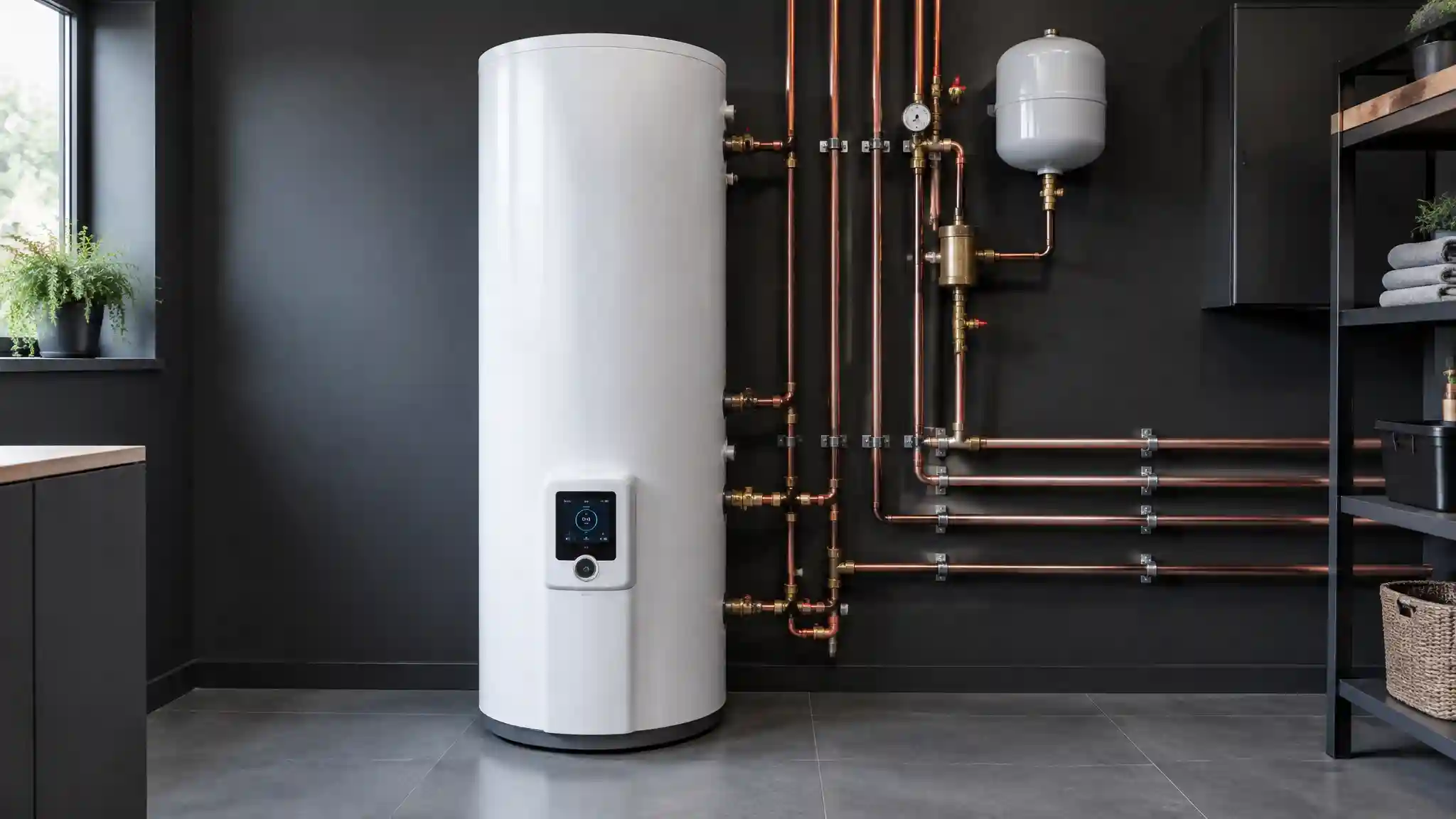
The defining weakness of a conventional unvented or vented cylinder is not insulation quality but heating geometry. With the coil or immersion element at the base, heated water rises by natural convection and continuously mixes with the cooler mass above it. This thermal dilution erodes any useful temperature gradient, so the controller has to bring the entire tank to setpoint before delivering reliably hot water at the outlet. A partial draw-off triggers a full-capacity reheat.
Mixergy inverts the process. A pump draws cold water from the base of the cylinder, passes it across the heat source and injects it through a diffuser at the top at low velocity. Because hot water is less dense, it forms a stable layer that grows downward, preserving a sharp thermocline between hot and cold zones. Sensors track the boundary in real time, reporting state of charge as a percentage. Holding only 40% of the tank hot reduces the high-temperature surface area exposed to ambient air, cutting standing losses proportionally.
That measurable state of charge is what makes the cylinder controllable as a thermal battery. Mixergy applies Machine Learning to household draw-off history, forecasting how much hot water is needed and when. Through tariff integrations such as the Octopus Agile API, it shifts charging into off-peak windows and negative-pricing events, buying heat when wholesale prices are lowest rather than when a fixed timer dictates.
Metric | Standard Cylinder | Mixergy Smart Cylinder |
|---|---|---|
Heating Mechanism | Bottom-up coil or immersion; convection mixes the whole volume | Volumetric top-down injection; cold water drawn from the base, heated and diffused at the top |
Standing Thermal Loss | Full tank held at setpoint; losses scale with total stored volume | Only the charged fraction is hot; reduced hot surface area cuts standing losses |
Reheat Speed (For First Shower) | Slow; usable outlet temperature only once a large share of the tank has recovered | Fast; a usable hot layer forms at the outlet within minutes of a charge starting |
Smart Grid Optimization | Fixed timer or thermostat; no tariff awareness | Machine Learning demand prediction with automated charging on off-peak, Octopus Agile and negative-price slots |
Solar PV Diversion Integration | Needs a third-party diverter wired to the immersion | Native PV diversion integrated into the cylinder controls |
For specifiers, the result is a cylinder that can be sized for peak demand without paying the standby penalty of keeping that peak volume hot. For investors and homeowners, it turns hot water from a passive load into a dispatchable, tariff-aware energy asset.
For pricing, installation requirements and product-level detail, see our full Mixergy smart cylinder review.