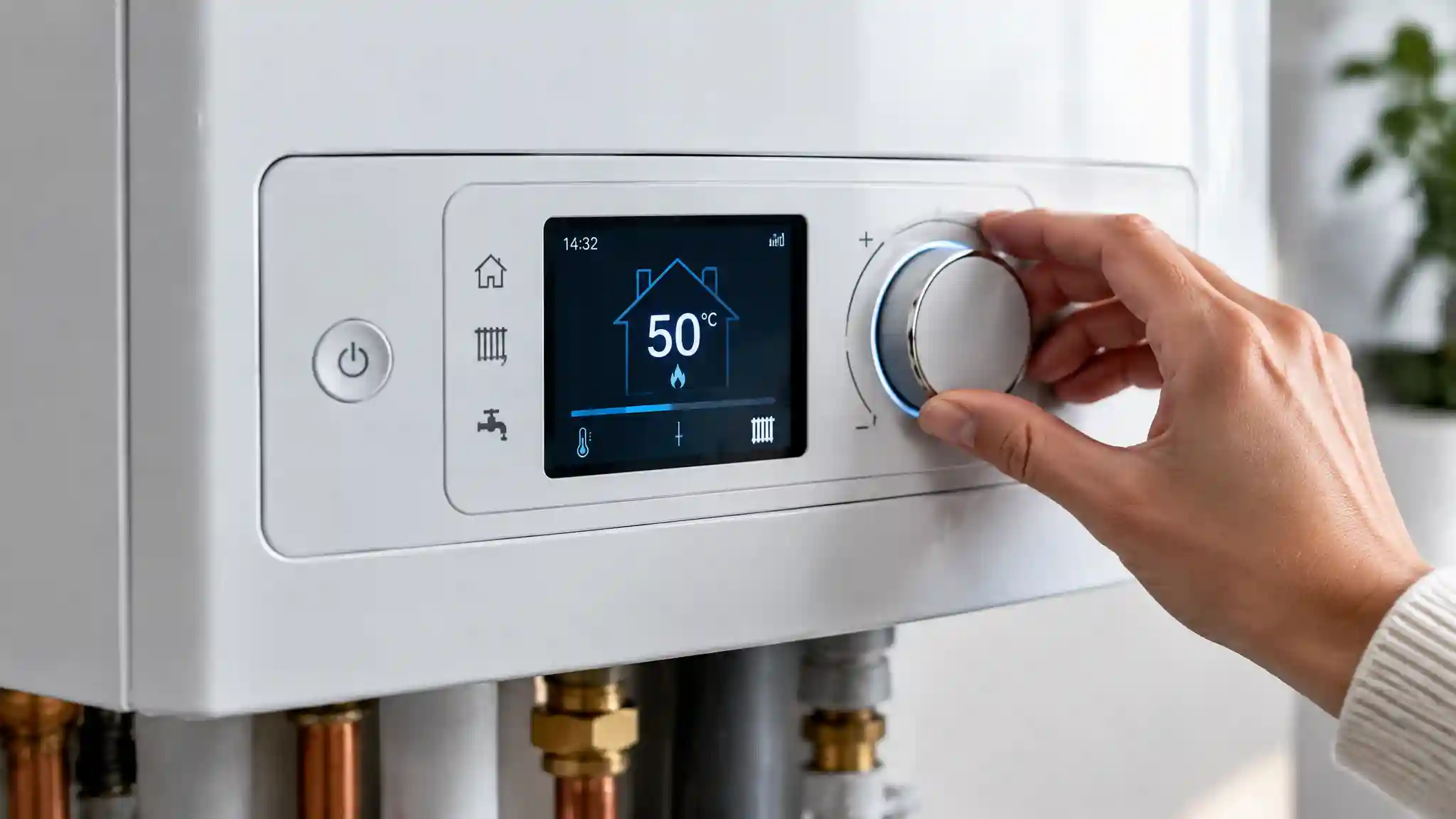
A condensing boiler only achieves its rated efficiency when the water returning to its heat exchanger is cool enough to condense water vapour out of the flue gases, recovering latent heat that would otherwise leave through the flue. For natural gas, that threshold sits at a return temperature of roughly 55°C to 57°C. A boiler running at 80°C flow typically returns water at around 60°C, so it rarely condenses at all. Dropping the flow temperature below 55°C pulls the return comfortably below the dew point and forces the boiler into true condensing mode, which can cut gas consumption by up to 15%, with real-world savings commonly in the high single digits.
The second benefit is diagnostic. A heat pump delivers its best coefficient of performance at flow temperatures of 45°C to 50°C, so running your existing boiler at the same setpoint reproduces the thermal conditions a heat pump would create. The method below turns a winter of normal use into a whole-house survey.
- Record a baseline. Note the current flow setpoint, weekly gas meter readings and target room temperatures before changing anything.
- Lower the heating flow temperature. On the boiler's central heating dial or menu, reduce the setpoint to 50°C. Leave the hot water setting alone; a stored cylinder should stay at 60°C or above for Legionella control.
- Rebalance and open up the system. Set TRVs in the main living spaces fully open and bleed any radiators with cold tops so every emitter is working at full surface area.
- Switch to long, continuous heating blocks. Replace short morning and evening bursts with extended periods at a steady, slightly lower thermostat setpoint, mirroring how a heat pump operates.
- Monitor through a cold spell. Log room temperatures on days near 0°C. If everything holds, try 45°C. If a room falls short, note it and return to the last comfortable setpoint.
The results isolate problems room by room. Radiator output falls sharply as the gap between water and room temperature narrows: a panel sized for 75°C flow may deliver around half its rated output at 50°C. A room that will not reach temperature on cold days points to an undersized emitter, solved by upgrading to a larger K2 (Type 22) or K3 (Type 33) double or triple panel radiator, or to a fabric weakness such as single glazing, draughts or an uninsulated external wall. Because these problems are identified before a heat pump is specified, installers and landlords can budget for them accurately and design the system around real measured performance rather than assumptions.