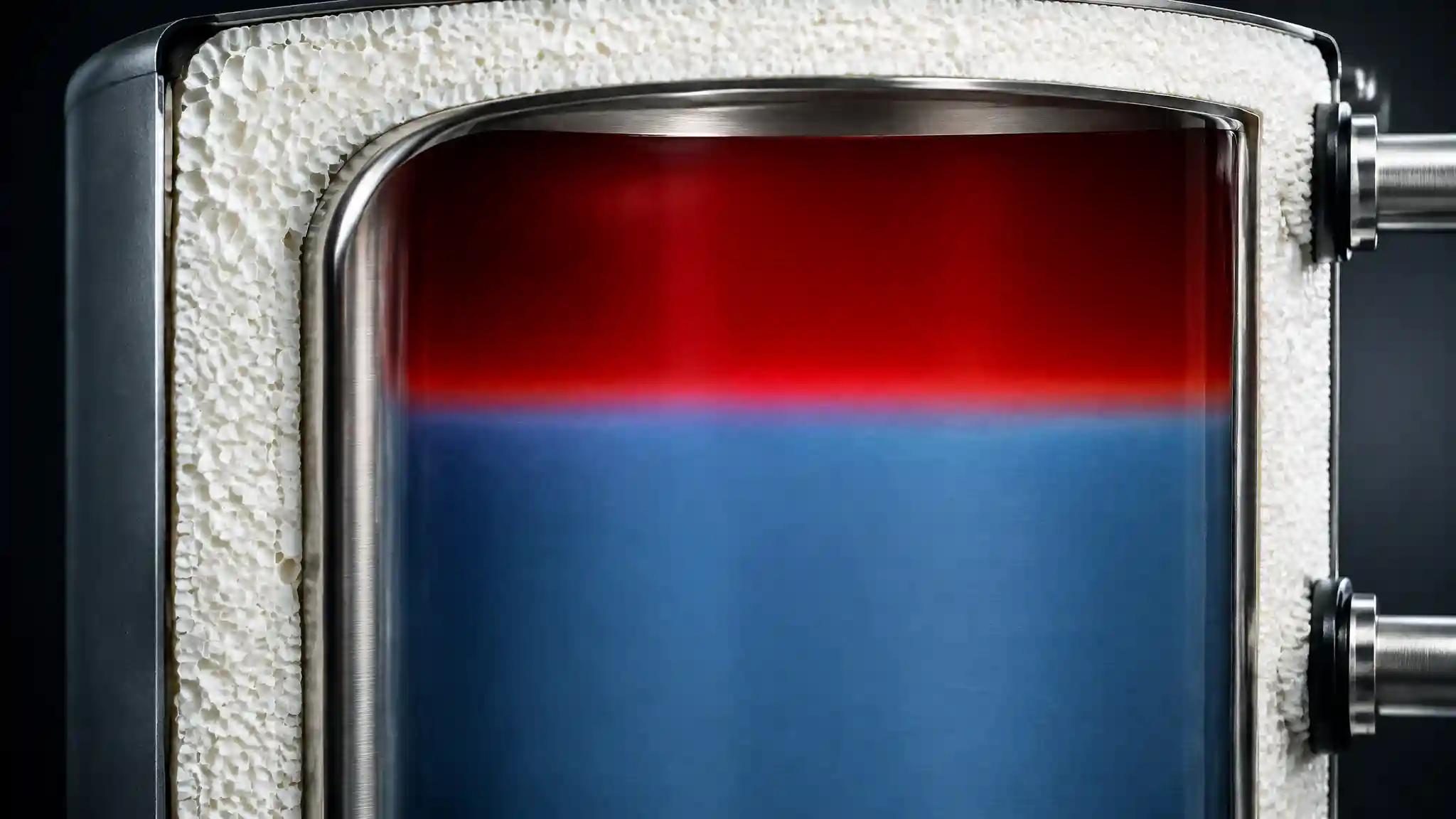
A well-performing cylinder is not a single body of warm water; it is a density-stratified column. Hot water is less dense, so it rises to the top while cold mains water settles at the base, separated by a narrow transition band known as the thermocline. The thinner and more stable that band, the more water can be drawn at full temperature before the outlet cools.
Legacy cylinders undermine this physics in two ways. First, cold mains water often enters through an open pipe at high velocity. The jet creates turbulent mixing that drives the cold layer upward, broadens the thermocline and causes thermal destratification, so the shower runs lukewarm long before the stored energy is used up. Second, thin foam or a loose lagging jacket allows heat to escape through the shell around the clock. Modern designs answer both problems with diffuser inlets that slow incoming water to laminar flow, and with high-density PU foam or vacuum-insulated panels that cut conductive losses sharply.
Metric | Legacy Copper Cylinder | Modern Stratified Insulated Cylinder |
|---|---|---|
Insulation | Loose lagging jacket or thin factory foam | 50mm to 100mm high-density PU foam or vacuum-insulated panels |
Standing Heat Loss | 1.5 to 2.2 kWh per 24 hours | 0.65 to 0.78 kWh per 24 hours |
Cold Inlet Design | Open pipe; high-velocity jet into the base | Diffuser or spreader plate that slows and directs incoming flow |
Stratification Stability | Turbulent refill mixes hot and cold layers | Stable thermocline with a sharp hot/cold boundary |
Usable Hot Water | Delivery temperature drops early in the draw | Near-constant outlet temperature until the thermocline arrives |
Reheat Behaviour | Frequent short reheat cycles to recover lost heat | Fewer, longer cycles suited to heat pumps and off-peak tariffs |
The decay maths is decisive. A legacy tank losing 1.5 to 2.2 kWh every 24 hours wastes roughly 550 to 800 kWh a year. A modern stratified cylinder at 0.65 to 0.78 kWh per day cuts that to 240 to 285 kWh. On an immersion heater at around 25p/kWh, the difference is worth about £75 to £130 a year, and well over £1,000 across a typical 15-year service life.
For specifiers and developers, the standing-loss figure on the product data sheet deserves the same scrutiny as cylinder volume. With heat pump hot water, a stable thermocline also protects the system COP, because the heat pump reheats cooler water at the base instead of chasing a mixed, lukewarm tank.