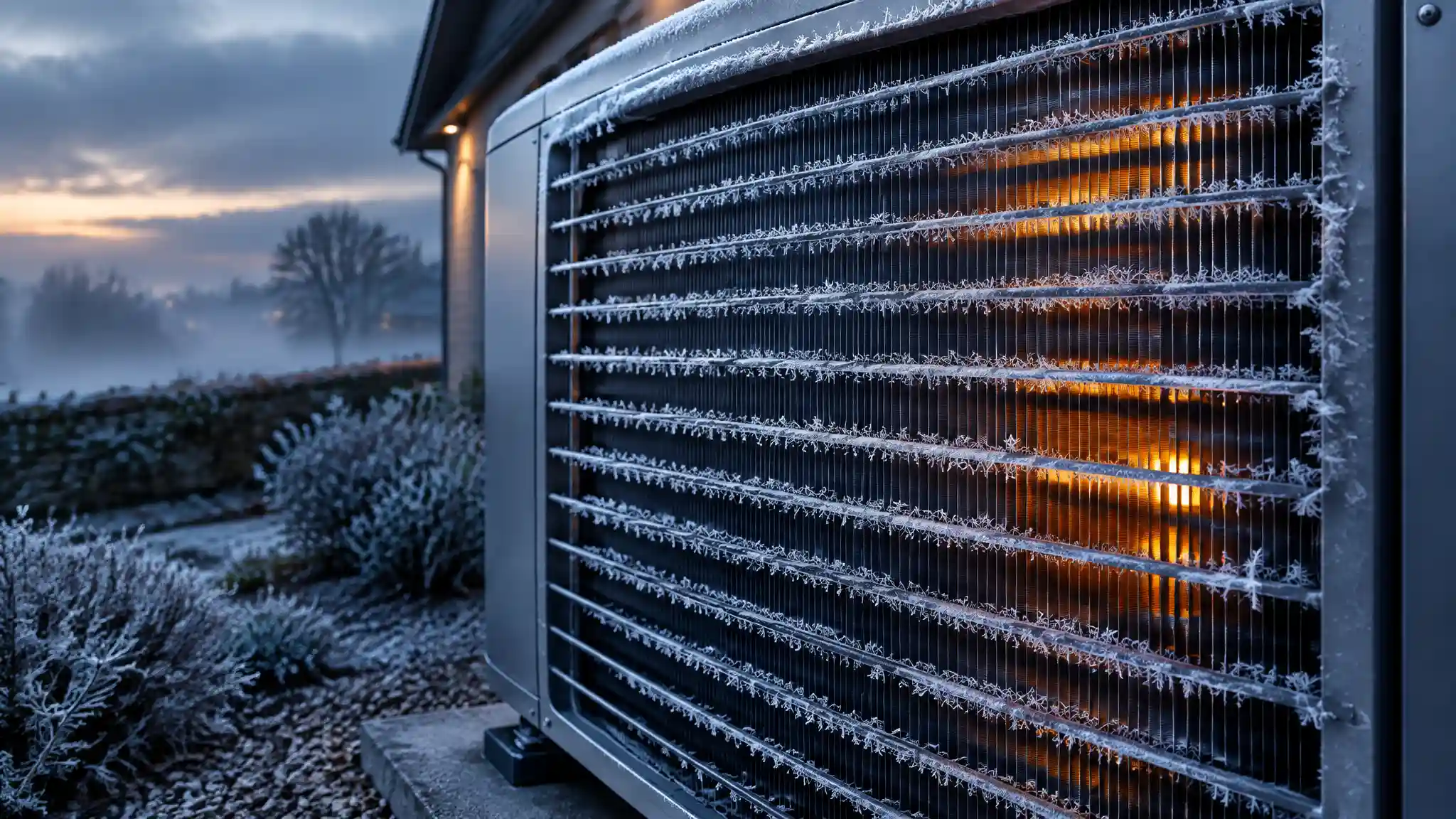
An air-source heat pump's outdoor evaporator runs several degrees colder than the surrounding air in order to absorb heat from it. When ambient temperatures sit between -2°C and +4°C with high relative humidity, the fin surface falls below both the dew point and freezing point, and moisture deposits directly as frost. Ice insulates the coil and blocks airflow, so heat transfer collapses. To recover, the unit performs a reverse-cycle defrost: the four-way valve swaps the roles of condenser and evaporator, drawing heat out of the property's heating circuit to melt the ice. During those minutes the momentary COP effectively drops to zero, and the energy spent must be repaid once normal heating resumes.
EN 14825 derives SCOP from a handful of part-load test points weighted across a standard climate profile. Frosting appears only at the +2°C point and within a short measurement window. It does not represent weeks of saturated Atlantic air holding near freezing, where defrost cycles repeat continuously. Combined with headline figures declared at 35°C flow, the result is an inflated SCOP projection relative to UK field monitoring data.
Variable | EN 14825 Laboratory Parameters | Real UK Winter Conditions |
|---|---|---|
Ambient Temperature Profile | Fixed steady-state test points weighted to a standard climate bin distribution | Prolonged spells hovering between -2°C and +4°C, with rapid swings |
Relative Humidity | Specified per test point and held constant | Frequently above 85–90% for days at a time in maritime air |
Defrost Frequency | Captured only within a short measurement window at the frosting test point | Repeated cycles, often hourly or more, through damp cold weeks |
Flow Temperature | Declared at a design flow, often 35°C for the headline figure | Commonly 45–55°C where emitters were not upsized |
Resulting Efficiency | Headline SCOP of 4.0 or higher | Field seasonal performance commonly closer to 3 |
The gap is not fixed; it is a design outcome. Correctly sized, larger radiators allow lower flow temperatures, raising baseline COP and adding thermal mass that keeps rooms comfortable while a defrost borrows heat. A buffer tank or volumiser supplies the stored energy each defrost needs without chilling the emitters, and weather compensation keeps flow temperatures no higher than conditions demand. Specified this way, real-world performance can approach the label.