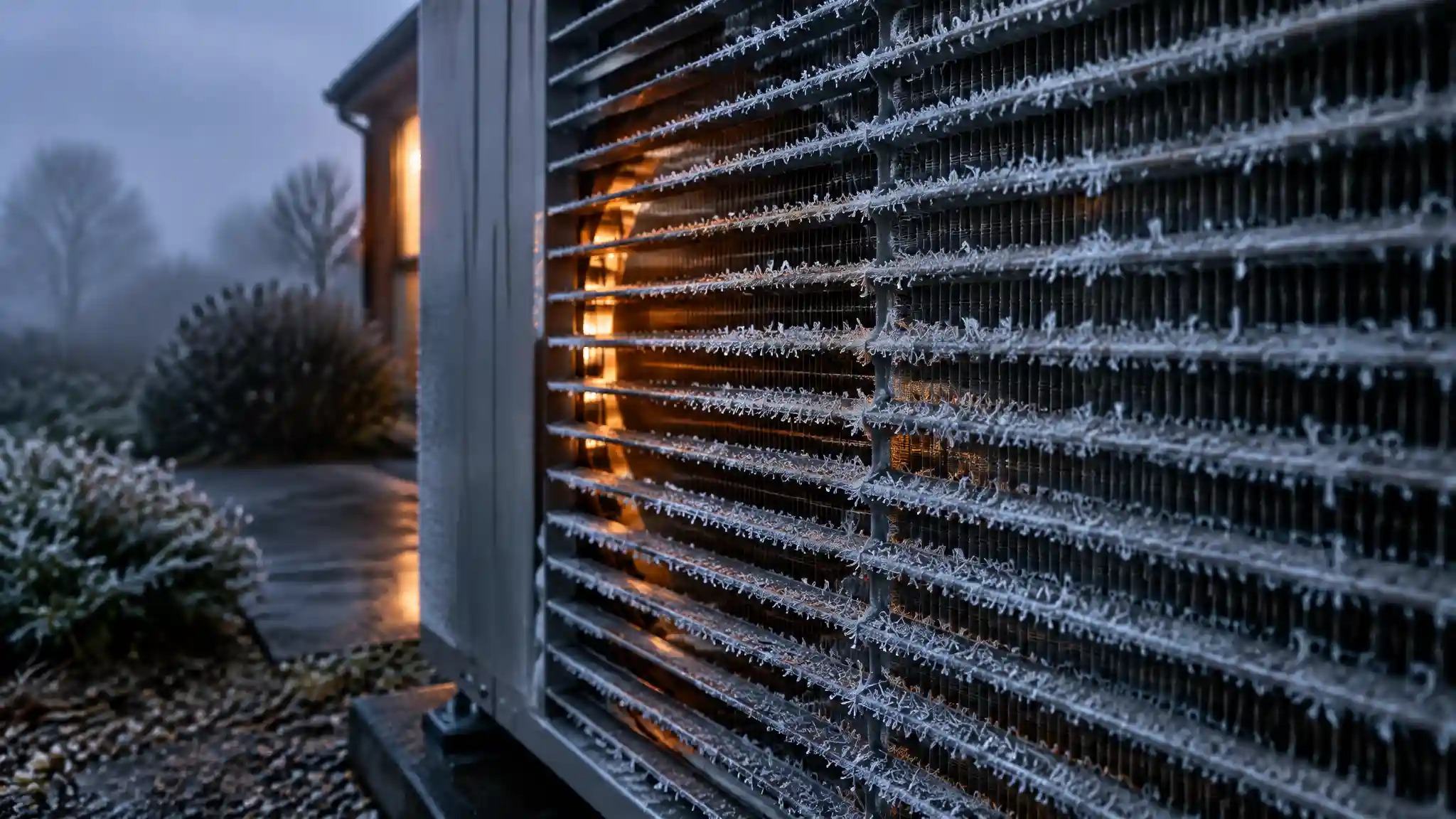
The UK's maritime climate is close to a worst case for frosting. Air near freezing and close to saturation carries enough moisture for water vapour to deposit as frost on evaporator fins running several degrees below 0°C. That moisture places a heavy latent heat load on the coil alongside the sensible heat being extracted. As frost builds, it acts as a thermal insulator and narrows the air channels between fins, so the fan moves less air across a poorer heat-transfer surface. Evaporating temperature falls, the compressor works harder to hold output, and efficiency slides until the controller triggers a defrost.
During a reverse-cycle defrost, the four-way reversing valve shifts and the refrigerant flow runs backwards. The indoor plate heat exchanger and emitter network become the evaporator, and the outdoor coil becomes the condenser, pushing hot discharge gas through the frozen fins. Melting ice is energy-hungry: every kilogram needs about 334 kJ of latent heat of fusion, before the coil's metal mass is warmed. For a few minutes the system takes heat from the house rather than delivering it, and its momentary COP falls below 1.
Variable | Laboratory Test Conditions (EN 14825) | Real-World UK Maritime Winter |
|---|---|---|
Ambient Profile | Fixed test points at controlled temperature and humidity | Prolonged spells between -2°C and +4°C at 85% to 100% RH |
Coil Frosting | Frost and defrost effects captured at limited test points only | Continuous frost build-up on fins; ice bridges airflow channels |
Defrost Frequency | Assumed within the averaged test data | Frequent cycles, often every 30 to 90 minutes in damp, near-freezing air |
Heat Source During Defrost | Not representative of a specific installation | Heat drawn from the home's emitter loop and stored water volume |
Momentary COP | Steady-state rating at each test point | Falls below 1 during a defrost; recovers once frost is cleared |
Flow Temperature Impact | Controlled return temperature | Return water drops several degrees; rooms can cool if system volume is low |
Good hydraulic design keeps this penalty hidden from occupants. Adequate system water volume, met where needed with a correctly sized buffer vessel, gives the defrost a thermal reservoir to draw from without collapsing the flow temperature. Low-temperature radiators sized for 35°C to 45°C flow hold more water and deliver steady output at lower temperatures, so short, intensive defrost windows pass without a noticeable drop in room temperature. Specifiers should check the manufacturer's minimum system volume and confirm it is reachable with zone valves closed.