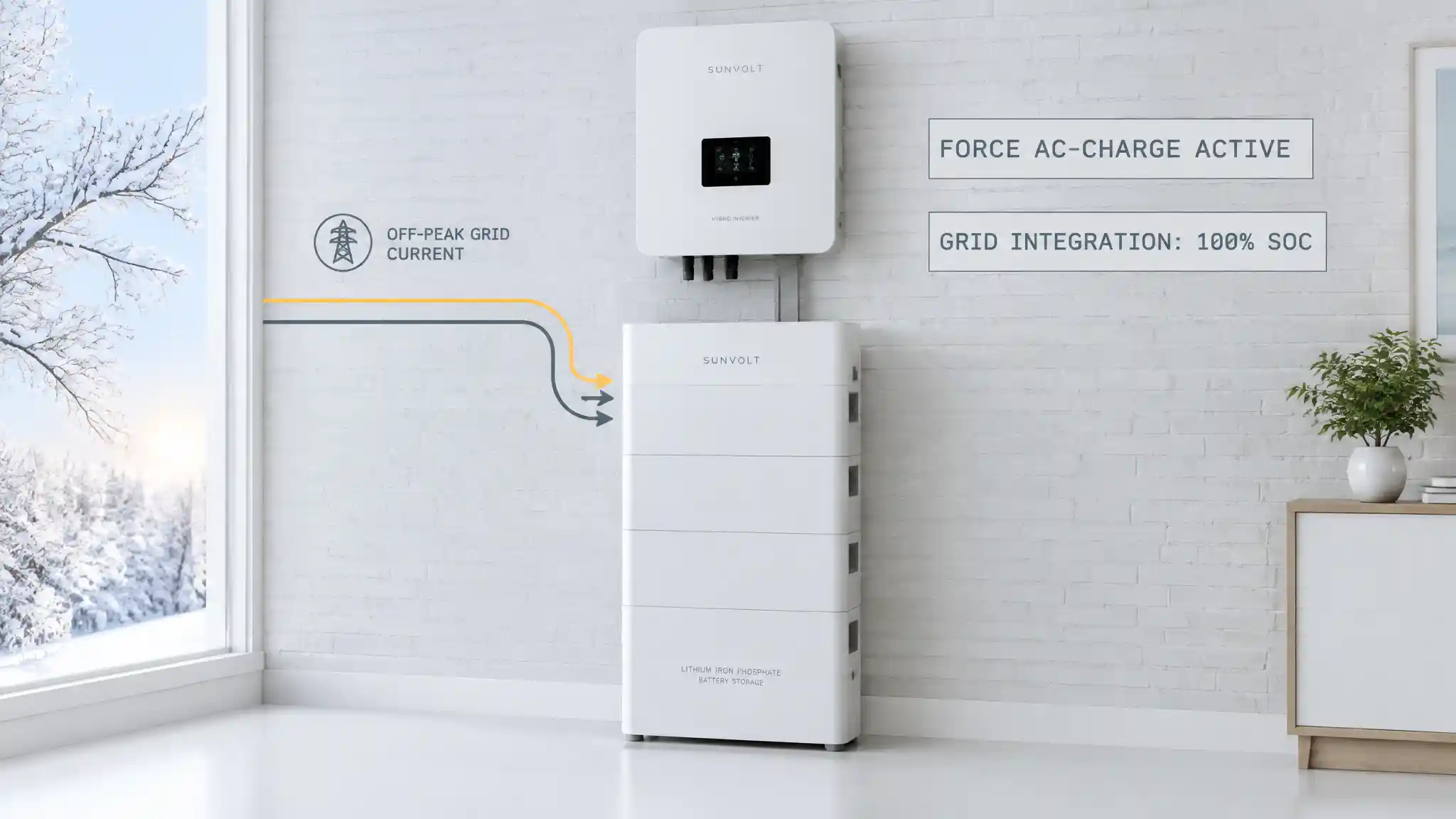
Can You Charge a Home Battery From the Grid During Winter?
Yes — most modern home battery inverters support "force charging" or "grid charging" from the mains during cheap overnight electricity windows, letting the battery discharge later during expensive peak-rate hours. Off-peak rates on tariffs like Octopus Intelligent Go have moved around through 2026 — from roughly 5.5p/kWh to around 8p/kWh depending on region and enrolment date — so always check your current app rate rather than assuming a fixed figure.
Why Winter Changes the Strategy
In summer, home batteries charge primarily from solar panels, with grid charging rarely needed. In winter, low sun angles and shorter daylight hours in the UK mean solar generation can drop by 70–80% compared to June, leaving batteries under-charged for the evening peak. Force-charging from the grid during a cheap overnight window replaces the shortfall in solar input, letting you still avoid paying peak-rate electricity (often 25p–35p/kWh) during the 4pm–7pm demand spike.
Step-by-Step: Setting Up Overnight Force Charging
- Step 1 — Confirm your tariff's cheap window. Octopus Intelligent Go typically runs 23:30–05:30; Economy 7 windows vary by DNO region. Check the current rate in-app, since it changes more often now than it used to.
- Step 2 — Access your inverter's app or portal. Brands like GivEnergy, SolarEdge, Tesla Powerwall, and Sofar Solar all expose a "grid charge" or "AC charge" toggle in their scheduling menu, separate from the standard solar-charge mode.
- Step 3 — Set a charging window matching your tariff. Input the exact start/end times of your cheap-rate period, and set a target State of Charge (commonly 80–100%) to avoid unnecessary wear from constant full cycling.
- Step 4 — Set a discharge/export restriction. Most inverters let you block battery discharge during the charging window itself, so you're not simultaneously buying and using grid power inefficiently.
- Step 5 — Monitor via the app for the first week. Confirm the battery is reaching full charge before the cheap window ends and depleting appropriately across the following peak period.
 Photo: Chris Barker / Unsplash.
Is It Actually Worth It?
For a typical 5kWh battery charged fully at around 7p/kWh and discharged to offset peak-rate usage at 30p/kWh, the arbitrage saves roughly £1.15 per full cycle (5kWh × (30p − 7p) = £1.15), or several hundred pounds a year if cycled daily through winter — before accounting for battery degradation, which most manufacturers rate for 6,000+ cycles. The exact saving moves with whatever your current off-peak and peak rates actually are, so it's worth recalculating each time your tariff's pricing changes.
Keep an eye out for occasional negative or near-zero pricing events (sometimes marketed as "Plunge Pricing" by Octopus and similar schemes by other suppliers) during periods of high wind generation and low demand — a battery already set up for scheduled grid charging is well-placed to take advantage of these without any manual intervention, since your inverter simply charges whenever the scheduled window says to.
Common Pitfalls
- Tariff mismatch: Force-charging on a standard variable tariff, then discharging to offset usage priced similarly, provides no financial benefit — this strategy only works on tariffs with a genuine day/night price gap.
- Inverter firmware limits: Some older inverters only allow one scheduled charge window per day — check compatibility before assuming split-window scheduling is available.
- Export tariff conflicts: If you're on an export tariff like Outgoing Agile, ensure grid-charged energy isn't accidentally re-exported, which some suppliers explicitly prohibit under their terms.
Don't have an EV/battery smart tariff yet? None of this works without one — a genuine day/night price gap is the entire basis of the saving.
Check my Octopus smart tariff & claim £50 credit →