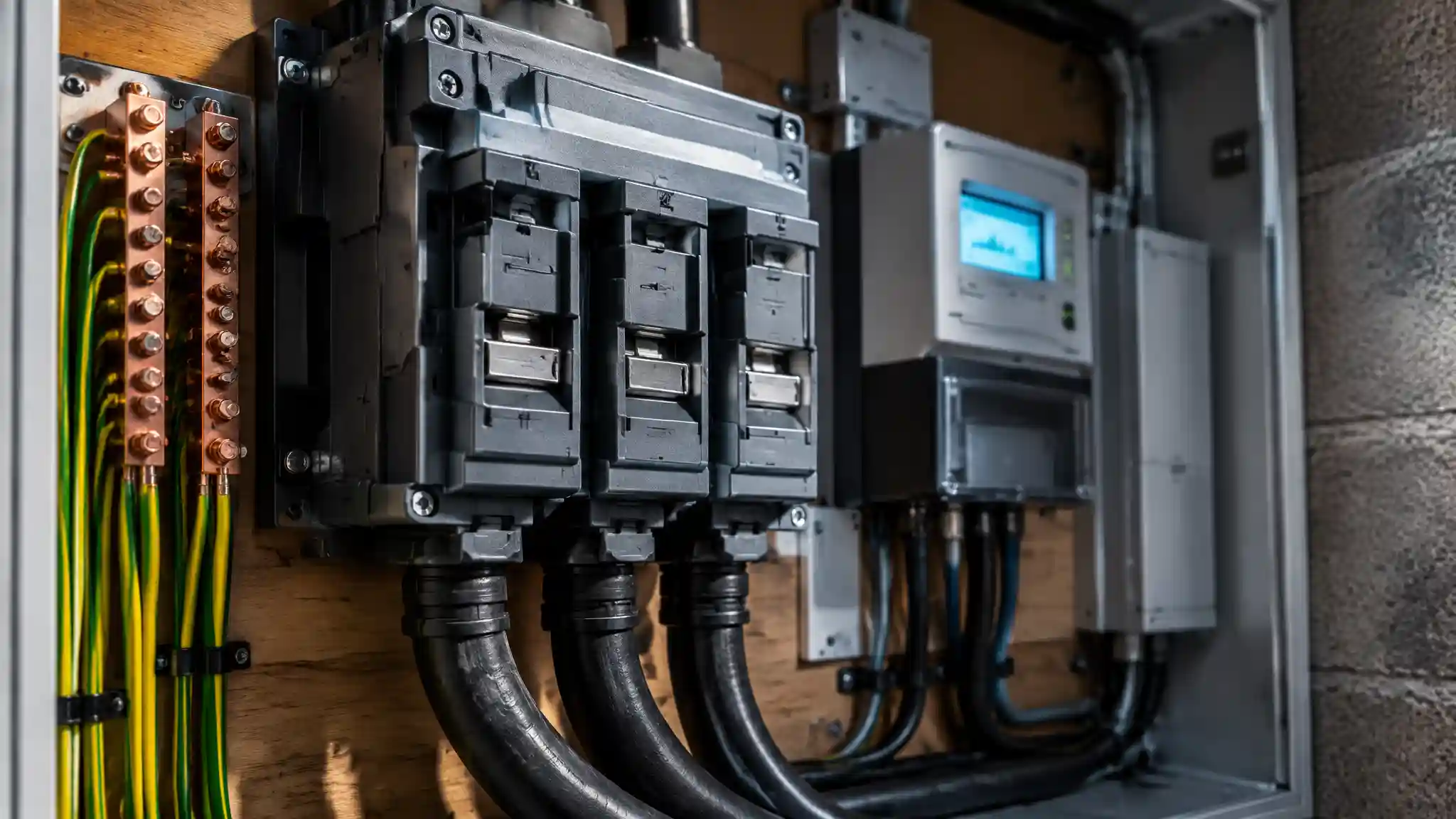
Looped services were a cost-saving design choice in the post-war housing boom, when a terraced household rarely drew more than a few kilowatts. Many of these loops are still protected by a 60A or 100A supply fuse that now has to serve two homes. The arithmetic no longer works. A 32A EV charger running for a full overnight session, combined with a 9.5kW power shower (about 40A) and an induction hob drawing 20A or more, can push a single property past 90A. Add a neighbour's evening demand and the shared cable runs at or beyond its thermal rating, which is why a looped supply triggers mandatory DNO intervention.
Parameter | Independent Service | Looped Service |
|---|---|---|
Cable Topology | Dedicated cable from the street main to a single cutout | One service cable feeding two or more properties in series |
Fuse Capacity | Typically 80A to 100A for one household | Often a single 60A or 100A fuse shared across homes |
Diversity Headroom | Full capacity available to one consumer | Capacity split between neighbours with uncoordinated demand |
LCT Notification | Standard ENA connect-and-notify process for most EV and heat pump installs | DNO assessment required; un-looping is usually a precondition |
Fault Isolation | A fault affects one property only | A fault or fuse operation can cut supply to every property on the loop |
Retrofit Readiness | Ready for EV, heat pump and battery storage | Blocked until the DNO cuts the loop and lays new cable |
The operational friction sits in the groundwork, not the paperwork. Under current Energy Networks Association guidance, DNOs will typically cut the loop free of charge where it blocks a low-carbon technology installation. The cost is not the problem; the schedule is. Un-looping means excavating driveways, front gardens and public pavements, securing street-works permits and coordinating access with neighbours. Retrofit timelines routinely slip by 4 to 16 weeks, leaving installers with idle crews and customers with chargers they cannot commission.
When an entire street electrifies at the same time, those delays compound. A single DNO crew may need to un-loop dozens of properties, often alongside LV feeder reinforcement that the new load also requires.
For contractors and retrofit coordinators the strategy is clear: identify looped supplies during the first survey, check the cutout fuse rating, and submit the DNO application before any hardware is ordered. Treat un-looping as the critical path, not an afterthought.