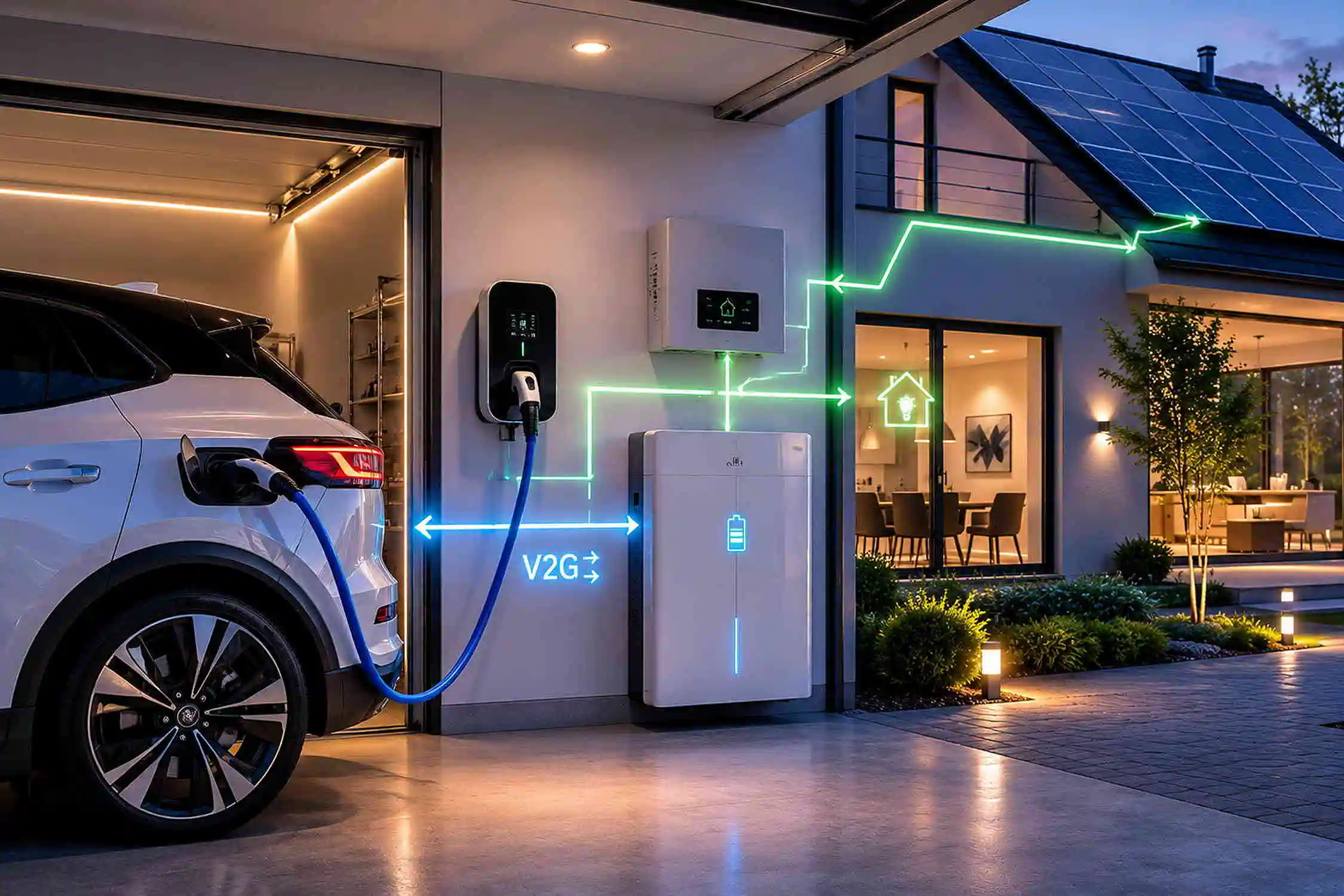
Vehicle-to-Home (V2H) charging is frequently presented as a software feature that a vehicle will simply acquire, as though the battery were already waiting to power a kitchen. In practice, V2H is a hardware, protocol and compliance problem long before it is a tariff opportunity. A modern battery electric vehicle holds between 60 kWh and 100 kWh of storage, several times the capacity of a typical domestic battery, yet turning that storage into a dependable domestic backup node demands an external power-conversion platform, a compatible communications stack, a certified islanding mechanism and a grid-connection process that was not written with mobile storage in mind. This audit examines each layer, using the Wallbox Quasar 2 as the reference product, and tests the claims against the engineering constraints that grid compliance managers, renewable microgrid developers and automated technology specifiers actually face.
The AC versus DC Bidirectional Engineering Split
Conventional AC charging is architecturally simple because the wallbox is not really a charger. It is a protected, communicating supply point. Alternating current is delivered to the vehicle, where the on-board charger (OBC) rectifies it, performs power factor correction, and steps it to the voltage and current profile the battery management system (BMS) requests. All the heavy power electronics, namely the rectifier, DC link, isolating converter and associated thermal management, reside inside the car. The wallbox contributes a contactor, a residual current device, a control pilot signalling circuit and metering.
Bidirectional operation reverses that power flow, and the engineering consequences are significant. Most on-board chargers are unidirectional by design: their rectifier stage uses diodes or one-way topologies that cannot invert DC back into a synchronised AC waveform. Building bidirectional capability into every OBC would add cost, mass and heat to the vehicle, and each manufacturer would also have to certify the vehicle as a generating source under grid codes. The practical consequence is that V2H using the AC port is the exception, while the dominant approach relocates the power electronics to the wall.
A DC bidirectional terminal connects directly to the battery pack through the vehicle's DC fast-charging inlet, bypassing the OBC entirely. The unit must then perform the full conversion chain in reverse: it accepts the battery's high-voltage DC (typically 400 V or 800 V nominal architectures), conditions it through an isolated DC/DC stage, and then inverts it into a clean sinusoidal 230 V single-phase output at 50 Hz, phase-locked to the grid when connected and self-regulating when islanded. Galvanic isolation, harmonic filtering to the limits of the relevant standards, and DC injection control all become the responsibility of this external box. That is why such units are physically large, heavy, fan or liquid cooled, and priced closer to a hybrid solar inverter than a wallbox.
The thermal and mechanical implications follow directly. Converting 11 kW of power at 95 to 97 per cent efficiency still dissipates several hundred watts as heat, concentrated in the semiconductor switches and magnetics. Sealed outdoor enclosures therefore need an engineered cooling strategy, which is the reason higher-end designs integrate liquid cooling and reject heat through a controlled thermal path. Efficiency also matters for the economics of asset-optimisation: round-trip losses through the vehicle's battery, the DC link, the inverter and the home's wiring typically cost a double-digit percentage of the energy cycled, which erodes arbitrage margins on narrow tariff spreads.
There is a second, subtler distinction between the architectures. In an AC-coupled approach, the vehicle's own bidirectional OBC would export synchronised AC, and the wallbox would simply provide protection and metering. This is attractive because it is cheaper, but it places the grid-code compliance burden on the vehicle and requires a vehicle-side communications standard that few manufacturers have implemented. In a DC-coupled approach, the wall unit owns the grid-facing behaviour: anti-islanding detection, voltage and frequency ride-through, reactive power response and protective settings. It can therefore be type-tested once, as an inverter, rather than once per vehicle model. This is a major reason that DC remains the commercially viable route today.
Auditing the Wallbox Quasar 2
The Wallbox Quasar 2 is the clearest example of the DC-coupled approach for the European market. It is a CCS2 bidirectional unit with an 11.5 kW power ceiling for both charging and discharging, housing its inverter and DC stage in a single wall-mounted enclosure. The 11.5 kW figure is a headline value: continuous output depends on the vehicle's maximum permitted discharge power, the battery's state of charge and temperature, and the BMS's willingness to allow sustained discharge. A vehicle that restricts discharge to a lower rate will cap the system below the rated ceiling regardless of what the terminal can do.
The unit's strategic value is its backup capability. When the grid fails, a V2H system must disconnect the home from the network and re-establish a local supply within a tolerable window. This is the role of the islanding mechanism: a gateway or automatic transfer switch opens the connection to the distribution network, preventing back-feed onto a line that utility crews may believe is dead, and then closes onto the isolated home circuits supplied by the inverter. Where the inverter must start itself without any external reference voltage, the capability is known as black start. The Quasar 2 is positioned to provide this function, forming a stable 230 V, 50 Hz reference from the vehicle's DC supply so that household loads can resume operating.
Islanding is not a minor software detail. Before the home can be isolated safely, the system has to detect the outage reliably through voltage, frequency and rate-of-change-of-frequency monitoring, avoid nuisance trips from transient dips, and complete the transfer without the neutral-earth arrangement being compromised. In UK installations, this connects to protective multiple earthing (PME) rules: an islanded supply must provide a safe earthing arrangement, which in many cases means an earth electrode and a switched neutral scheme designed to the relevant requirements of BS 7671. Installers should expect the island circuit to be restricted to a defined set of essential loads on a separate consumer unit board, because the 11.5 kW ceiling cannot support simultaneous operation of a heat pump, an induction hob and an electric shower.
The Quasar 2 also relies on what could be called localised energy management handshakes. To avoid exporting more than the connection agreement allows, or to prioritise solar self-consumption, the system needs real-time visibility of household and grid power. This is delivered by current transformer (CT) clamps at the point of supply, communicating with the unit over a local interface. The handshake works in both directions: the energy management layer instructs the terminal to charge or discharge on the basis of tariff signals, solar generation and household demand, while the terminal reports its status, limits and the vehicle's state of charge. The reliability of that local control loop, particularly its behaviour when the internet connection is lost, is a key specification question for any microgrid developer.
The CHAdeMO versus CCS2 Protocol Bottleneck
The reason that the market looks the way it does is largely historical. CHAdeMO, the Japanese DC fast-charging standard, was designed with bidirectional power flow from the outset. Its protocol uses a dedicated controller area network (CAN) bus between vehicle and charger and defines discharge parameters natively. The Nissan Leaf, the best-selling early battery electric vehicle in Europe, therefore supported V2X through its CHAdeMO inlet for many years, and early deployments of V2H and vehicle-to-grid pilots in the UK relied on that foundation. The first generation of domestic bidirectional hardware, including the earlier Quasar, was a CHAdeMO product for this reason.
The difficulty is that the UK and Europe standardised on CCS2 (Combined Charging System, Type 2) for new vehicles. CCS communicates using power line communication (PLC) based on the DIN 70121 and ISO 15118 families of standards. The first editions of these standards were written around unidirectional charging. Bidirectional power transfer arrives in ISO 15118-20, which introduces the bidirectional power transfer (BPT) mode, richer scheduling, and improved security through certificate-based authentication and plug-and-charge. Implementing it is far from trivial: manufacturers must update the vehicle's communications controller, validate the BMS behaviour during discharge, re-certify the vehicle's warranty position and agree how discharge cycles count against battery degradation.
The result is a prolonged mismatch. The hardware has existed in prototype and limited-release form for some time, but the number of CCS2 vehicles on sale that expose a working ISO 15118-20 bidirectional mode and permit it in the UK market is small, and availability is often restricted by model year, battery variant and country. Some manufacturers offer bidirectional features through limited programmes with partner energy suppliers, rather than as an open capability. For a specifier, the compatibility matrix is therefore a three-way constraint: the vehicle must support bidirectional power in hardware and firmware, the terminal must support the vehicle's protocol version, and the energy supplier or the installer's warranty must permit the arrangement. A mismatch at any stage leaves the installation limited to ordinary charging.
The pre-existing CHAdeMO fleet creates an awkward asymmetry. The vehicles that can discharge today are ageing, with smaller battery capacities and a port standard that is being phased out of public networks, while the vehicles with large batteries and long expected service lives are those still awaiting bidirectional enablement. Buyers considering V2H as a reason to choose a vehicle should treat the manufacturer's written confirmation of bidirectional support, including the specific protocol and any supplier or region restrictions, as a purchasing prerequisite rather than a roadmap promise.
Regulatory Certification and Grid Compliance Friction
Connecting a source of generation to a domestic installation in Great Britain engages the engineering recommendations that govern distribution connections. Small-scale generation up to 3.68 kW per phase is generally handled through the G98 notification process, in which the installer informs the DNO within a short period after commissioning, while larger or multi-source installations fall under G99, which requires prior application and agreement. A bidirectional 11.5 kW system exceeds the G98 threshold, so the application route, network study and any limits on export capacity must be considered at design stage. In many cases the connection agreement caps export at a lower level, with the system configured for zero or limited export and full capability reserved for islanded operation.
Equipment also has to be type-tested against the required standards, and the DNO needs evidence that the protection settings, including voltage and frequency trip thresholds and loss-of-mains detection, comply with the applicable engineering recommendation. Because a V2H terminal is a combination of charger, inverter and vehicle, the certification pathway is ambiguous: the inverter may be tested as a generator, the charger as EV supply equipment, and the combined system as a hybrid, with each regulator or standards body applying different expectations. This ambiguity is a principal source of delay. Wiring regulations add further layers, since BS 7671 requires specific provisions for installations with generating sets and for the earthing arrangements of islanded supplies. Compliance managers should assume that each step needs written evidence, and should not rely on a manufacturer's marketing description of the product's capability.
Capital Expenditure Boundaries
The total setup economics explain why V2H remains a specialised, premium proposition. A standard 7 kW AC wallbox, installed, typically costs in the region of £800 to £1,500. A bidirectional DC terminal replaces that simple device with a full power-conversion system. The terminal itself is a significant capital item because it contains the inverter, the isolating stage and the cooling system, and the cost of this hardware alone is commonly several thousand pounds. Published pricing for specialised units has generally sat well above the price of a conventional charger, and availability constraints mean that buyers rarely have the benefit of competitive pricing.
Around the terminal sits a set of additional components that all add to the bill of materials:
- Gateway or islanding switch. The automatic transfer device that isolates the home from the network and reconnects it safely. Its cost depends on the rating, the switching topology and whether it also incorporates metering and protection.
- Dynamic CT clamping arrays. Current transformers at the point of supply, together with their wiring and communications hardware, supply the real-time measurements needed for energy management and export limiting.
- Essential-loads consumer unit. A separate board for the circuits that will remain live during an outage, including the rewiring required to segregate them from the main distribution board.
- Earthing and protection upgrades. Where the existing supply arrangement is PME, an earth electrode or other measures may be necessary to make the islanded system compliant.
- Commissioning, G99 application and compliance documentation. Engineering time for the DNO application, protection testing and certification, which falls on the installer and is reflected in the quotation.
- Energy management software and tariff integration. Subscription or licence costs may apply, depending on the platform and the supplier.
Together these items drive total procurement deep into four-figure territory and often towards the upper end of it or beyond, depending on the site. The economic case therefore depends less on the unit price than on the value of the services stacked on top of it. Arbitrage between off-peak and peak rates on a smart tariff can generate meaningful annual savings for a household with high consumption and a large, regularly available battery, but the payback period is long when round-trip losses, battery degradation allowances and the opportunity cost of reserving the vehicle for the home are included. Backup resilience carries a value that is harder to quantify, which is highest for sites with medical equipment, remote locations or a history of outages. Specifiers should model the system on conservative assumptions and treat any vehicle-to-grid revenue streams as upside rather than as part of the base case.
Finally, there is the matter of the battery warranty. Cycling the vehicle's pack for domestic services adds throughput beyond normal driving, and warranty terms vary on whether such use is permitted and how it is metered. A V2H arrangement that voids or limits the traction battery warranty can transfer a considerable hidden liability to the owner, which should be checked in writing before commissioning.
The Comparative Matrix
The matrix below contrasts the principal bidirectional approaches against the five characteristics that determine deployability. Costs and friction levels are indicative and depend on site conditions, the DNO and the vehicle.
| Bidirectional Charging Architecture | Native Power Conversion Location | Standard UK Port Protocol | Average Hardware Cost Barrier | Real-World Grid Certification Friction Level |
|---|---|---|---|---|
| Standard unidirectional AC charging | Inside the vehicle (on-board charger) | Type 2 (AC) | Low: roughly £800 to £1,500 installed for a 7 kW unit | Low: standard installation and DNO notification |
| Legacy DC V2H over CHAdeMO | External wall-mounted DC unit | CHAdeMO (largely legacy on new vehicles) | High: several thousand pounds for the terminal alone | Moderate to high: G99 route and islanding protection, though protocol support is mature |
| DC V2H over CCS2 (such as the Wallbox Quasar 2) | External wall-mounted DC unit with integrated inverter | CCS2 with ISO 15118-20 for bidirectional mode | Very high: four-figure total once gateway, CT array and essential-loads work are included | High: G99 application, type-test evidence and vehicle-side enablement all required |
| Vehicle-integrated AC bidirectional | Inside the vehicle (bidirectional on-board charger) | Type 2 (AC) with ISO 15118-20 signalling | Moderate: simpler wall hardware, but cost is embedded in the vehicle | Severe: each vehicle model needs its own grid-code certification, and few are available |
Engineering Verdict and Specification Guidance
The audit points to a consistent conclusion. The physics of V2H is well understood and the Quasar 2 shows that a capable DC-coupled solution exists. The obstacles are protocol readiness, certification and capital cost. For specifiers and compliance managers, the following checks are recommended before committing to a project:
- Confirm vehicle enablement in writing. Obtain written manufacturer confirmation of bidirectional support for the exact model, battery variant, software version and market, including the protocol and any supplier restrictions.
- Verify hardware availability and lead times. Treat stated availability dates as provisional until units are held in UK stock and the installer can supply type-test and G99 documentation.
- Engage the DNO early. Establish the application route, the permitted export limit and whether network studies are required before ordering equipment.
- Design the essential-loads circuit conservatively. Size backup loads against the 11.5 kW ceiling and the vehicle's discharge limit, and review the earthing arrangement for islanded operation.
- Model the economics on conservative assumptions. Include round-trip losses, battery degradation allowances and warranty implications, and treat grid-service revenue as upside.
- Plan for local control resilience. Verify that the energy management layer continues to operate safely if the internet connection is lost.
In summary, V2H is a specialised, asset-optimisation proposition rather than a mass-market upgrade. Until ISO 15118-20 support is widely standardised across CCS2 vehicles, and until certification is localised into a clear and repeatable process, the market will remain constrained by hardware scarcity and cost. Projects that proceed now should be treated as carefully characterised pilots with defined success criteria, while most households and developers will be better served by a conventional smart AC charger paired with a stationary battery until the vehicle ecosystem catches up.