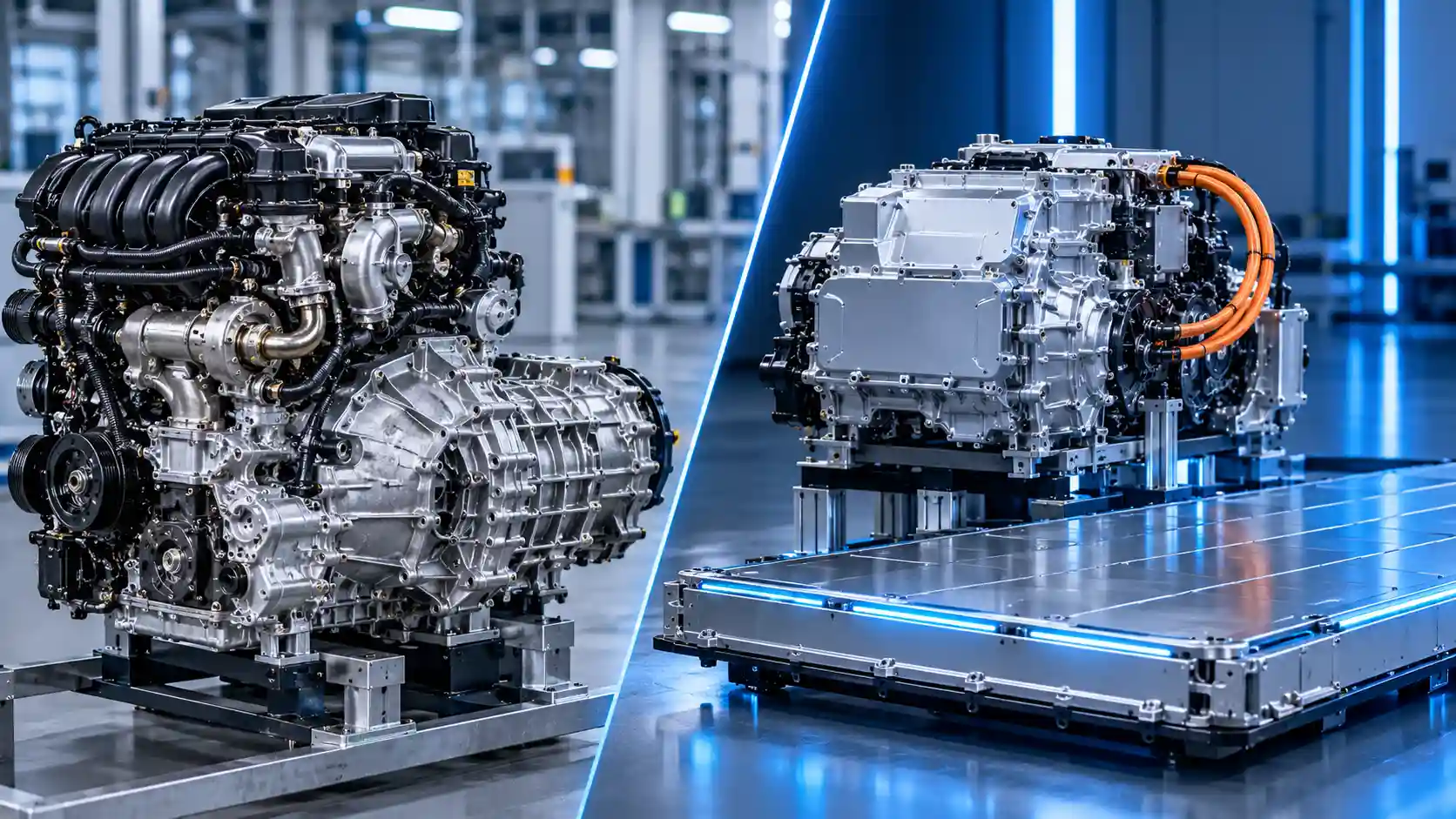
Trade policy debates about electric vehicles (EVs) tend to run on the assumption that the competitive gap between Chinese and European manufacturers is a matter of subsidy and market access. Countervailing duties, minimum price undertakings and local content rules are therefore treated as the principal instruments for rebalancing the contest. They may buy time. They cannot, however, change the physics of how a vehicle is made, the chemistry of how a cell is manufactured or the pace at which software is written. If the tariffs were removed tomorrow, the question that would determine the survival of the European automotive industry is an engineering one: at what cost, at what speed and with what degree of control can each side turn raw materials into a finished, updatable vehicle?
This pillar audit sets protectionism aside and examines the unprotected baseline. It decomposes the structural manufacturing cost advantage enjoyed by leading Chinese EV producers, analyses the upstream battery materials supply chain that underpins it, contrasts the software and silicon architectures of the two industrial systems, and sets out the engineering pivots that European manufacturers would need to make to reach parity. It is written for automotive chief technology officers, heavy industry investment specifiers and clean-tech supply chain consultants who must allocate capital against a ten-year horizon in which regulatory shelter cannot be assumed.
Deconstructing the structural manufacturing cost advantage
What a thirty per cent gap actually means
Estimates of the cost differential between Chinese and European EVs vary with the segment, the model, the exchange rate and the accounting basis, but analyses by consultancies and investment banks have repeatedly placed the gap in the region of 20 to 35 per cent at comparable specification, with some small-car comparisons higher. The brief figure of at least 30 per cent should be read as a representative central estimate, not a measured constant. What matters for engineering analysis is not the headline but the composition: where, in the sequence from cell to finished vehicle, the cost advantage accumulates.
Three sources dominate. The first is the cost of the battery, which in an EV typically represents 30 to 40 per cent of the bill of materials. The second is the cost of the body and chassis structure, including the manufacturing process and the capital intensity of the factory. The third is the cost of engineering, validation and software development, spread across volume. Subsidy and state-supported financing contribute to each, but the larger part of the gap is explained by process architecture and scale, which are replicable in principle and demonstrable in practice.
Cell-to-body integration
A conventional EV battery is assembled hierarchically. Cells are grouped into modules, modules are mounted into a pack housing with cooling plates, busbars, fasteners and a sealed enclosure, and the pack is then installed beneath the cabin as a discrete subassembly. Each level of hierarchy adds parts, mass and assembly time, and each interface consumes volume that could otherwise hold active material. The pack becomes a structure that carries energy but contributes little to the strength of the vehicle.
Cell-to-pack (CTP) design removes the module level, mounting cells directly in the pack, and raises volumetric utilisation from around 40 per cent to 60 per cent or more. Cell-to-body (CTB) goes further. The upper surface of the battery pack becomes the floor of the passenger compartment, and the cell array is bonded into a structural assembly with the body. The pack lid and the cabin floor are one component; the battery enclosure functions as a load-bearing member that contributes to torsional stiffness and side-impact resistance. Engineering gains follow: fewer parts, a lower floor height or more battery in the same height, reduced mass in the combined structure and shorter assembly sequences. Manufacturers that have adopted CTB, most visibly BYD, have reported improvements in torsional rigidity and in vehicle packaging efficiency alongside reductions in cost.
The trade-offs are real. Structural batteries complicate repair, since a damaged cell or pack may not be separable from the body. They demand tighter manufacturing tolerances and sophisticated adhesive and sealing processes. They concentrate thermal-runaway risk in a load-bearing assembly, requiring robust cell-level safety, such as the thermal stability of lithium iron phosphate (LFP) chemistry. These disadvantages explain why legacy OEMs have been slower to adopt the approach, but they do not offset the cost advantage for a manufacturer that designs the vehicle around it from the outset.
Mega-casting and part-count reduction
The rear and front underbody of a conventional steel unibody is assembled from many stamped sheet-metal parts, commonly 70 or more for the rear section alone, which are joined by spot welding, laser welding, riveting and bonding in a sequence of robotic stations. Each part requires a die, a press line, logistics and quality control, and each joint is a potential source of variation. The body-in-white shop is among the most capital-intensive and space-hungry areas of a vehicle factory.
Mega-casting replaces this assembly with a single large aluminium casting produced in a high-pressure die-casting machine of 6,000 to 12,000 tonnes clamping force. A rear underbody that required 70 parts can become one or two castings, with a corresponding reduction in robots, welding equipment, fixtures and floor space. Reductions in body shop footprint of 30 per cent or more, reduction in labour content in the body shop, and shorter cycle times have been reported by manufacturers adopting the process. The technology demands specialised aluminium alloys that do not require heat treatment, sophisticated die design and thermal management, and process controls that keep scrap rates at an acceptable level. When these are mastered, the economics favour casting at volume.
Floor space, labour and the fixed-cost base
The significance of part-count reduction lies in the structure of factory costs. A modern assembly plant represents several billion euros of capital, and its cost per vehicle depends on utilisation, takt time and floor space per unit of output. A design that eliminates stations, shortens lines and reduces the number of suppliers feeding the plant cuts the capital cost per vehicle, the labour hours per vehicle and the working capital tied up in inventory. Chinese manufacturers have also benefited from newer plants designed around EV architectures from the start, with highly automated body shops, while European legacy plants are often multi-product facilities adapted from internal combustion engine (ICE) lines and carry the burden of flexibility that EV-only plants do not need.
Labour cost is a secondary factor. While hourly wages are lower in China, the larger structural effect is hours per vehicle, driven by design for manufacture, automation density and the proportion of components made in-house. European plants tend to report materially higher hours per vehicle for comparable products, and the gap is more a function of process design than of wage rates.
Legacy multi-material unibodies
European premium and volume platforms were optimised over decades for efficient, safe and refined ICE vehicles, using a multi-material unibody of high-strength steels, aluminium closures and, in places, composites and magnesium. This architecture delivers excellent crash performance and low mass per unit of stiffness, but it is complex to manufacture and difficult to adapt. Platforms have been modified to accept batteries, producing compromises in packaging, such as a high floor, a central tunnel that is redundant in a rear-wheel-drive EV and engine bay architecture that carries redundant volume. Purpose-built EV platforms from several European manufacturers have narrowed this gap, but they carry the legacy supplier structure, process choices and cost base of the organisations that produce them.
Upstream battery chemistry and materials dominance
The cost position of the cell
The battery cell is the single largest cost element in an EV, and its price is determined by materials, process yield, scale and energy cost. Chinese cell manufacturers, led by CATL and BYD's FinDreams unit, supply a large majority of global EV cell capacity and have driven cell prices to levels, particularly for LFP, that analysts at BloombergNEF and others have recorded as substantially below those prevailing for equivalent European or American production. The difference arises at every stage.
Cathode active materials and refining
Battery-grade lithium chemicals are produced by refining spodumene concentrate or brine-derived lithium into lithium carbonate or hydroxide. The mining of the raw material is geographically diverse, with Australia, Chile and Argentina prominent, but the chemical refining is concentrated heavily in China, which accounts for a majority of global lithium chemical processing capacity. The same pattern holds for cathode active material (CAM) production: for LFP, the precursors of iron phosphate and lithium carbonate are processed into cathode powder predominantly in China, which holds an overwhelming share of global LFP capacity. For nickel-rich chemistries, the refining of nickel and cobalt intermediates and the synthesis of precursor cathode materials follow a similar concentration.
Processing is not a simple commodity step. The synthesis of CAM involves controlled co-precipitation, calcination in tightly controlled atmospheres and particle engineering that determines energy density, rate capability and cycle life. The process know-how is embodied in equipment, operators and decades of accumulated yield improvements. An entrant without that experience will suffer low yields and inconsistent quality in the first years of operation, a penalty that is not eliminated by capital investment alone.
Graphite anodes
Graphite is the dominant anode material, and the concentration is even more pronounced than for cathodes. China produces a very large majority, on most estimates over 90 per cent, of battery-grade anode material, using both natural flake graphite and synthetic graphite derived from petroleum coke and needle coke. Synthetic graphite production requires graphitisation at temperatures above 2,800 degrees Celsius over days, consuming large amounts of electricity, and the spheronisation and coating of natural graphite is a specialised chemical engineering process. Export controls introduced by the Chinese government on certain graphite products demonstrate that the concentration is not only an economic fact but a strategic one.
Cell manufacturing and the yield curve
Cell manufacturing combines electrode coating, calendering, slitting, winding or stacking, electrolyte filling, formation and ageing in a clean, dry environment. Yield, the proportion of cells that pass final inspection, is the dominant variable in cost: a few percentage points of scrap on a gigafactory with billions of euros of capital invested equate to a large cost penalty. Chinese manufacturers have scaled production with fast iteration, high equipment utilisation and domestically produced machinery of reducing cost and increasing speed. European ventures have experienced well-publicised delays and yield difficulties in their ramp-up phases, and several have been restructured or cancelled.
Energy cost compounds the effect. Cell plants and materials processing are energy-intensive, and industrial electricity prices in Europe have been materially higher than in China, particularly since 2022. A cathode or anode plant located in a region with low-cost power has a persistent operating cost advantage that scale alone cannot erase.
LFP and chemistry-level cost optimisation
The chemistry choice amplifies the structural advantage. LFP cells contain no nickel or cobalt, which removes exposure to the most volatile and ethically sensitive raw materials, and they use abundant iron and phosphate. Their energy density per kilogram is lower than that of nickel-manganese-cobalt (NMC) chemistries, but advances in cell-to-pack and cell-to-body design recover much of the loss at pack and vehicle level, since the volumetric efficiency gain compensates for the lower cell-level energy density. LFP offers longer cycle life and higher thermal stability, supporting simpler pack safety systems. Chinese manufacturers took an early and large position in LFP, building supply chains, equipment and process expertise over a decade while European and American manufacturers focused on NMC. Much of the world's LFP intellectual property and manufacturing capacity is now in China, although key patents have expired or been licensed, opening a route for non-Chinese producers.
The European position: buy or build
European OEMs face an unattractive choice. They may buy cells, often from Chinese suppliers manufacturing in Europe or importing, accepting a margin to the supplier, exposure to a supply chain they do not control and limited ability to differentiate. They may build domestic cell manufacturing capacity, accepting a scale and learning-curve penalty, higher energy and labour costs, and dependence on imported materials for the upstream stages. The most viable mix may involve both. Joint ventures with Asian leaders locating plants in Europe, as exemplified by the Hungarian megasite built by CATL, transfer knowledge and capacity to Europe but do not necessarily transfer control or value capture.
| Parameter | Vertically integrated Chinese leader | Legacy European multi-tier OEM |
|---|---|---|
| Supply Chain Depth | In-house or tightly controlled from lithium chemicals and cathode materials through cells, power electronics, motors and semiconductors to final assembly. | Tier-1 and tier-2 supplier pyramid; cells and electronics sourced externally; limited visibility and control beyond tier 1. |
| Powertrain Integration Topology | Cell-to-body structural pack, integrated drive units combining motor, inverter and gearbox, and mega-cast underbody sections. | Module-based packs bolted beneath a multi-material unibody; components sourced from separate suppliers; platform shared with ICE variants. |
| Battery Chemistry Cost Optimisation | Large-scale LFP and lower-cost variants, with packaging gains offsetting lower cell energy density; domestic materials and low energy cost. | Predominantly NMC and nickel-rich cells, with LFP only recently introduced; reliance on imported materials and externally supplied cells. |
| Software-Hardware Cycle Velocity | Development cycles approaching 18 to 24 months from concept to production; central compute and frequent over-the-air updates. | Cycles of 36 to 48 months or longer; many suppliers' electronic control units and slower feature deployment. |
| Localised Production Cost Overhead | Baseline; lower capital per vehicle, fewer labour hours and lower energy cost. | Commonly estimated at 20 to 35 per cent above the Chinese baseline at comparable specification. |
The cycle times and cost ranges in the matrix are indicative estimates drawn from industry commentary and should be validated against current data for a specific segment. The structure of the comparison is more important than any individual number: the Chinese advantage is cumulative and systemic, arising from the interaction of integration, chemistry, process and speed, not from any single factor.
Software cycle velocity and silicon architecture
The distributed ECU legacy
The electronic architecture of a conventional European vehicle evolved over decades by accretion. Each new function, from airbags to adaptive cruise control to infotainment, was added as a dedicated electronic control unit (ECU) supplied by a specialist tier-1 company, with its own processor, software stack and communication bus. A premium vehicle can contain over 100 ECUs and more than 100 million lines of code, much of it developed by different suppliers to different standards and integrated late in the development cycle by the OEM. Every software change has to propagate across a web of interdependent modules, each validated separately, with the result that the integration, testing and release process takes years.
This architecture has strengths. It supports functional safety by isolation, allows specialist suppliers to bring deep domain knowledge and has delivered extremely reliable vehicles. Its weaknesses are the complexity of the wiring harness, which is among the heaviest and most costly components in the vehicle, the difficulty of updating features after sale and the dependency on suppliers for software that the OEM cannot easily modify. In an era where the user experience is increasingly defined by software, these weaknesses are strategic.
Domain, zonal and central compute
Modern architectures consolidate computing. Domain controllers group functions such as powertrain, chassis, infotainment and driver assistance on more powerful processors. Zonal architectures go further, placing zone controllers physically close to groups of sensors and actuators, reducing wiring length and complexity, and connecting them with high-bandwidth Ethernet to a central compute platform. The central computer runs the major vehicle functions in software, on virtualised or containerised operating environments, with hardware abstraction layers that allow functions to be updated or moved between processors independently of the underlying hardware.
The consequences are substantial: reduced harness mass and cost, simplified assembly, hardware that can be specified once and software that can be developed continuously. New entrants have designed vehicles around such architectures from the beginning. Established European manufacturers are pursuing the same transition, but they must manage compatibility with existing platforms, supplier relationships and in-house organisations structured around ECU ownership. Delays in major European software programmes have been publicly acknowledged, and several have forced the postponement of vehicle launches.
Consumer electronics lifecycle versus automotive lifecycle
Chinese EV makers operate in a market where consumers compare vehicles to smartphones. Large touchscreens, voice assistants, digital cockpits, and advanced driver assistance features are expected at all price points, and new model refresh cycles of 12 to 24 months are normal. Manufacturers with strong ties to the consumer electronics and semiconductor ecosystem have access to rapidly evolving components and software talent. Over-the-air (OTA) updates deliver new features, performance improvements and bug fixes throughout the vehicle's life, converting the car from a fixed product into a service platform.
The European lifecycle is longer by design. Automotive validation covers extreme temperature, vibration, durability and safety standards, and regulatory type approval imposes additional process. These disciplines have value and cannot be discarded. They can, however, be applied more efficiently through continuous integration, simulation-based validation, hardware-in-the-loop test benches and modular software that limits the scope of re-validation after each change. The manufacturers that have mastered this combination can respond to the market at the speed of consumers while retaining the safety culture of automotive engineering.
Silicon sourcing and compute strategy
The silicon dimension is also changing. Central compute requires high-performance system-on-chip devices from a small group of suppliers, and the choice of platform determines software portability, development tools and cost. Chinese manufacturers increasingly use domestic silicon alongside international suppliers, supporting resilience against export controls and shortening supply chains. European manufacturers rely on international suppliers, and the semiconductor shortage of 2021 and 2022 demonstrated the vulnerability of just-in-time sourcing. Securing long-term compute supply and developing in-house silicon competence are now strategic objectives rather than procurement decisions.
The catch-up framework: engineering pivots for parity
Abandoning the legacy tier-1 distribution model
The legacy supply model, in which the OEM specifies a component and tier-1 suppliers design and manufacture it, has served the industry well for decades but is poorly matched to the pace and integration depth of EV development. It distributes engineering capability across companies with separate margin requirements, slows decision-making and prevents cross-system optimisation. The alternative is selective vertical integration of the components that define the product and its cost: battery systems, power electronics, electric drive units and core software. Other commodity elements can remain outsourced. The strategic task is to decide which capabilities are differentiating and which are not, and to bring the first group in-house or under close partnership control.
The transition is not trivial. It requires the OEM to acquire competences it has relied upon suppliers to hold, to restructure supplier relationships that employ hundreds of thousands of people and to accept short-term costs and risks. It nevertheless addresses the most important structural disadvantage identified in this audit: the multiplication of margins and interfaces between the cell and the customer.
Leveraging open-source and standardised components
Software development cost and time can be reduced by adopting open-source foundations. Linux-based operating systems, open standards for service-oriented architectures, open-source middleware and common frameworks allow manufacturers to share development effort on non-differentiating layers and concentrate their own engineers on the features that distinguish the product. Industry collaborations on shared software platforms and standardised interfaces have begun, but progress requires manufacturers to relinquish proprietary control over elements they have traditionally guarded. In hardware, standardised cell formats, modular drive units and shared platform components across brands reduce engineering duplication and increase volume per component.
Co-located battery ecosystems
The cost advantage of Chinese battery production arises partly from clustering: materials processors, cell manufacturers, equipment suppliers, recyclers and vehicle assemblers are located within short distances of one another, enabling rapid iteration, low logistics cost and shared infrastructure. Replicating this in Europe requires co-located ecosystems around vehicle plants, with cell production, cathode and anode material processing, electrolyte and separator supply and recycling in a single industrial cluster supplied with competitively priced low-carbon power. Regions with abundant renewable electricity and available industrial land, such as parts of Scandinavia, Iberia and Central and Eastern Europe, are natural candidates.
Recycling is an integral part of the ecosystem. Europe has limited primary lithium, nickel and graphite resources, so secondary materials from end-of-life batteries and manufacturing scrap offer a route to supply security. The EU Battery Regulation's recycled content requirements create a structural market for these materials. A closed loop of cell production, vehicle use, recycling and cathode regeneration may eventually reduce dependence on imported materials, although the volumes available in the near term are small.
Manufacturing process modernisation
Parity in cost also requires convergence in process. European plants need to adopt large-scale casting where appropriate, reduce the number of body parts, simplify final assembly through modular sub-assembly and increase automation density, while designing platforms for a single propulsion architecture rather than compromising for multiple. Plants dedicated to EVs are more efficient than multi-energy plants, but the transition period requires careful management of legacy capacity, workforce and supplier commitments. The speed of this transition matters: every year of delay adds to the cumulative cost and volume disadvantage.
Development speed as a discipline
The least visible yet most decisive pivot is organisational. Chinese leaders have reduced vehicle development time to under two years through parallel engineering, empowered small teams, simulation-first validation and tolerance for iteration. European manufacturers must restructure decision rights, reduce internal approval layers and reward speed alongside quality. Without this change, even a competitive cost base will be undermined by a product that arrives late and out of date.
What the unprotected baseline implies
The first implication is that tariffs and quotas do not solve the problem; they defer it. Protection can give European manufacturers time to execute the pivots described above, but it can also reduce the urgency to do so. Chinese manufacturers have responded to tariffs by localising production within Europe, as shown by investments in Hungary, Spain and Turkey, which keeps the competitive pressure inside the market while allowing them to benefit from proximity and avoid duties. The benefits of protection accrue only if used to build capability.
The second is that the gap is not insurmountable. European manufacturers possess formidable strengths: brand equity, deep expertise in chassis dynamics, safety and refinement, well-developed customer networks, premium positioning and sophisticated manufacturing engineering. Several are making credible progress on LFP, structural batteries, software-defined architectures and dedicated EV platforms. The challenge is to compress a transformation that took Chinese rivals a decade into a few years, while maintaining profitable legacy operations.
The third is that scale and speed are cumulative. A manufacturer that sells more vehicles learns faster, spreads fixed costs further and justifies larger investment, which reinforces its advantage. The window in which European players can catch up on equal terms narrows with each product cycle. Decisions on capital allocation, supplier restructuring and platform strategy taken in the next two to three years will determine the competitive position for the following decade.
Recommendations for CTOs, investment specifiers and supply chain consultants
- Benchmark on a teardown basis. Disassemble and cost current Chinese vehicles at part level to identify where the cost gap arises, rather than relying on aggregate estimates.
- Prioritise cell and pack integration. Invest in LFP and structural pack designs, and secure cell supply through partnerships, licensing or in-house capability.
- Consolidate the electronic architecture. Move to zonal and central compute with a clear software abstraction layer, and rebuild internal software capability to own the stack.
- Reduce part count by design. Adopt large castings and integrated structures where the volume and process maturity justify them.
- Restructure supplier relationships. Identify differentiating domains for insourcing, and shift others to commodity sourcing with standardised interfaces.
- Cluster the battery ecosystem. Locate cell, materials and recycling capacity near vehicle plants with access to competitive low-carbon electricity.
- Measure cycle time as a core performance metric. Track concept-to-production and software release intervals alongside cost and quality.
- Stress-test investment cases without tariffs. Evaluate capital allocation against a scenario in which trade protection is reduced or circumvented by local production.
Conclusion: a contest decided on engineering, not on policy
The unprotected baseline reveals a competitive gap that is structural, cumulative and largely engineering-based. It arises from vertical integration across the battery supply chain, from cell-to-body and mega-casting architectures that remove parts, floor space and labour hours, from a chemistry strategy that leverages LFP and domestic materials processing, and from software and silicon architectures that allow development at the pace of consumer electronics. Each element reinforces the others, and the resulting cost advantage of 20 to 30 per cent or more is the sum of many engineering choices, not the product of a single subsidy.
Europe can close this gap, but not by policy alone. The path requires selective vertical integration, adoption of structural battery and casting technologies, a pivot to LFP and cost-optimised chemistries, consolidation of the electronic architecture, open and standardised software foundations, clustered battery ecosystems and an organisational commitment to speed. It also requires honesty about timing: the room for error is shrinking with every model cycle. For automotive chief technology officers, heavy industry investment specifiers and clean-tech supply chain consultants, the practical question is not whether protection will be maintained, but whether the capability will be built during the period it provides. The industries that treat shelter as a window for transformation will compete. The industries that treat it as a substitute for transformation will find that the physics were never negotiable.