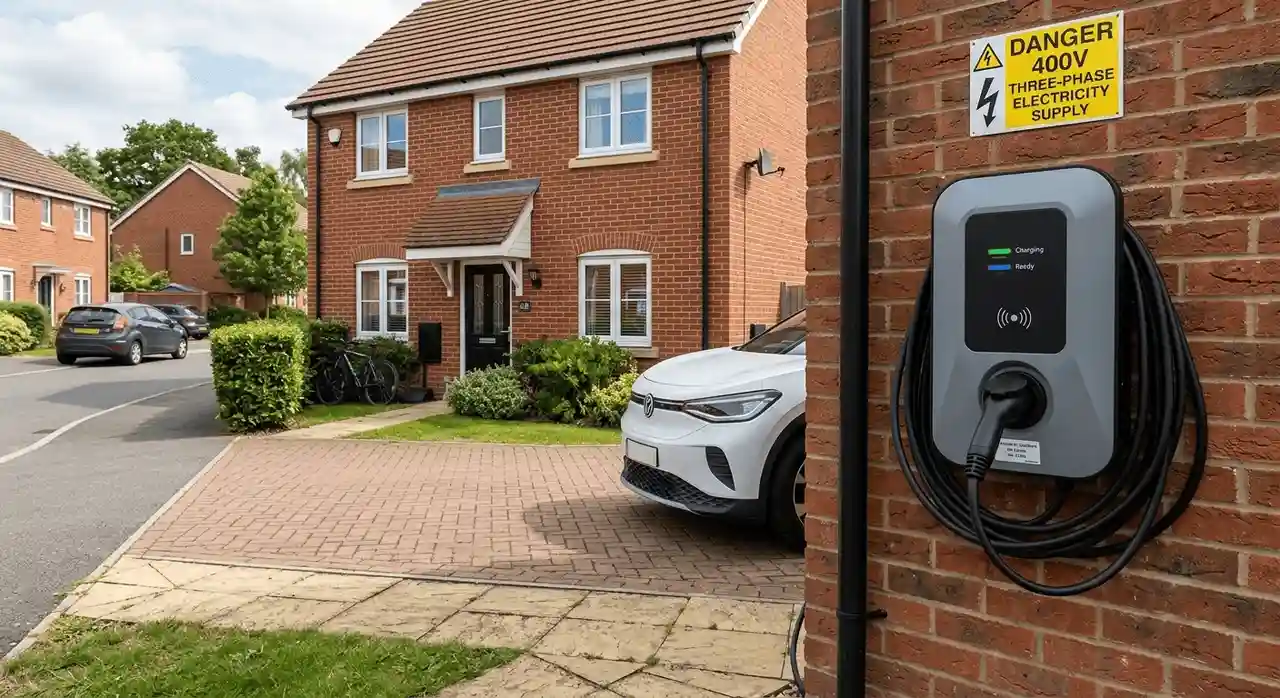
The proposition sounds seductive to anyone who has watched a 7 kW wallbox crawl through an overnight session: install a 22 kW three-phase charger, cut replenishment times by two-thirds, and future-proof the property. For electrical contractors, fleet deployment specifiers and clean-tech residential developers, however, the question is never simply "how fast can the hardware run?" It is whether the electricity supply, the distribution network and, above all, the vehicle itself can use that capacity. This article applies a three-phase evidentiary check, covering the physics, the DNO civics and the on-board charger constraints, before any capital is committed.
Phase One: The Physics of Single-Phase versus Three-Phase Supply
A standard UK domestic connection is single-phase: one live conductor at a nominal 230 V (permitted tolerance +10% / -6%) and a neutral return. A 32 A continuous charging circuit therefore delivers 230 V × 32 A, or roughly 7.36 kW, commonly rounded to 7.4 kW. Thirty-two amps is the practical ceiling for an EVSE (electric vehicle supply equipment) circuit because the load is continuous. Unlike a cooker or an immersion heater, a charging session can draw close to its rated current for several hours, so conductor heating, termination temperature rise and protective device derating are all designed around that duty cycle rather than around diversified intermittent use.
A three-phase supply uses three live conductors, each carrying a sinusoidal voltage wave displaced from the others by 120 electrical degrees, plus a shared neutral. Each phase-to-neutral voltage remains 230 V, while the phase-to-phase voltage is approximately 400 V (230 V × √3). A three-phase EVSE rated at 32 A per phase delivers 3 × 230 V × 32 A, or about 22.1 kW. Because the three currents are displaced in time, they sum to near zero in a balanced load, so the neutral conductor carries almost no current. The same cross-sectional area of copper per phase therefore carries three times the real power, which is why three-phase is the standard for industrial distribution and why it is so effective for high-power AC charging.
It is worth separating three figures that are often conflated. The first is the supply capacity: a typical UK single-phase cut-out is rated at 80 A to 100 A, which sets the ceiling for the whole property. The second is the circuit rating: the EVSE circuit, protected by an appropriately rated device with Type A RCD protection and DC fault detection (6 mA DC detection is typically built into the charger itself), together with cable sizing derated for installation method. The third is the delivered power, which is the lower of the charger rating and the vehicle's on-board charger limit. A 22 kW three-phase circuit in a house with an 80 A single-phase-equivalent maximum demand history needs a cut-out and metering position that can support it, and the property's existing loads (electric hobs, heat pumps, immersion heaters) must be assessed alongside the new continuous load.
Three-phase also introduces balance considerations that single-phase never raises. Many vehicles with single-phase on-board chargers, which includes a significant share of plug-in hybrids and older battery electric vehicles, draw their entire load from one phase, even when plugged into a three-phase charger. A 32 A single-phase draw on one leg of a three-phase installation can unbalance the house's phase loading. Good installation practice is therefore to specify a charger that supports automatic phase detection or rotation and a dynamic load management system that monitors each phase using current transformers (CTs) at the origin of the installation.
Phase Two: The DNO Infrastructure and Civic Bottlenecks
Where the physics is straightforward, the infrastructure is not. A domestic property in Great Britain is connected to one of the regional Distribution Network Operators (DNOs), such as UK Power Networks across London, the South East and the East of England, or National Grid Electricity Distribution across the Midlands, the South West and South Wales. The DNO owns the service cable, the cut-out and the network to which it connects. Converting from single-phase to three-phase is not a modification the householder or contractor can carry out independently. It requires an application to the DNO, a network assessment, a quotation, acceptance and payment, and finally DNO-led works.
The cost driver is almost always the geometry of the existing network. Many UK streets are fed by a three-phase low-voltage main, with individual properties spread across the three phases to balance the load. If a three-phase main passes the property and the existing service cable is a short underground spur, the DNO may be able to install a new three-phase service cable, replace the cut-out and fit a three-phase metering position at a relatively contained cost. Quotations in these straightforward cases commonly run to a few thousand pounds, and the contestable and non-contestable split means that part of the work may be tendered competitively through an accredited independent connection provider.
The picture changes materially when any of the following apply:
- Unlooping shared service cables. In many terraced and semi-detached streets, neighbouring properties are fed by a shared or "looped" service cable. Before a new three-phase service can be installed, the DNO may need to separate (unloop) that shared arrangement, which can mean excavating footways and affecting neighbours' supplies, with planned outages to be coordinated.
- Upgrading the cut-out and service head. Older properties may have a cut-out, fuse carrier or service head that is not suitable for a three-phase supply, or a service cable of insufficient conductor size. Replacing these is within DNO scope and is priced accordingly.
- Distance to the nearest three-phase main. If the street is served only by a single-phase network, which is common in rural settings and some small estates, the DNO may need to extend a three-phase main for a considerable length, passing the cost of that reinforcement on to the applicant in whole or in part.
- Substation capacity and street-level reinforcement. Where the local distribution substation has insufficient headroom for an additional 22 kW diversified load, or where the low-voltage feeder is thermally constrained, the DNO may specify transformer upgrades, new feeder cables or modifications requiring ground-breaking at street level. These works can introduce asset penalties running into tens of thousands of pounds.
- Highway works, permits and reinstatement. Opening the public highway requires street works notices, traffic management, permits and permanent reinstatement to specification. These civic overheads are frequently the largest line items in a quotation and the least negotiable.
Timelines compound the financial exposure. A site survey, network study and formal quotation can take several weeks. Following acceptance, scheduling the works, which depend on traffic management slots and crew availability, frequently extends to a number of months. For a fleet or developer programme, this lead time has to be sequenced ahead of the electrical first fix and the handover date, not discovered afterwards. Developers of multi-unit schemes should also request a single, consolidated supply capacity assessment at the planning stage, because it is cheaper to size the substation and the LV network for EV load at construction than to retrofit it later.
Two further points deserve attention. First, a 22 kW charger does not automatically demand a 22 kW network allowance: the DNO assesses the maximum demand of the whole premises, and load management that caps the combined demand at a defined threshold can reduce the requested capacity. Second, installing a charger that can draw more than 3.68 kW per phase can trigger notification or application requirements under the DNO's connection procedures, and a failure to notify risks enforcement and forced disconnection. Always confirm the current process with the relevant DNO before committing to hardware.
Phase Three: The Vehicle's On-Board Charger Constraint
Even a perfectly delivered 22 kW AC supply is only useful if the car can accept it. AC charging passes alternating current to the vehicle, where an on-board charger (OBC) converts it to DC for the battery. The charger at the wall is therefore little more than a smart, safety-critical contactor and communication interface, and the rate of charge is set by the OBC's rating and its phase configuration. Fast, high-power charging is done by DC rapid chargers that bypass the OBC entirely.
The overwhelming majority of mainstream battery electric vehicles sold in the UK are fitted with on-board chargers limited to 11 kW AC on three-phase, or 7.4 kW AC on single-phase. Examples include the Tesla Model 3 (11 kW in UK specification on three-phase), the Volkswagen ID.4 (11 kW) and the Kia EV6 (11 kW). Connecting any of these to a 22 kW terminal produces exactly the same charging power as connecting it to an 11 kW terminal: the vehicle negotiates a maximum current limit via the control pilot signal, and the on-board converter declines to draw more. The additional capacity, along with the extra capital expenditure on the supply, is simply unutilised.
There are exceptions, and they are specific. The Renault Zoe has long been associated with a 22 kW AC capability through its Chameleon charger, and certain variants of the Audi e-tron and other premium models offer optional 22 kW on-board chargers, as do some city cars such as the Smart EQ range and certain Porsche Taycan configurations. Specifications vary by model year, battery size and market, so it is essential to verify the exact OBC rating against the vehicle's documentation rather than assuming. Fleet specifiers should additionally recognise that the vehicle market is moving towards higher DC charging speeds as the route to fast replenishment, not towards higher AC on-board charger ratings, which add weight, cost and thermal load to the vehicle.
Drivers who plan to run an 11 kW vehicle from a 22 kW terminal gain only the benefit of future compatibility. For a home installation, an 11 kW three-phase charger (16 A per phase) typically delivers a full overnight charge for the vast majority of drivers. A 75 kWh pack, for example, takes roughly seven hours to charge from low state of charge at 11 kW, comfortably within a typical off-peak window, so the practical advantage of 22 kW over 11 kW is rarely realised in domestic use.
The Comparative Matrix
The following matrix contrasts the principal supply configurations against the five criteria that determine whether a home installation is justified. Cost ranges are indicative and vary considerably by DNO, region and site geometry; formal quotations always take precedence.
| Electrical Supply Configuration | Max Deliverable AC Power | Average Home Installation Cost | Typical DNO Civics Complexity | Real-World Car Compatibility Level |
|---|---|---|---|---|
| Single-phase, 230 V, 32 A | Approximately 7.4 kW | Roughly £800 to £1,500 for a standard wallbox installation | Low: usually no network works, subject to DNO notification and a suitable cut-out | Universal: every EV and plug-in hybrid can use it, though cars with larger on-board chargers are limited |
| Three-phase, 400 V, 16 A per phase | Approximately 11 kW | Roughly £1,000 to £2,000 where a three-phase supply already exists; several thousand pounds more if a conversion is required | Moderate to high where conversion is needed: new service cable, cut-out and metering | High: matches the 11 kW on-board charger of most mainstream models such as the Tesla Model 3, Volkswagen ID.4 and Kia EV6 |
| Three-phase, 400 V, 32 A per phase | Approximately 22 kW | Roughly £1,500 to £3,000 for hardware and installation, before any DNO reinforcement charges, which can reach tens of thousands of pounds | High to severe: unlooping, substation headroom, feeder reinforcement and highway reinstatement | Low: only vehicles with a 22 kW on-board charger, such as the Renault Zoe and selected Audi e-tron variants, can use the full rating |
Engineering Verdict and Specification Guidance
The evidentiary check yields a clear hierarchy. On the first test, physics, 22 kW is technically straightforward and entirely sound: a balanced three-phase 32 A circuit is a mature, well-understood design. On the second test, infrastructure, the cost is unbounded until the DNO has quoted, and a single unlooping requirement or a distant three-phase main can transform a modest project into a five-figure liability in a domestic setting. On the third test, vehicle compatibility, the benefit is narrow, since the great majority of vehicles on UK roads cannot draw more than 11 kW AC.
For practical specification, the following approach is recommended:
- Audit the vehicle first. Confirm the on-board charger rating of every vehicle that will use the installation, now and across the expected replacement cycle. If none exceeds 11 kW, a 22 kW terminal is an over-specification.
- Request the DNO quotation before buying hardware. Submit a supply application early and treat the quotation as a go/no-go gate, not as a formality.
- Prefer an 11 kW three-phase charger where three-phase already exists. It delivers the same practical performance for mainstream vehicles at a lower installation burden.
- Use dynamic load management. CT-based monitoring allows the charger to modulate its draw against the rest of the building's demand, reducing the capacity requested from the DNO and avoiding costly reinforcement.
- Consider a 7.4 kW single-phase unit for most homes. For typical domestic mileage, a single-phase unit is more than sufficient and avoids network works altogether.
- Plan for scale in developments. Residential developers and fleet operators should size the substation, the LV network and the containment for future load growth at construction, when civic costs are lowest, and then specify load-managed 7 kW to 11 kW points across the scheme.
In summary, a 22 kW home charger is an asset-optimisation question disguised as a speed question. For the great majority of households, the standardised, specialised and localised answer is that the substation cost does not buy a proportionate benefit. It is justified only where a verified 22 kW-capable vehicle is in use, where the DNO quotation is demonstrably modest, and where the property already holds a three-phase supply. In every other case, the capital is better directed at tariff optimisation, load management and, where speed is genuinely required, public DC rapid charging.